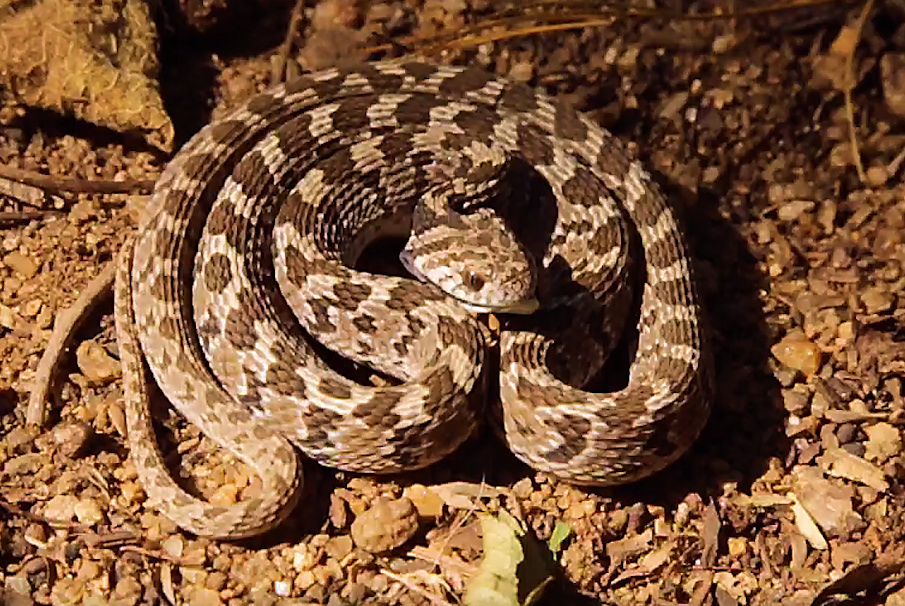
Photo: Wynand Uys
Feravox · The Voice of the Wild
Rhombic Egg Eater
Dasypeltis scabra
Least Concern
Rhombic Egg Eater (Dasypeltis scabra) lives in diverse terrestrial habitats across Sub-Saharan Africa. It feeds on exclusively eggs. Its conservation status is Least Concern.
The rhombic egg eater, Dasypeltis scabra, is a sleek, almost toothless colubrid that stretches to 40–46 inches (100–120 cm) in total length. Its dorsal surface is a mosaic of rhomboidal dark brown spots set against a lighter background, punctuated by a striking V-shaped mark on the back of the neck. On the belly, a yellowish hue may be uniform or speckled with dark dots, and its scales are finely saw-toothed, producing a hissing rasp when rubbed together. Found across sub-Saharan Africa from sea level up to 2,600 m (8,500 ft), D. scabra shuns dense closed-canopy forests and true deserts, thriving instead in savannas, woodlands and rocky outcrops. By night it becomes an agile climber, scaling rocks and trees to raid bird nests, yet it remains primarily terrestrial. This snake feeds exclusively on eggs: ridged mouth linings grip the shell, vertebral hypapophyses pierce it in the esophagus, and the empty shell is regurgitated whole. When threatened, D. scabra inflates its body, produces a distinctive hiss by rubbing its keeled scales, and opens its mouth wide in a display. Its reproductive cycle peaks in summer, when a mature female can lay one or two clutches of six to twenty-five eggs, each about 36 mm by 18 mm, hatching into 21–24 cm hatchlings.
Real recorded sounds, 11 nature games and a free Daily 5, 1v1 quiz duels, conservation wins and a safe Kids mode. Free on Feravox.