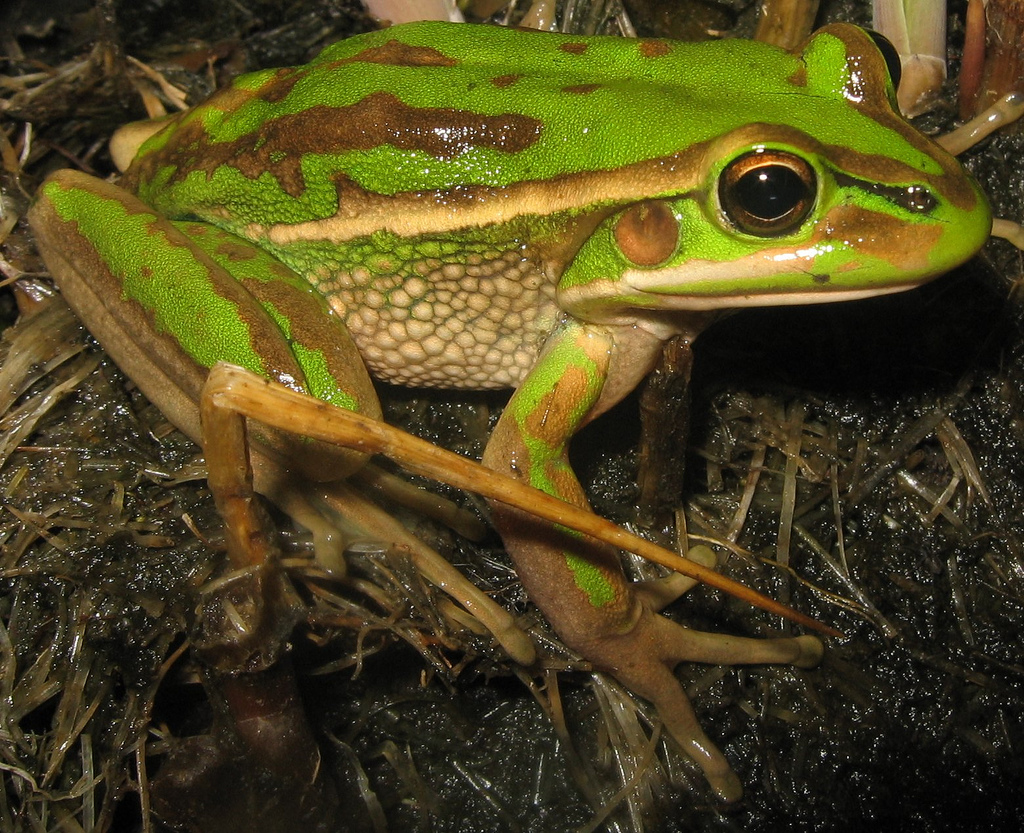
Green-and-Golden Bell Frog (Ranoidea aurea) lives in eastern wetlands across Eastern Australia. It feeds on insects and worms. Its conservation status is Near Threatened.
Hear the Green-and-Golden Bell Frog
A real field recording of the Green-and-Golden Bell Frog, made in the wild.
Fascinating facts about the Green-and-Golden Bell Frog
Despite its ground-dwelling habit, the frog can cover impressive distances: field records show daily movements of 1.0-1.5 km, and some individuals have been tracked moving up to 3 km from their breeding pond. Even when water is scarce, frogs have been spotted as far as 400 m away from the nearest source, yet they usually settle within a 100-700 m² home range, returning to familiar sites when conditions stay suitable.
Tadpoles tolerate fresh-water salinity up to six parts per thousand (ppt) without harm, but levels of eight ppt or higher stunt growth and raise death rates. Paradoxically, a modest 1-2 ppt boost can be lifesaving, as it suppresses the deadly chytrid fungus that threatens amphibians worldwide. Breeding also slows sharply when pond temperatures dip below 20 °C (68 °F), linking climate and water chemistry directly to reproductive success and highlighting how subtle environmental shifts can tip the balance for this endangered species.
At up to 11 cm (4.5 in) long, this stout frog ranks among Australia's biggest amphibians. Adults span 4.5-11 cm, with the typical adult measuring 6-8 cm.
Males become breeding-ready after just nine months, while the larger females wait two full years. Frogs will attack each other within a metre, often leaving injuries.
Sources
Every fact above was checked against these pages, and kept only where one of them states it.