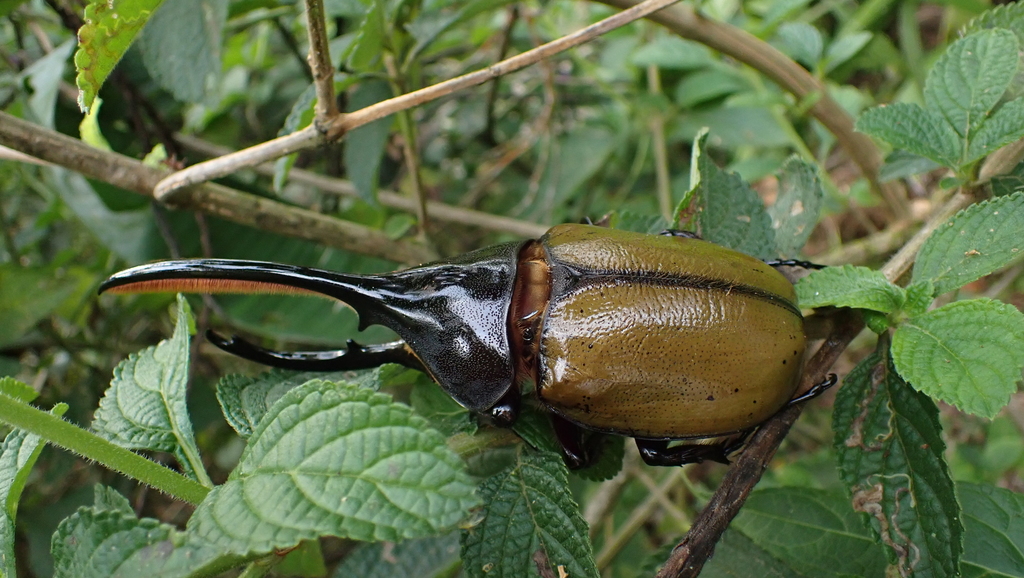
Rhinoceros Beetle (Dynastes hercules) lives in forest across Southeast Asian Forests. It feeds on tree sap & fruit. Its conservation status is Least Concern.
Fascinating facts about the Rhinoceros Beetle
- Male Hercules beetles can stretch to a staggering 173 mm long when you count the horn, longer than a standard ruler and the longest of any living beetle. Typical adults without the horn range from 50 mm to 85 mm, yet some island giants have been measured at 180 mm, rivaling a small hand-saw blade.
- A Hercules beetle larva can grow longer than a school ruler, up to 11 cm, and tip the scales at over 100 g, with some reports of 15 cm and 140 g. That weight is enough to fill a human hand, meaning the forest must supply massive, rotting logs for these giants to develop. Their sheer bulk drives rapid wood decomposition, turning dead timber into nutrient-rich soil and highlighting the beetle's pivotal role as a forest recycler.
- From egg to adult, a Hercules beetle spends almost three years in development: about a month for the egg, 12-18 months as a larva, then 2-3 months pupating, before emerging as a beetle that can live 8-12 months in the wild, up to 34 months total. This prolonged underground phase means the larvae dominate nutrient cycling for most of their lives, while the brief adult stage focuses on reproduction and fruit foraging, underscoring a life history split between ecosystem engineering and dispersal.
- When a male lifts its massive thoracic horn, the muscle behind it can push with a force of 140 Newtons, roughly the pull of a 14.3-kg weight. This power lets the beetle grapple, flip, and pin rivals during battles for mates, turning a simple horn into a biomechanical weapon.
- The beetle's shell changes colour with the air's moisture: in dry conditions the elytra glow yellow-olive, but as humidity rises they turn stark black. This hygrochromic shift is caused by microscopic structures that bend light differently when wet.
Sources
Every fact above was checked against these pages, and kept only where one of them states it.
At a glance
RangeSoutheast Asian Forests
HabitatForest
DietTree sap & fruit
About the Rhinoceros Beetle
In the depths of the tropical rainforest, a behemoth of the insect world emerges, its imposing form undulating as it moves with a slow, deliberate intent, the Rhinoceros Beetle's polished black carapace glinting like dark jewels in the dappled light. As it navigates the forest floor, its powerful legs propel it forward with a lumbering gait, the clicking of its joints and the soft rustle of its wings a testament to its unyielding presence. With its majestic horns and unyielding strength, this ancient creature reigns as a monarch of the underbrush, a true marvel of evolutionary ingenuity.
Hear the Rhinoceros Beetle, and 4,400+ more
Real recorded sounds, 11 nature games and a free Daily 5, 1v1 quiz duels, conservation wins and a safe Kids mode. Free on Feravox.
More insects and spiders to discover