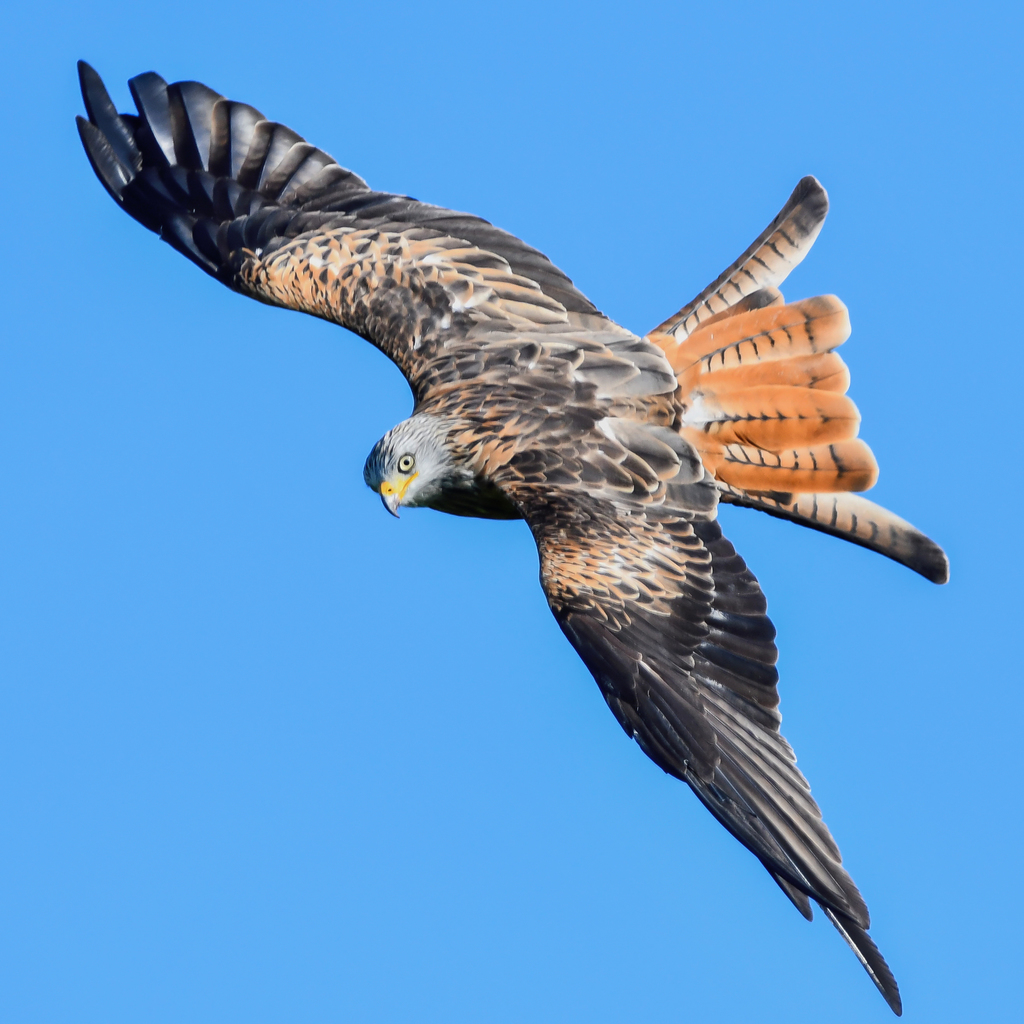
Red Kite (Milvus milvus) lives in open woodland across Western Palearctic region in Europe and northwest Africa. Its conservation status is Least Concern.
Hear the Red Kite
A real field recording of the Red Kite, made in the wild.
A red kite's nest perches 12-15 m up in a sturdy hardwood fork, a height comparable to a five-storey building, where the male delivers dead twigs 30-50 cm long for the female to arrange. The clutch usually holds one to three eggs, each 57 × 45 mm and weighing 63 g, which hatch after 31-32 days. Chicks stay in the nest for 48-70 days before fledging.
Red kites can interbreed with their black-kite cousins: in captivity the two species have produced hybrids, and a wild hybrid zone exists in Central Europe. Genetic tests, which trace only maternal DNA, suggest female F1 hybrids are infertile, echoing Haldane's law. Yet in 2006 a male black kite and a female red kite in Scotland successfully fledged two chicks, showing that occasional cross-species breeding can still occur when birds are blown off course.
Europe still hosts all 32,200-37,700 known breeding pairs of red kites, but the species once lost almost a fifth of its numbers between 1990 and 2000. Since then, those declines have halted and the overall count is now rising thanks to growth elsewhere. The biggest ongoing danger is poisoning, both illegal baits and pesticide residues, particularly in the wintering ranges in France and Spain.
Red kites now breed exclusively in Europe, a contraction from a historic range that once stretched into West Asia and Northwest Africa. Yet they remain adventurous travelers: vagrants have been spotted as far north as Finland and as far south as Israel, Libya and the Gambia. They favour habitats from broadleaf woodlands to wetland edges, up to 1,600 m elevation, showing a remarkable tolerance for varied landscapes across the western Palearctic.
Red kites span the sky like miniature gliders, measuring 60 to 70 cm in length yet stretching a wingspan of 175-195 cm. Males tip the scales at 800-1,200 g while females bulk up to 1,300 g. Their size lets them soar for hours on thermals.
Sources
Every fact above was checked against these pages, and kept only where one of them states it.
RangeWestern Palearctic region in Europe and northwest Africa
HabitatOpen woodland
DietSmall mammals birds
About the Red Kite
As the Red Kite soars through the sky, its reddish-brown plumage glistens in the sunlight, its forked tail streaming behind it like a banner, a symbol of its mastery of the aerial realm. With effortless ease, it rides the thermal currents, its wings beating in a slow, measured rhythm, as it scans the landscape below for the telltale signs of small mammals and carrion. In a flash of swift, predatory intent, it tucks its wings and plunges downwards, a whirlwind of feathers and talons, a true marvel of evolutionary adaptability.
Advertisement
Hear the Red Kite, and 4,400+ more
Real recorded sounds, 11 nature games and a free Daily 5, 1v1 quiz duels, conservation wins and a safe Kids mode. Free on Feravox.