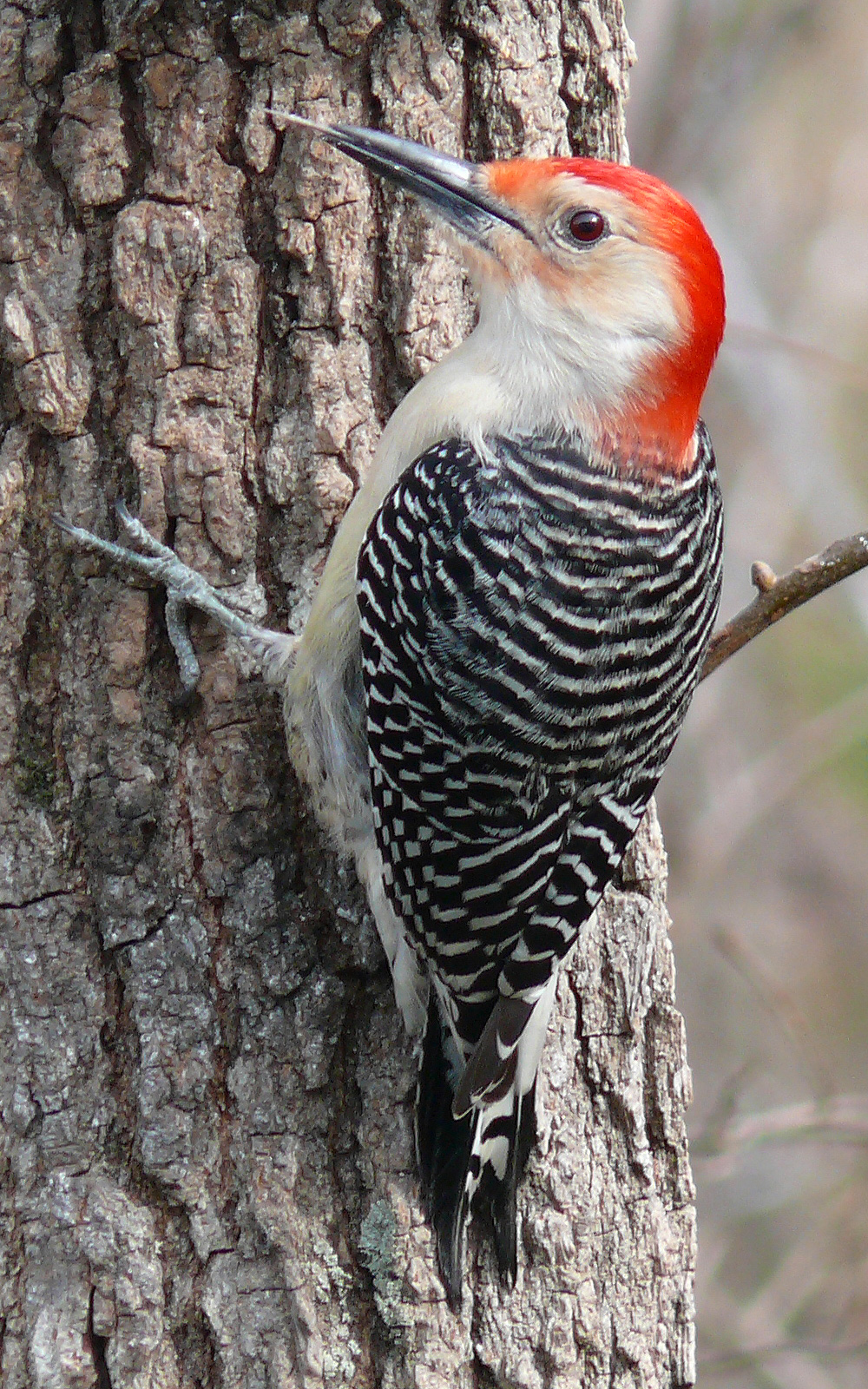
Red-Bellied Woodpecker (Melanerpes carolinus) lives in mature woodlands across Eastern North America. It feeds on insects and nuts. Its conservation status is Least Concern.
Hear the Red-Bellied Woodpecker
A real field recording of the Red-Bellied Woodpecker, made in the wild.
Fascinating facts about the Red-Bellied Woodpecker
The red-bellied woodpecker is a major predator of the invasive emerald ash borer in the U.S. Midwest, attacking the pest inside dying ash trees. In a single infested tree it can remove up to 85 percent of the larvae, effectively wiping out most of the outbreak. This high removal rate makes the bird an important natural control agent for the ash-borer, especially where the beetle threatens forest health.
In urban areas the red-bellied woodpecker often drums on metal objects such as aluminium roofs, guttering and transformer boxes to signal a potential mate. Both sexes drum, but males tend to use the metal surfaces more frequently when courting.
When searching for food the red-bellied woodpecker depends heavily on dead or decaying trees, spending between 20 percent and 69 percent of its foraging time on such snags. This reliance on rotting wood allows it to extract beetles, larvae and other arthropods hidden beneath the bark. The bird's habit of probing and chiselling into these weakened trunks also supports its role in controlling pests like the emerald ash borer.
Young red-bellied woodpeckers are ready to leave the nest after just 24 to 26 days, at which point they begin to explore their surroundings. Researchers have observed a distinct natal dispersal phase, during which the fledglings stay close to their birthplace. They typically remain in this natal area for about 27 weeks before venturing farther.
The red-bellied woodpecker is monotypic, meaning no subspecies are recognised across its entire range. It belongs to the genus Melanerpes, which currently contains 24 species that were grouped together by William Swainson in 1832. Linnaeus originally cited a broad North American type locality, but modern taxonomy restricts the type locality to South Carolina. This uniform classification reflects a single, cohesive taxonomic unit for the species.
Sources
Every fact above was checked against these pages, and kept only where one of them states it.
As the Red-Bellied Woodpecker flits through the sun-dappled canopy, its crimson cap a flash of vibrant color against the muted greens of the forest, it embodies a spirit of restless energy, drumming out a staccato beat on the trunks of ancient trees. With each swift, darting motion, it weaves a complex tapestry of sound and movement, its very presence a testament to the dynamic, interconnected web of life that thrives in these woodland realms. In its agile, aerial pursuits, the Red-Bellied Woodpecker is a master of its domain, a whirling dervish of feathers and fury that leaves all who witness it in awe.
Advertisement
Hear the Red-Bellied Woodpecker, and 4,400+ more
Real recorded sounds, 11 nature games and a free Daily 5, 1v1 quiz duels, conservation wins and a safe Kids mode. Free on Feravox.