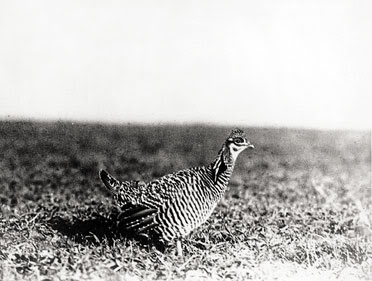
Prairie Chicken (Tympanuchus cupido) lives in grasslands across Great Plains of North America. It feeds on insects and seeds. Its conservation status is Near Threatened.
Hear the Prairie Chicken
A real field recording of the Prairie Chicken, made in the wild.
A single male can claim up to 90% of all matings on his lek, turning the booming grounds into a high-stakes love arena. Males inflate orange neck sacs and snap their tails for almost two months each spring, while the dominant few monopolize females. This skewed breeding system means that a handful of birds drive most of the next generation, making the species especially vulnerable to loss of those key individuals and highlighting the need to protect lek sites.
When prairie-chickens once roamed the Midwest, Illinois counted millions in the 1800s; by 2019 only about 200 remained in the state. Across North America the total fell to roughly 360,000 individuals by 2020. Such dramatic declines illustrate how habitat loss and historic overhunting have pushed a once-abundant bird to the brink, underscoring why every managed prairie parcel now matters for its survival.
A Kansas telemetry study showed hens avoid nesting within a quarter-mile of power lines and a third-mile of paved roads, treating these structures like invisible predators. This avoidance reduces suitable breeding habitat dramatically, because over 95% of original tallgrass prairie has been turned into cropland. Understanding these fine-scale sensitivities helps land managers design prairie restorations away from such disturbances.
The Attwater's subspecies, a close relative, survived on fewer than 100 birds across three Texas sites, prompting a captive-breeding program that hatched 80 chicks last year alone. By coordinating breeding among six zoos and NASA's Johnson Space Center, the program maintains genetic diversity and supplies birds for release. This effort shows how ex-situ stewardship can buy time for wild populations while habitat restoration catches up.
In Wisconsin, booming male counts rose from 649 in 1998 to 307 in 2025, the highest since 2007, thanks largely to the Buena Vista prairie management area, which now protects over 30,000 acres.
Sources
Every fact above was checked against these pages, and kept only where one of them states it.
Across the sun-drenched prairies of North America, the Prairie Chicken dances with abandon, its vibrant plumage a testament to its unbridled spirit as it twirls and leaps with reckless joy, its courtship rituals a whirlwind of color and sound. With each deliberate stride, the chicken weaves through the tallgrass, its feathers rustling softly against the gentle breeze as it moves with a quiet confidence, its very existence a poignant reminder of the fragile beauty that still persists in these dwindling wild landscapes. In this fleeting glimpse of a bygone era, the Prairie Chicken embodies the untamed essence of the American heartland, a vulnerable yet resilient symbol of a vanishing world.
Advertisement
Hear the Prairie Chicken, and 4,400+ more
Real recorded sounds, 11 nature games and a free Daily 5, 1v1 quiz duels, conservation wins and a safe Kids mode. Free on Feravox.