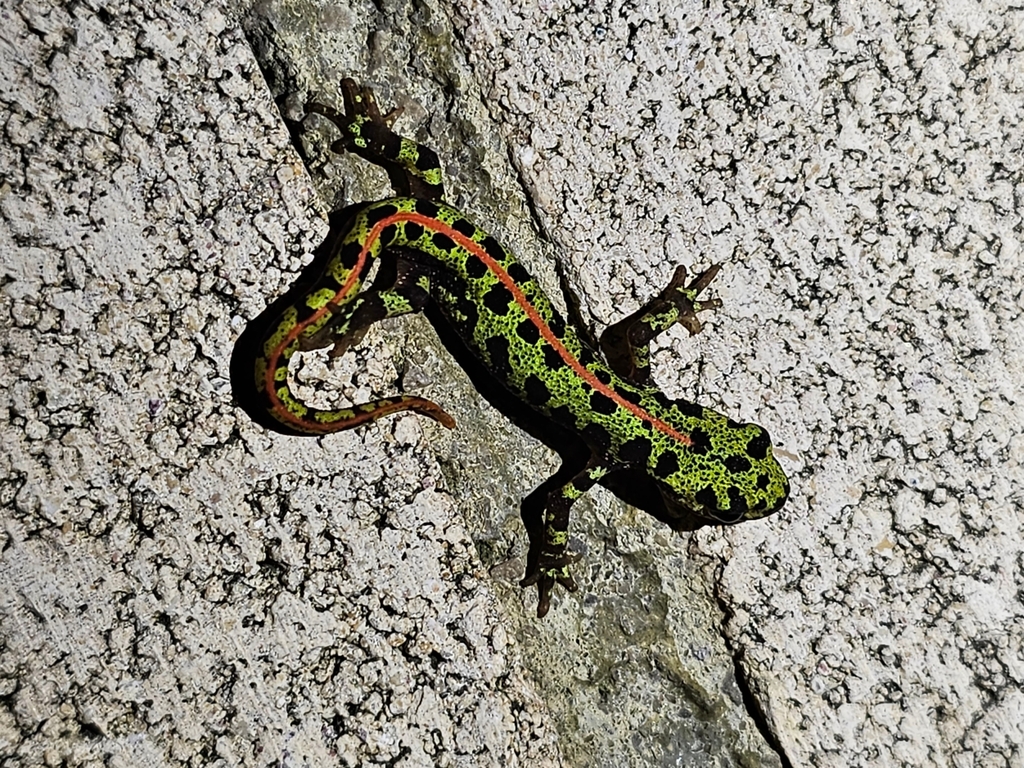
Photo: Diego González Dopico
Feravox · The Voice of the Wild
Marbled Newt
Triturus marmoratus
Vulnerable
Marbled Newt (Triturus marmoratus) lives in hilly forested terrain across Iberian Peninsula and France. It feeds on not mentioned. Its conservation status is Vulnerable.
The marbled newt (Triturus marmoratus) glides through the mist-shrouded hills of the Iberian Peninsula and France with a sleek, dark brown or black coat splashed with irregular green markings, a black belly peppered with off-white specks, and, in adult females, a vivid orange stripe that runs the length of the back. Males, until about nine months old, share this stripe before it fades, and during the breeding season they raise a striking wavy crest, yellow-white striped with black, that arches from neck to tail tip, a visual cue of fitness that females eagerly assess. Measuring 5 to 6.5 inches (13–17 cm), these amphibians are primarily terrestrial, seeking refuge in hilly, forested terrain far from open exposures, yet they return each fall and winter to shallow, temporary ponds when rain is plentiful and temperatures drop. When the summer sun dries those breeding pools, the newts abandon the water and embark on short, often concealed migrations, typically about 10 m, but sometimes up to 160 m, through tree-laden corridors that shield them from predators and desiccation. Their reproductive choreography is equally intricate: females, unaccompanied by males, select a fresh leaf, fold it around each egg with their hind legs, and briefly pause to surface for air, a process where larger females excel. A surprising twist in their ecology is the reliance on celestial cues to locate breeding sites; without a clear sky they fail to orient, yet geomagnetic changes leave them unfazed, highlighting a unique sensory hierarchy that underpins their survival in a climate-driven world.
Real recorded sounds, 11 nature games and a free Daily 5, 1v1 quiz duels, conservation wins and a safe Kids mode. Free on Feravox.