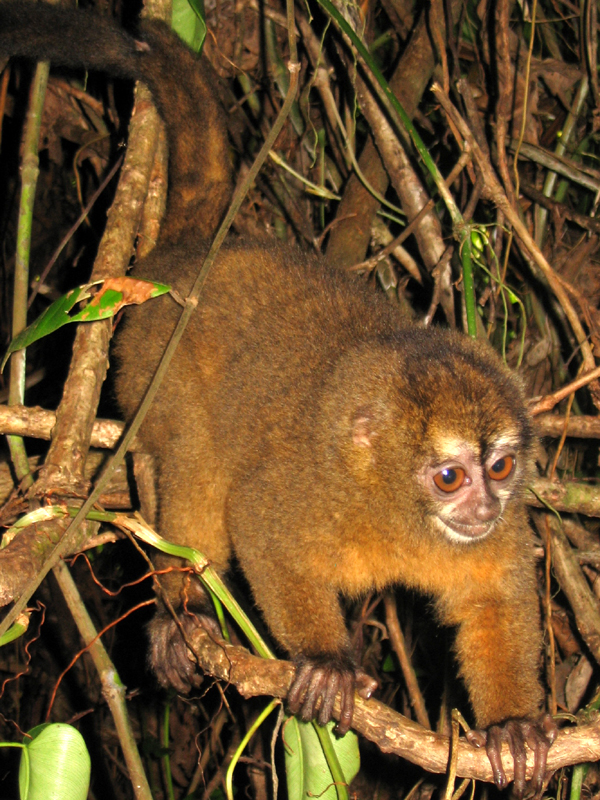
Panamanian Night Monkey (Aotus zonalis) lives in tropical rainforest across Central America. It feeds on fruits and insects. Its conservation status is Near Threatened.
Fascinating facts about the Panamanian Night Monkey
- The Panamanian night monkey is both arboreal and active after dark, making it one of the very few monkeys that live and feed at night. It and the other members of the genus Aotus are the only nocturnal monkeys in the world, a distinction highlighted by their specialised behaviour. They travel in small family groups of two to six individuals, typically an adult pair with their young.
- Like its close relatives, the Panamanian night monkey possesses unusually large eyes that aid vision in low light, yet it lacks the reflective tapetum lucidum found in most nocturnal species. This combination of big eyes without a mirror-like layer is noted as a unique adaptation for night sight. In addition, its tail is short relative to body size, a trait shared across the genus. These features together support its strictly nocturnal, tree-dwelling lifestyle.
- Male Panamanian night monkeys develop a scent gland near the base of the tail at about one year of age, which they use to mark their territory with scented urine. This olfactory signalling is complemented by a behaviour called urine washing, where the animal rubs its own urine onto its hands and feet. Both scent marking and urine washing form part of a broader communication system that also includes at least nine distinct vocal calls.
- On Barro Colorado Island the Panamanian night monkey's diet is heavily weighted toward fruit, which makes up 65% of what it eats, while leaves contribute about 30% and insects only 5%. This reliance on fruit reflects its preference for plant material in the forest canopy. It also consumes a variety of other foods and can move both by walking on all fours and by leaping or running when needed, allowing it to exploit different food sources across its arboreal habitat.
- The father begins caring for the newborn within one or two days, carrying the infant until the mother takes over for nursing. The monogamous pair typically produces a single offspring each year, though twins can occasionally occur, and the pregnancy lasts roughly 133 days.
Sources
Every fact above was checked against these pages, and kept only where one of them states it.
At a glance
RangeCentral America
HabitatTropical rainforest
DietFruits and insects
About the Panamanian Night Monkey
In the twilight realm of the Panamanian forest, the Night Monkey emerges, its large, round eyes gleaming like lanterns as it navigates the shadowy canopy with effortless agility. With a soft, whispery call, it summons its troop, and together they weave through the darkness, their slender limbs and prehensile tails orchestrating a silent, aerial ballet. As they forage for fruit and insects, their nocturnal world is filled with a gentle, ethereal beauty, a testament to the magic that unfolds when the sun dips below the horizon.
Hear the Panamanian Night Monkey, and 4,400+ more
Real recorded sounds, 11 nature games and a free Daily 5, 1v1 quiz duels, conservation wins and a safe Kids mode. Free on Feravox.