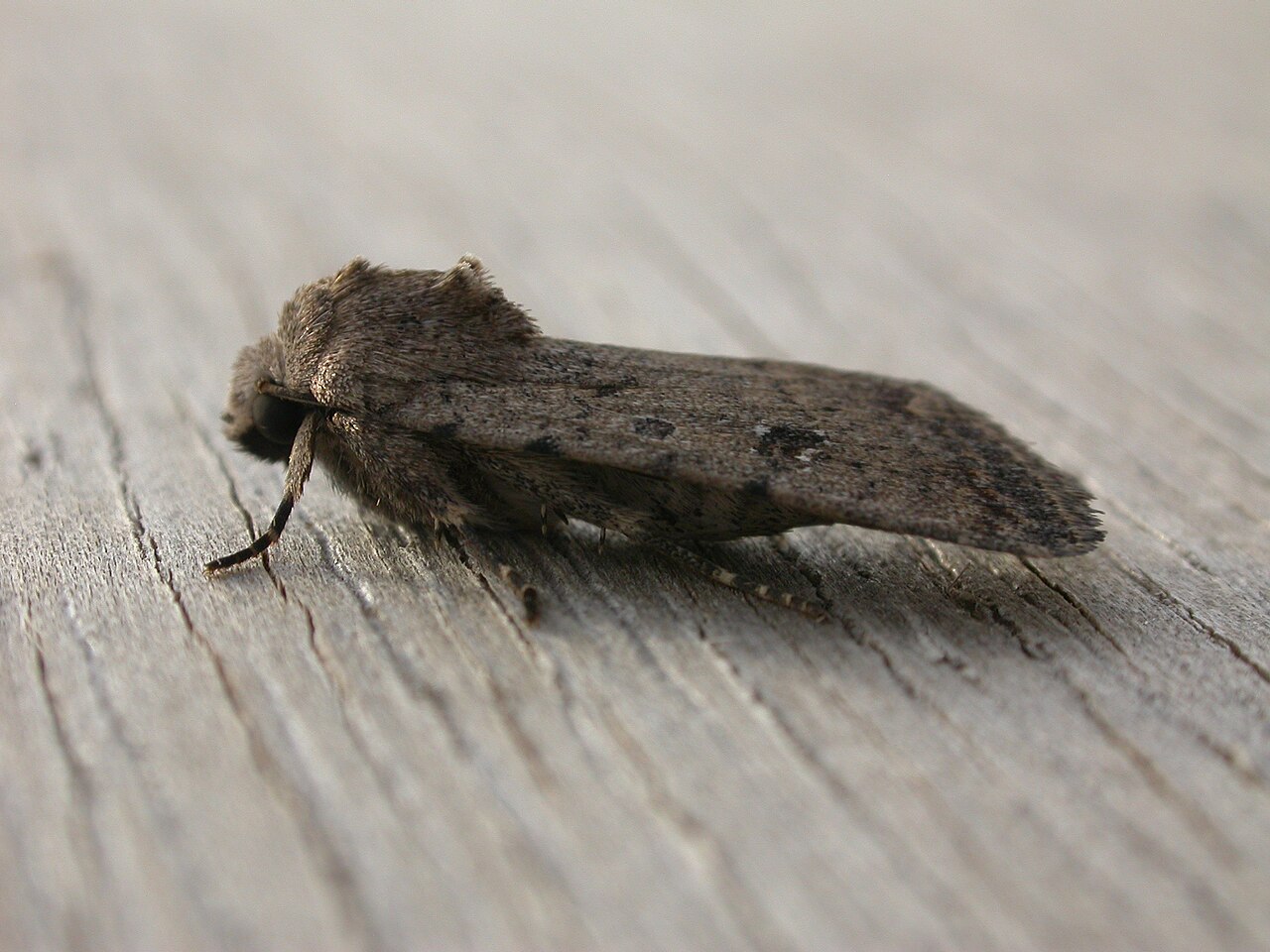
Pale Mottled Willow Moth (Caradrina clavipalpis) lives in temperate woodland edges across Palearctic realm.
Fascinating facts about the Pale Mottled Willow Moth
- The pale mottled willow moth was formally named by Giovanni Antonio Scopoli in his 1763 work Entomologia Carniolica, giving it the scientific name Caradrina clavipalpis that has endured for over two and a half centuries. It belongs to the family Noctuidae, a large group of night-flying moths. The species is native to the Palearctic realm, ranging across Europe, North Africa and much of Asia.
- The moth arrived in North America as an introduced species, with its first North American record coming from Queens, New York City in 1993. That observation marked the species' initial appearance on the continent, indicating a recent expansion beyond its native Palearctic range. Being an introduced species means it was not originally part of the local fauna and had to establish a new population.
- By 2009 the moth was documented in Rochester, New York, showing that it had become established and was spreading further inland from its original entry point. The finding suggests a growing population that can move beyond coastal introductions. The species is active for much of the warmer months, with adults flying from April to October depending on location, which aids its dispersal across new habitats.
- In its North American range the species manages two full generations each year. Adults are on the wing from April to October, a period that varies with local climate and allows the two breeding cycles. The larvae, which are fuscous with a green tinge, feed on Plantago species and a variety of grasses, providing the food needed for rapid development. This bivoltine pattern helps the moth establish and spread in its introduced habitats.
- The laciniosa form displays a distinctive subterminal line made of three yellowish spots that each reach the wing's outer edge. This line contrasts with the typical pale to dark grey forewings that often have darker dusting and occasional ochreous tinges. In the laciniosa variant the spots are a vivid yellowish colour, extending to the termen and breaking the usual subterminal pattern.
Sources
Every fact above was checked against these pages, and kept only where one of them states it.
At a glance
RangePalearctic realm
HabitatTemperate woodland edges
DietWillow leaves only
About the Pale Mottled Willow Moth
In the whispering hours of dawn, the Pale Mottled Willow Moth stirs, its delicate wings unfolding like the petals of a moonflower as it takes to the air. With a gentle, fluttering flight, it dances across the dew-kissed meadows, its mottled grey and brown hues blending seamlessly into the shadows, a master of subtle concealment. As it flits from blade to blade, its feathery antennae twitching with every nuance of the morning breeze, this unassuming moth weaves a quiet magic, its very existence a testament to the intricate beauty of the natural world.
Hear the Pale Mottled Willow Moth, and 4,400+ more
Real recorded sounds, 11 nature games and a free Daily 5, 1v1 quiz duels, conservation wins and a safe Kids mode. Free on Feravox.
More insects and spiders to discover