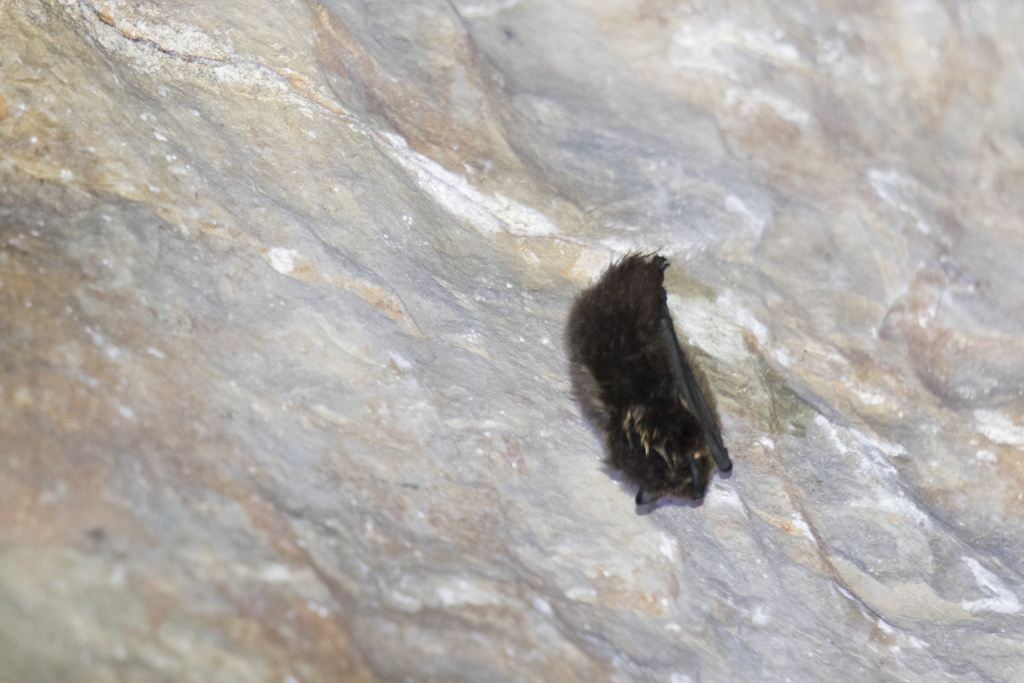
Northern Serotine (Cnephaeus nilssonii) lives in european forests across Northern Europe. It feeds on insects and spiders. Its conservation status is Least Concern.
Hear the Northern Serotine
A real field recording of the Northern Serotine, made in the wild.
Northern bat colonies have moved as far as 450 km over several years. They are the most common bat throughout northern Eurasia, ranging from France to Hokkaidō and south to Kazakhstan.
Female northern bats mate in late autumn and retain the male's sperm throughout the winter months. After hibernation ends in April, they become pregnant in spring and carry the gestation for 50-60 days before giving birth. This reproductive timing ensures that the young are born in early summer when insect prey are abundant, supporting rapid growth before the colony disperses in August.
Northern bats hunt fast, flying at 5-6 m s⁻¹ in open areas where they often pursue ghost moths hovering to attract mates. Their nocturnal foraging is supported by rapid echolocation pulses that help them track airborne insects. By exploiting these open-space hunting grounds, they can capture prey efficiently during their active periods after dusk and before dawn.
When hunting, northern bats emit very short echolocation pulses that last ten to thirteen milliseconds in typical foraging conditions, and can extend to eighteen milliseconds when the steeply frequency-modulated component is needed. These pulses sweep through a frequency range of about forty to thirty kilohertz, giving a detailed acoustic picture of the surroundings.
In the far north, female northern bats sometimes take to the air in daylight because the winter nights are extremely short, yet their main feeding activity still clusters just after sunset and again before sunrise. This pattern lets them exploit the brief twilight periods when insects are most active. The bats tend to defend small, food-rich territories that they may reuse for many years, ensuring a reliable supply of prey during these limited foraging windows.
Sources
Every fact above was checked against these pages, and kept only where one of them states it.
In the whispering twilight, the Northern Serotine bat stirs, unfolding its delicate wings like a dark, leathery cloak, as it takes to the evening skies with a soft, fluttering beat. With echolocation calls that punctuate the night air, this diminutive creature navigates the shadows, its high-frequency squeaks painting a sonic picture of the world around it, a testament to the intricate, unseen ballet of insect and predator. As it flits and weaves through the trees, the Northern Serotine embodies the very essence of nocturnal magic, a fleeting, winged silhouette that vanishes into the darkness as suddenly as it appears.
Advertisement
Hear the Northern Serotine, and 4,400+ more
Real recorded sounds, 11 nature games and a free Daily 5, 1v1 quiz duels, conservation wins and a safe Kids mode. Free on Feravox.