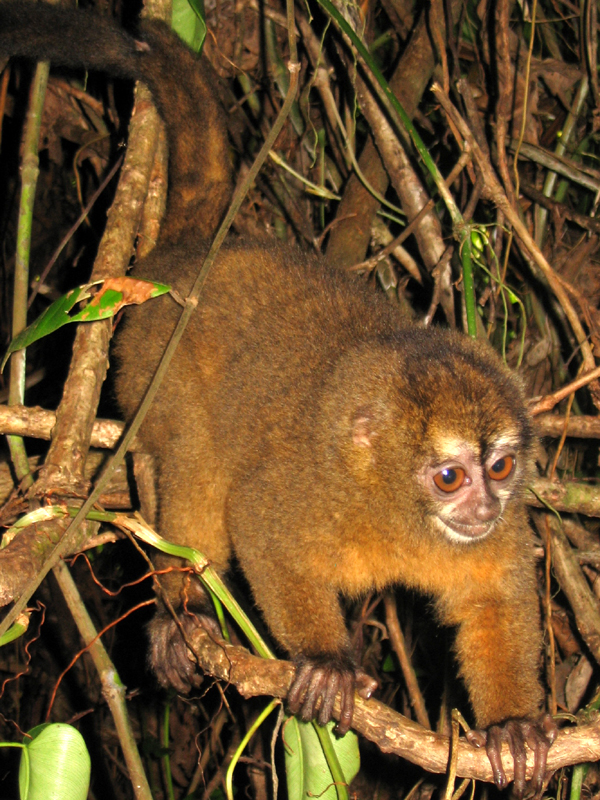
Owl monkey (Aotus nigriceps) lives in tropical rainforest across Central and South America. It feeds on fruits and insects. Its conservation status is Least Concern.
Fascinating facts about the Owl monkey
- Adult black-headed night monkeys tip the scales at about 750 g, a weight they reach by roughly 14 months old. Newborns are tiny, weighing just 90-150 g, and must grow over a year to hit adult size. Males hit sexual maturity at two years, while females wait three to four years before they can reproduce. Breeding occurs between August and February, and each female typically delivers a single infant per year.
- Male black-headed night monkeys shoulder most of the parenting load. After the mother nurses the newborn for the first two weeks, the male assumes all care except nursing. He continues feeding, grooming and protecting the infant until about eight weeks old, when weaning begins and the male also starts nudging the youngster away.
- Territorial battles among black-headed night monkeys can turn into marathon fights lasting five to thirty minutes. Males clash with other males and females with other females, defending a home range that averages 9.2 ha (about 92,000 m²). The winner claims not only the territory but also any infants left behind by the defeated pair, effectively inheriting both space and offspring. Such high-stakes aggression underscores the importance of space for feeding and breeding.
- Each night these monkeys travel between 340 m and 1,025 m, averaging 708 m, as they forage through the upper canopy. Their nightly routes expand with brighter moonlight and favorable weather, allowing them to cover more ground in search of ripe figs and occasional insects. This extensive nightly mileage helps them exploit scattered fruit trees while staying hidden from ground predators.
- When a 5.2-km oil pipeline cut through their forest, black-headed night monkeys were among the most frequent users of natural canopy bridges left in place. Camera traps recorded them, and researchers estimate at least 150 individuals crossed the bridges. Their willingness to cross high up, rather than descend to the ground, shows how preserving canopy continuity can keep populations linked despite human infrastructure.
Sources
Every fact above was checked against these pages, and kept only where one of them states it.
At a glance
RangeCentral and South America
HabitatTropical rainforest
DietFruits and insects
About the Owl monkey
In the twilight depths of the tropical forest, the owl monkey emerges as a phantom, its large, round eyes glowing like lanterns in the fading light as it navigates the canopy with an effortless, ethereal grace. With each gentle leap, its slender form seems to defy gravity, the soft whoosh of its fur a whispered promise of secrets hidden in the shadows. As it settles into its nocturnal rhythm, the owl monkey's haunting, melodic calls weave a spell of enchantment, a siren's song that echoes through the darkness, a testament to the magic that still lurks in the unseen corners of our world.
Hear the Owl monkey, and 4,400+ more
Real recorded sounds, 11 nature games and a free Daily 5, 1v1 quiz duels, conservation wins and a safe Kids mode. Free on Feravox.