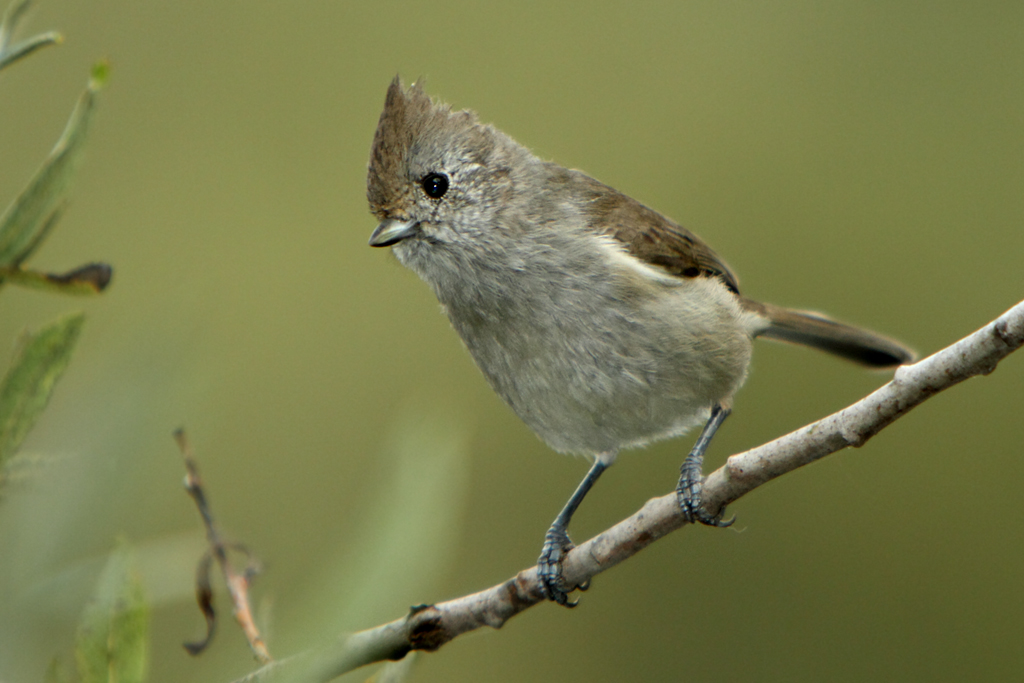
Oak Titmouse (Baeolophus inornatus) lives in woodland areas across Southwestern North America. It feeds on insects and seeds. Its conservation status is Least Concern.
Fascinating facts about the Oak Titmouse
- In 1996 the American Ornithologists' Union split the plain titmouse into the oak titmouse and the juniper titmouse, citing distinct song, habitat and genetic differences. The oak titmouse belongs to the tit family Paridae and is a small, brown-tinged gray bird with a modest crest on its head. Its face is plain and the underparts a lighter gray, and males and females look alike with virtually no sexual dimorphism.
- Research from Stanford University and the USGS shows the oak titmouse now begins breeding about 20 days later each decade as temperatures rise. Normally the species breeds from March into July, with peak activity in April and May, laying three to nine eggs, usually six to eight. The female incubates the clutch for 14 to 16 days, and the altricial young are fed by both parents for 16 to 21 days before fledging.
- The female oak titmouse builds the nest in just 4 to 10 days while the male stays nearby bringing food, and the pair places the cup in a woodpecker hole, a natural cavity or a nest box. Materials such as grass, moss, mud, hair, feathers and fur are woven together to line the chamber.
- Oak titmice often lose their nesting cavities to invasive European starlings and must also share holes with western bluebirds and house wrens. Such competition for limited cavities pushes the birds to pair up early in life. These pairs usually stay together for life, jointly defending the same territory throughout the year. The strong bond helps them maintain a reliable nesting site despite the pressure from other cavity-nesters.
- When feeding, the oak titmouse will hang upside down on branches and hammer seeds against twigs to crack them open. It forages on foliage, twigs, branches, trunks and even on the ground, catching insects in mid-air when the opportunity arises. In addition to insects and spiders, it also takes berries, acorns and other seeds. This versatile foraging behaviour lets it exploit a wide range of food sources in its oak-rich habitat.
Sources
Every fact above was checked against these pages, and kept only where one of them states it.
At a glance
RangeSouthwestern North America
HabitatWoodland areas
DietInsects and seeds
About the Oak Titmouse
In the sun-dappled woodlands of western North America, the Oak Titmouse flits with effortless agility, its grey and brown plumage blending seamlessly into the dappled shade as it darts between the gnarled branches of ancient oaks. With a twitch of its distinctive grey crest, this diminutive bird navigates its domain with a quiet confidence, its large, dark eyes ever-vigilant for the hidden treasures of seeds and insects that lie hidden within the labyrinthine foliage. As it moves, its soft, whistled songs weave a subtle tapestry of sound, a gentle counterpoint to the rustling leaves and snapping twigs that accompany its busy, insect-hunting forays.
Hear the Oak Titmouse, and 4,400+ more
Real recorded sounds, 11 nature games and a free Daily 5, 1v1 quiz duels, conservation wins and a safe Kids mode. Free on Feravox.