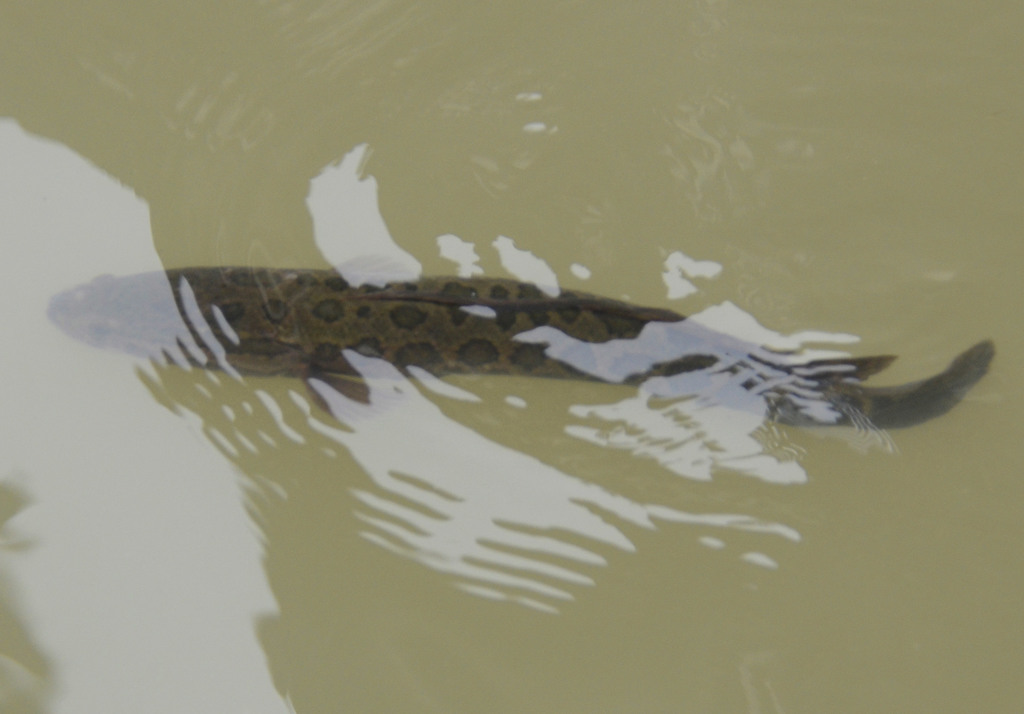
Photo: Mike Duran
Feravox · The Voice of the Wild
Northern Snakehead
Channa argus
Least Concern
Northern Snakehead (Channa argus) lives in stagnant muddy waters across East Asia, North America. It feeds on primarily fish, also crustaceans. Its conservation status is Least Concern.
The northern snakehead (Channa argus) is a strikingly armored predator, its golden-tan to pale brown skin mottled with dark blotches that run like saddles across its back. A long dorsal fin bearing 49–50 rays and an even longer anal fin with 31–32 rays frame a small, depressed head whose eyes sit above the mid-jaw, while a massive mouth, extending well beyond the eye, houses rows of villiform teeth and formidable lower-jaw canines. Adults typically reach 100 cm, though Russian ichthyologists have recorded individuals approaching 150 cm, and the International Game Fish Association lists a record weight of 9.53 kg. Unlike many snakeheads, juveniles share the same coloration as adults, and two irregular, blotched bars on the caudal peduncle set C. argus apart from its close relative C. maculata. This amphibious fish thrives in stagnant, muddy waters or slow, murky swamp streams, where it stalks fish, crustaceans, invertebrates and amphibians, breathing both through gills and a suprabranchial organ that lets it survive out of water for days, a trait that fuels its invasive potential. Native to temperate East Asia, from the Amur River watershed in Siberia and Manchuria down to Hainan, the species is a cornerstone of regional aquaculture, yielding 510,000 tonnes annually and spawning 100,000 eggs per female each spring. Its ability to double populations in as little as 15 years, coupled with a tolerance for only minimal salinity (under 10 ppm), enables it to colonize new habitats via accidental releases or deliberate introductions. In the United States it now inhabits waters from Pennsylvania to Mississippi, with notable establishments in the Potomac River, Arkansas ponds, and recent sightings as far north as Missouri and New Jersey, illustrating how its hardy air-breathing capacity and prolific breeding continue to push the species into fresh ecosystems.
Real recorded sounds, 11 nature games and a free Daily 5, 1v1 quiz duels, conservation wins and a safe Kids mode. Free on Feravox.