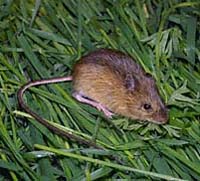
Northern Pacific Jumping Mouse (Zapus trinotatus) lives in pacific coastal forests across North America. It feeds on seeds and fruits. Its conservation status is Least Concern.
Fascinating facts about the Northern Pacific Jumping Mouse
- Pacific jumping mice can launch themselves, leaping over 150 cm in a single bound while keeping their heads down, arching their backs and diving to the ground before spring-loading for the next jump. This extreme distance, matching the 90-180 cm leaps described for predator escapes, lets them sprint away from owls, snakes and coyotes in a flash, turning a sprint into a series of aerial hops.
- Before winter, these mice double their body weight in fat and then hibernate for up to eight months in shallow burrows, dropping their core temperature to just two °C. They only awaken when the air warms to negative six degrees Celsius or more in mid-April, emerging lean but ready to breed. Such a long, low-temperature torpor lets them survive the Pacific Northwest's wet, cold winters without needing to forage.
- A newborn Pacific jumping mouse weighs barely a gram, just 0.7-0.9 g, and is born hairless, pink and blind. After a gestation of 18-23 days, the mother delivers 4-8 pups that are weaned in four weeks and become independent after about a month, reaching sexual maturity the following year. This rapid early growth, combined with a potential lifespan of at least four years in the wild, means a single female can produce several litters.
- The mouse's body is built for jumping: a tail 112-155 mm long, hind feet 30-36 mm, ears 14-16 mm, and a total length of 221-242 mm, all proportioned to a shortened torso and a shifted center of gravity. These dimensions, together with 39 vertebrae and a lengthened pseudosacrum, give it the leverage to push off with its powerful hind limbs and land on its forefeet, turning a short hop into a spring-loaded leap.
- These rodents thrive in the Pacific Northwest's rain-soaked habitats, from alder-rich marshes to alpine meadows, because their populations become denser as precipitation rises. Their range stretches from southwestern British Columbia through Washington, Oregon and into California's coastal redwoods, occupying streams, swamps, bogs and meadow edges. Moist, thick vegetation supplies both the seeds they love and the cover they need to evade predators, linking their survival directly to the health of wetland ecosystems.
Sources
Every fact above was checked against these pages, and kept only where one of them states it.
At a glance
RangeNorth America
HabitatPacific coastal forests
DietSeeds and fruits
About the Northern Pacific Jumping Mouse
In the verdant undergrowth of the Pacific Northwest, a tiny, unassuming hero of the forest floor comes alive, as the Northern Pacific Jumping Mouse bursts into motion, its powerful hind legs coiling and springing with effortless ease, propelling it through the dense thicket with a mesmerizing blend of speed and agility. With each leap, it seems to defy gravity, its slender body arcing through the air as it pursues the hidden treasures of seed and insect that lie scattered amidst the leaf litter. As it navigates this secret world, the jumping mouse embodies a remarkable fusion of fragility and resilience, its very existence a testament to the enduring magic of the natural world.
Hear the Northern Pacific Jumping Mouse, and 4,400+ more
Real recorded sounds, 11 nature games and a free Daily 5, 1v1 quiz duels, conservation wins and a safe Kids mode. Free on Feravox.