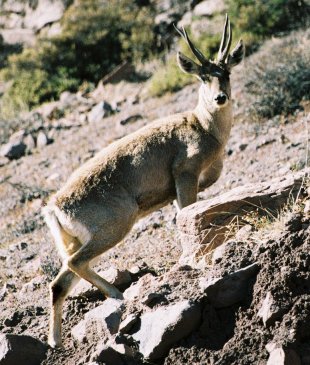
Northern Huemul (Hippocamelus antisensis) lives in andean mountain forests across South America. It feeds on grasses and leaves. Its conservation status is Vulnerable.
Fascinating facts about the Northern Huemul
- The taruca's antlers are reduced to just two tines, the rear one being larger, a structure shared only with its close relative the huemul. This simple branching sets it apart from all other South American deer and is found only on males, as females do not grow antlers. The longer tine of a full-grown male generally measures around 30 cm, giving the animal a modest but distinctive set of horns.
- Male tarucas possess canine teeth in their upper jaw, a feature that most females lack. These canines are exclusive to males, highlighting a clear sexual difference in dentition.
- The taruca inhabits the high Andes, occupying elevations from 3 500 m up to 5 000 m, where the thin air and rugged terrain shape its lifestyle. At the lower end of this range it may share territory with the endemic Peruvian whitetail deer, indicating a degree of habitat overlap. Its distribution is confined to the Andes, stretching from central Peru through Bolivia and extreme north-eastern Chile into northern Argentina, making it a true high-mountain specialist.
- Even far from human settlements, taruca groups are extremely sparse, with densities dropping to just 0.15 individuals per km². Their populations are scattered because they require relatively specialised habitats, so individuals drift between temporary groups of up to thirty members. This low density occurs across their high-altitude range of 3 500 m to 5 000 m, where rugged slopes and puna grasslands dominate.
- A 2008 survey suggested that between 9,000 and 12,000 tarucas inhabited the central Andes, and Peru supports the largest share of this total. The species' range stretches from central Peru, through Bolivia and extreme north-eastern Chile, down into northern Argentina, confining it to the high-mountain corridor. Within this corridor the deer occupy rocky slopes, queñual forests and puna grasslands, often near glacial lakes.
Sources
Every fact above was checked against these pages, and kept only where one of them states it.
At a glance
RangeSouth America
HabitatAndean mountain forests
DietGrasses and leaves
About the Northern Huemul
In the rugged, windswept landscapes of the Andes, the Northern Huemul roams with a quiet majesty, its large brown eyes watchful and alert as it navigates the rocky terrain with a sure-footed elegance. With each step, its slender legs propel it effortlessly across the mountainous terrain, its coat a warm, earthy hue that blends seamlessly into the surrounding landscape. As one of the most endangered deer species in South America, the Northern Huemul's very existence is a testament to the resilience and adaptability of life in these harsh, breathtaking environments.
Hear the Northern Huemul, and 4,400+ more
Real recorded sounds, 11 nature games and a free Daily 5, 1v1 quiz duels, conservation wins and a safe Kids mode. Free on Feravox.