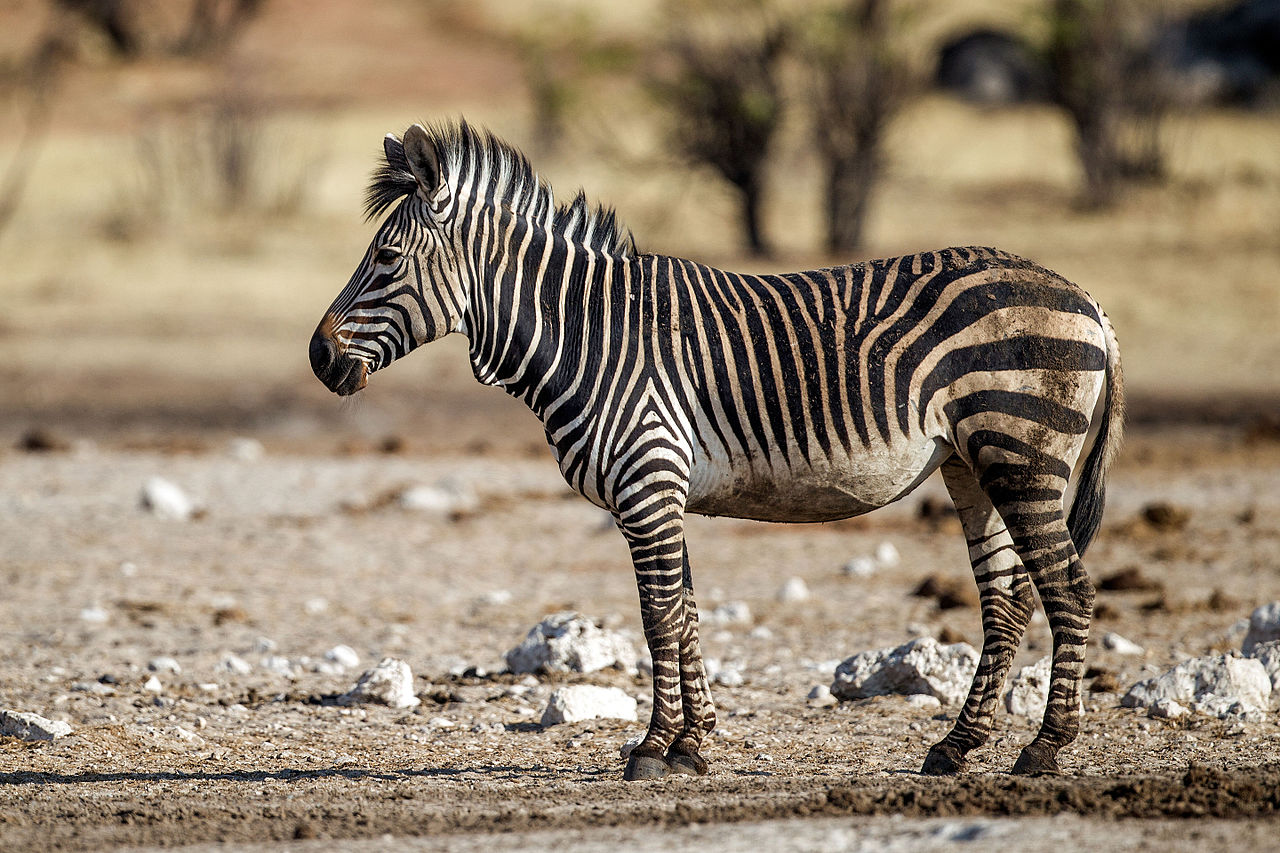
Mountain Zebra (Equus zebra) lives in mountainous grasslands across Southern Africa. It feeds on grass and leaves. Its conservation status is Vulnerable.
Fascinating facts about the Mountain Zebra
- Mountain zebras can live on slopes and plateaus as high as 2,000 m above sea level, descending to lower elevations in winter. They prefer mountainous terrain, especially escarpments that support a wide range of grass species. In addition to steep slopes they also occupy open grasslands and woodlands where vegetation is sufficient, allowing them to browse when grasses are scarce.
- When surface water disappears during drought, mountain zebras will dig for groundwater in dry river beds to satisfy their need to drink each day. Daily drinking is essential, so they seek any available source, and the digging behaviour allows them to survive in arid, rocky environments where ponds may be absent for weeks.
- Unlike plains zebras, mountain zebras stay in small family units of one stallion with up to five mares and their young, forming tight groups rather than large herds. Bachelor males live apart in separate groups and attempt to capture young mares to establish their own harems, often confronting the resident stallion. This social structure limits group size and maintains distinct breeding units.
- By the 1930s hunting had driven the Cape mountain zebra to the brink of disappearance, leaving only about one hundred individuals alive. Conservation actions later reversed this decline, and a 1998 survey recorded roughly 1,200 zebras spread across national parks, provincial reserves and other protected areas. Ongoing protection and management have since boosted the wild population to more than 2,700 animals, marking a remarkable recovery.
- Thanks to intensive conservation programmes the total number of wild mountain zebras now exceeds 2,700 individuals, a figure that reflects the success of coordinated protection across their range. Both the Cape and Hartmann's subspecies benefit from legal safeguards, being listed as vulnerable on the IUCN Red List and placed under Appendix II of CITES, which regulates international trade. These designations help ensure continued monitoring and habitat preservation.
Sources
Every fact above was checked against these pages, and kept only where one of them states it.
At a glance
RangeSouthern Africa
HabitatMountainous grasslands
DietGrass and leaves
About the Mountain Zebra
In the rugged, rocky outcrops of southern Africa, the mountain zebra navigates its habitat with a sure-footed elegance, its black and white stripes a dazzling camouflage amidst the stark, sun-baked landscape. As it moves, its mane-like crest and erect ears give it an air of alert, watchful dignity, ever vigilant for the predators that stalk its mountain strongholds. With each deliberate step, this remarkable creature embodies the harsh, beautiful resilience of the wild places it calls home.
Hear the Mountain Zebra, and 4,400+ more
Real recorded sounds, 11 nature games and a free Daily 5, 1v1 quiz duels, conservation wins and a safe Kids mode. Free on Feravox.