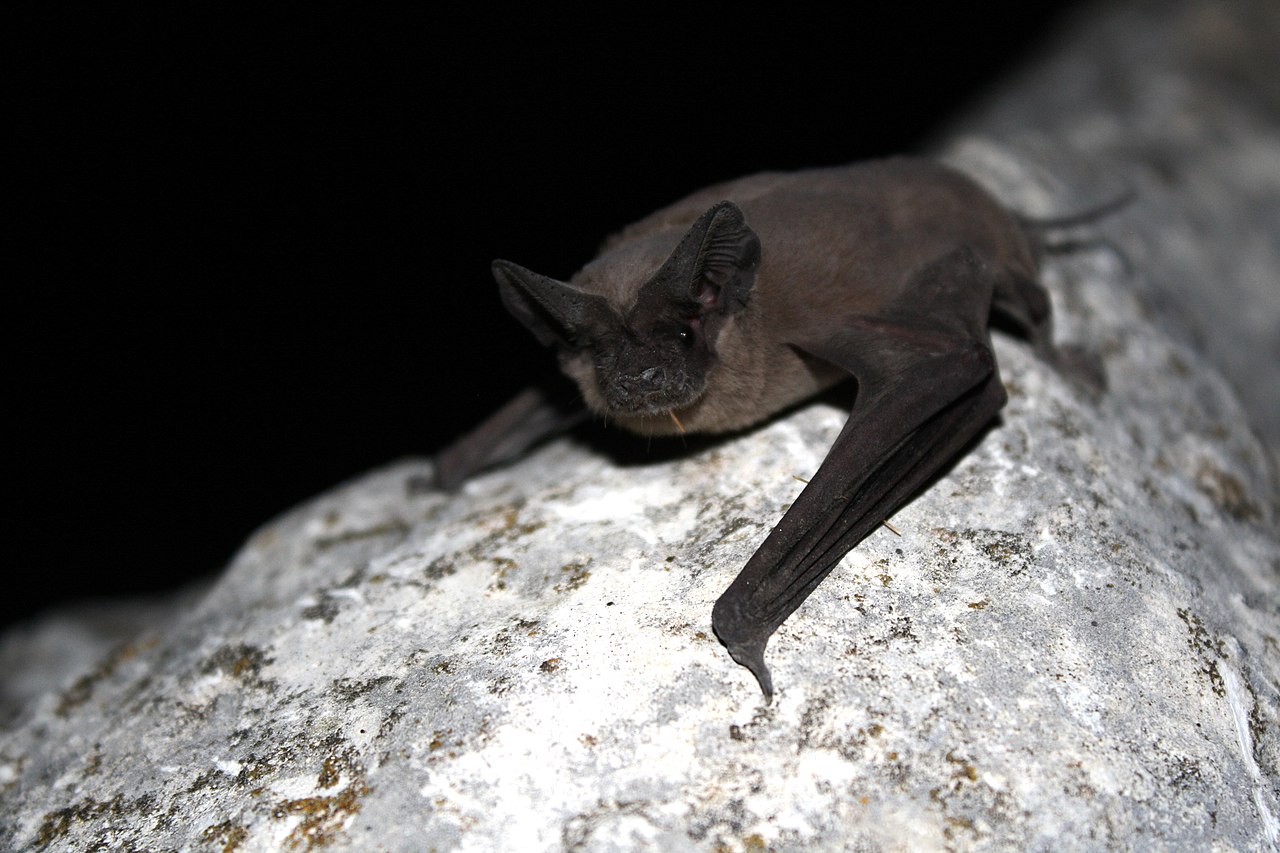
Mexican Free-tailed Bat (Tadarida brasiliensis) lives in caves across Southwestern North America. It feeds on insects & moths. Its conservation status is Least Concern.
Hear the Mexican Free-tailed Bat
A real field recording of the Mexican Free-tailed Bat, made in the wild.
Fascinating facts about the Mexican Free-tailed Bat
Speed demons of the sky, Mexican free-tailed bats have been clocked at up to 99 mph (160 km/h) in level flight, the fastest horizontal speed recorded for any animal. This record comes from a ground-speed measurement taken by an aircraft-tracking device, though wind may have boosted the reading.
A single cave can host a city-sized bat metropolis: Bracken Cave in Texas shelters nearly 20 million Mexican free-tailed bats, the world's largest known colony. Even urban bridges support staggering numbers; up to 1.5 million individuals roost beneath Austin's Congress Avenue Bridge each summer. Such density but also renders them vulnerable to habitat loss because so many rely on just a few roost sites.
Bat guano from these colonies piles up to 99 metric tons per cave, adding up to over 18,700 metric tons each year worldwide. In Texas, hundreds of tons were mined annually from 1900 to 1980, once the state's top mineral export before oil. The nitrogen-rich waste fuels eco-friendly fertilizers and even historic gunpowder, showing how a single species can power both agriculture and industry through its waste.
When Swainson's hawks hunt the swirling clouds of Mexican free-tailed bats, they don't chase individual insects; instead they lock onto a fixed point in the dense swarm, keeping a constant bearing as the bats stream out of a cave at dusk. Researchers filmed nearly a million bats emerging and showed that the hawks' strategy sidesteps the "confusion effect," revealing how predators adapt to overwhelming numbers by targeting the group rather than the individual.
Nightly, a single Austin colony devours roughly 30,000 lb (13,600 kg) of insects. Across their range, each night the bats consume between 10,000 and 30,000 lb.
Sources
Every fact above was checked against these pages, and kept only where one of them states it.
As the sun sets over the arid landscapes of North America, a dark, undulating tide of Mexican Free-tailed Bats emerges from the crevices and caverns, their leathery wings beating in unison as they take to the evening skies. With a mesmerizing fluidity, they pour through the air, their high-pitched calls piercing the dusk as they navigate the thermal currents and insect-rich updrafts with an effortless, aerial agility. In this nocturnal dance, the Mexican Free-tailed Bat is a master of the night, its very existence a testament to the enduring power and beauty of the natural world.
Advertisement
Hear the Mexican Free-tailed Bat, and 4,400+ more
Real recorded sounds, 11 nature games and a free Daily 5, 1v1 quiz duels, conservation wins and a safe Kids mode. Free on Feravox.