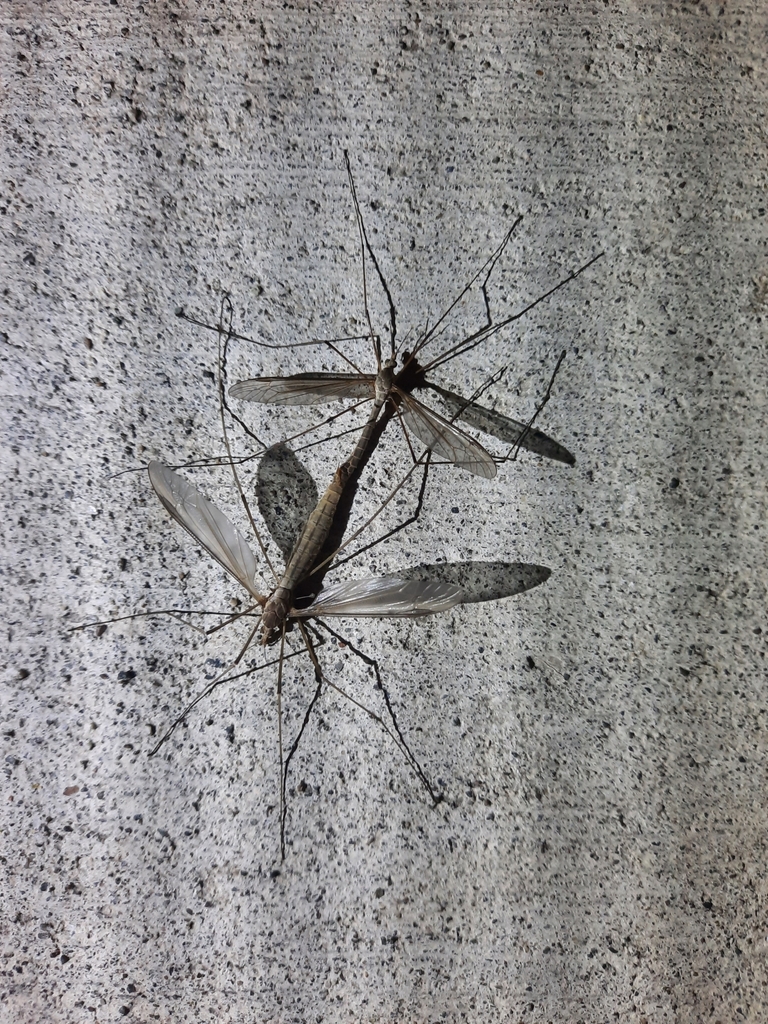
Marsh Crane Fly (Tipula oleracea) lives in damp grasslands across Europe and Asia. It feeds on decaying plant matter.
Fascinating facts about the Marsh Crane Fly
- Marsh crane flies have wings that stretch only 18-28 mm. Their bodies are usually grey, but the abdomen can flash a rusty hue with a black longitudinal stripe. Males carry a short median projection on tergite 9, while females have wings as long as their abdomen.
- Tipula oleracea thrives across most of Europe, from Greece and Crete in the southeast, yet it skips Finland and Latvia. Its range pushes south into North Africa, stopping at Algeria's eastern edge, and even reaches Malta. Across the Atlantic, the fly has slipped into the western United States from British Columbia to California and the eastern corridor between Michigan and New York, with a foothold in Ecuador.
- Marsh crane fly larvae hatch after about 15 days, emerging as brownish grubs only 3-4 mm long. Over roughly four months they molt four times, swelling to several centimetres before burrowing into the soil to pupate. While they feast on decaying plant matter, they also gnaw delicate roots and can damage crops like cabbage, especially at night when they climb to nibble leaves.
- Adults take to the air from April through June, peaking in May-June, then reappear in a second generation from August to October. These evening swarms hover low over fields, where the flies sip only liquid nectar with their soft mouthparts. The second generation overwinters as larvae in the soil, emerging in late spring to repeat the cycle. From egg to adult, the entire life span stretches up to eight months, allowing two breeding rounds in a single year.
- A single female marsh crane fly can lay up to 1 200 eggs in moist soil, each egg barely under a millimetre long. In a dense patch, as many as 400 larvae may occupy a single square metre.
Sources
Every fact above was checked against these pages, and kept only where one of them states it.
At a glance
RangeEurope and Asia
HabitatDamp grasslands
DietDecaying plant matter
About the Marsh Crane Fly
In the misty veil of dawn, the Marsh Crane Fly emerges, its delicate form suspended in mid-air as it executes a stately dance, its long, slender legs dangling like silken threads. With a hypnotic slowness, it navigates the lush, emerald world of the marsh, its iridescent wings beating in a blur of motion as it seeks out the sweet, sticky nectar that sustains it. As it alights upon a trembling reed, its very presence seems to embody the ephemeral, whispered magic of this enchanting realm.
Common questions
Where does the Marsh Crane Fly live?
Habitat: damp grasslands. Range: Europe and Asia.
Hear the Marsh Crane Fly, and 4,400+ more
Real recorded sounds, 11 nature games and a free Daily 5, 1v1 quiz duels, conservation wins and a safe Kids mode. Free on Feravox.
More insects and spiders to discover