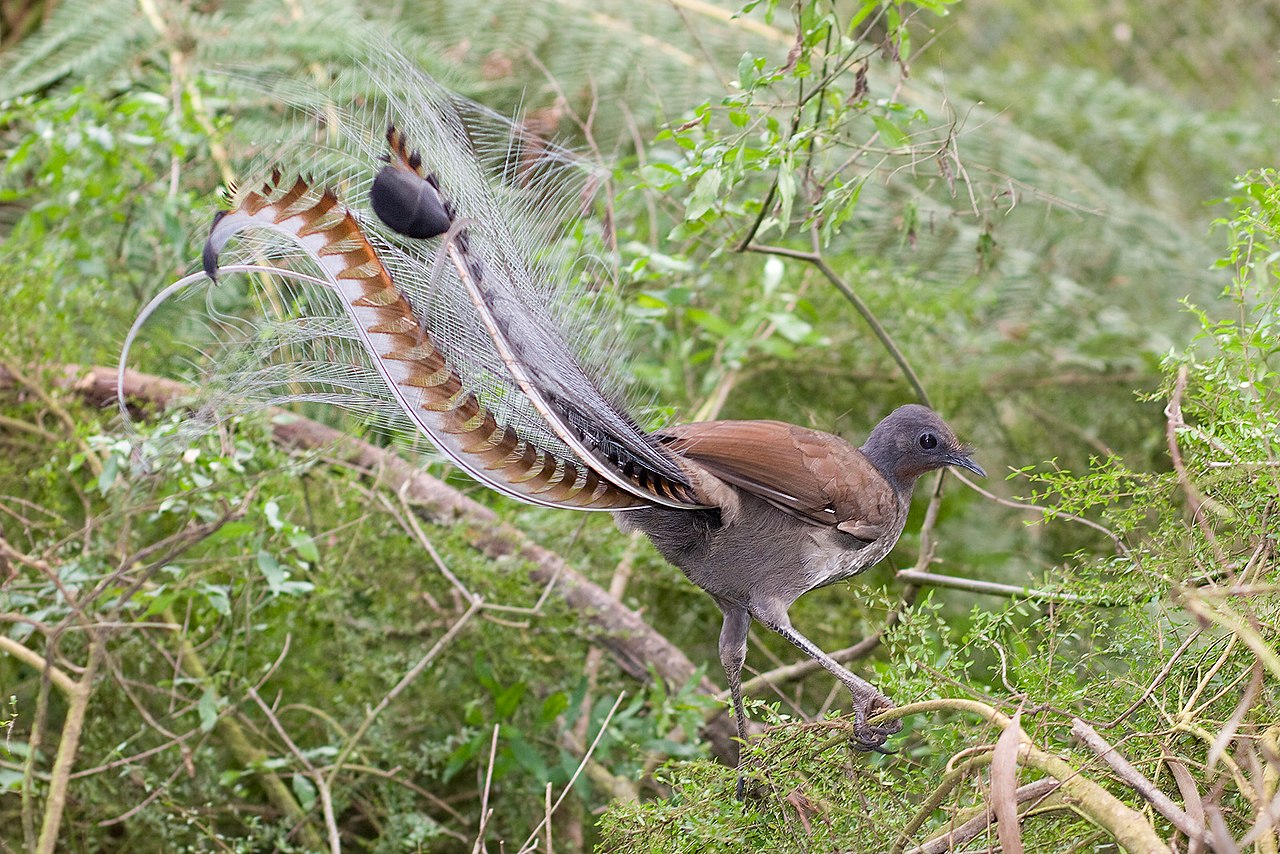
Lyrebird (Menura novaehollandiae) lives in forest across Eastern Australia. It feeds on insects and worms. Its conservation status is Least Concern.
Fascinating facts about the Lyrebird
- A male superb lyrebird can stretch a tail, reaching up to 70 cm (28 in) and made of sixteen feathers. The bird itself measures 860 mm (34 in) in females and up to 1 m (39 in) in males, weighing about 0.9 kg (2.0 lb) for females and 1.1 kg (2.4 lb) for males. Males don't finish growing their spectacular plumage until they are 7-9 years old, while females mature a year earlier.
- One lyrebird can turn a hectare of forest floor into a giant compost heap, moving and burying up to 200 tonnes of leaf litter and soil each year, more than any other animal in the ecosystem. By constantly stirring the ground, they speed up leaf decay, release nutrients faster, and create bare patches that act as fire breaks, lowering both the extent and intensity of wildfires. This hidden engineering helps keep the rainforest healthy and less prone to catastrophic burns.
- Around three-quarters of a male lyrebird's song is pure imitation, 70-80 % of his vocalisations copy other birds or even marsupials, and females choose mates based on how accurately and diversely they can mimic. Studies show females prefer males with the most precise and varied mimicry, making this vocal talent a direct driver of reproductive success.
- Superb lyrebirds practice polygyny: a single male may hold a territory that overlaps with up to six females. Within his domain he builds several circular mounds of bare dirt, which he fiercely defends and uses as stages for elaborate courtship dances, tail-fanning, wing-beats and loud, mimicked songs. These displays not only attract mates.
- Lyrebirds have been roaming Australian forests for about 15 million years, as shown by fossils in the Australian Museum. Today they occupy southeastern Australia from southern Victoria to southeastern Queensland and are listed as Least Concern on the IUCN Red List. After being introduced to southern Tasmania between 1934 and 1954, the population there not only survived but is now thriving and expanding.
Sources
Every fact above was checked against these pages, and kept only where one of them states it.
At a glance
RangeEastern Australia
HabitatForest
DietInsects and worms
About the Lyrebird
In the dappled underbrush of the Australian forest, the lyrebird reigns as a master of mimicry, its extraordinary voice weaving a tapestry of sounds that echo through the trees, from the chirping of birds to the rustling of leaves. With each step, its powerful legs propel it effortlessly across the forest floor, its intricate plumage a testament to its remarkable adaptability. As it moves, the lyrebird's very presence seems to embody the essence of the wild, a symphony of sound and motion that is at once captivating and humbling.
Hear the Lyrebird, and 4,400+ more
Real recorded sounds, 11 nature games and a free Daily 5, 1v1 quiz duels, conservation wins and a safe Kids mode. Free on Feravox.