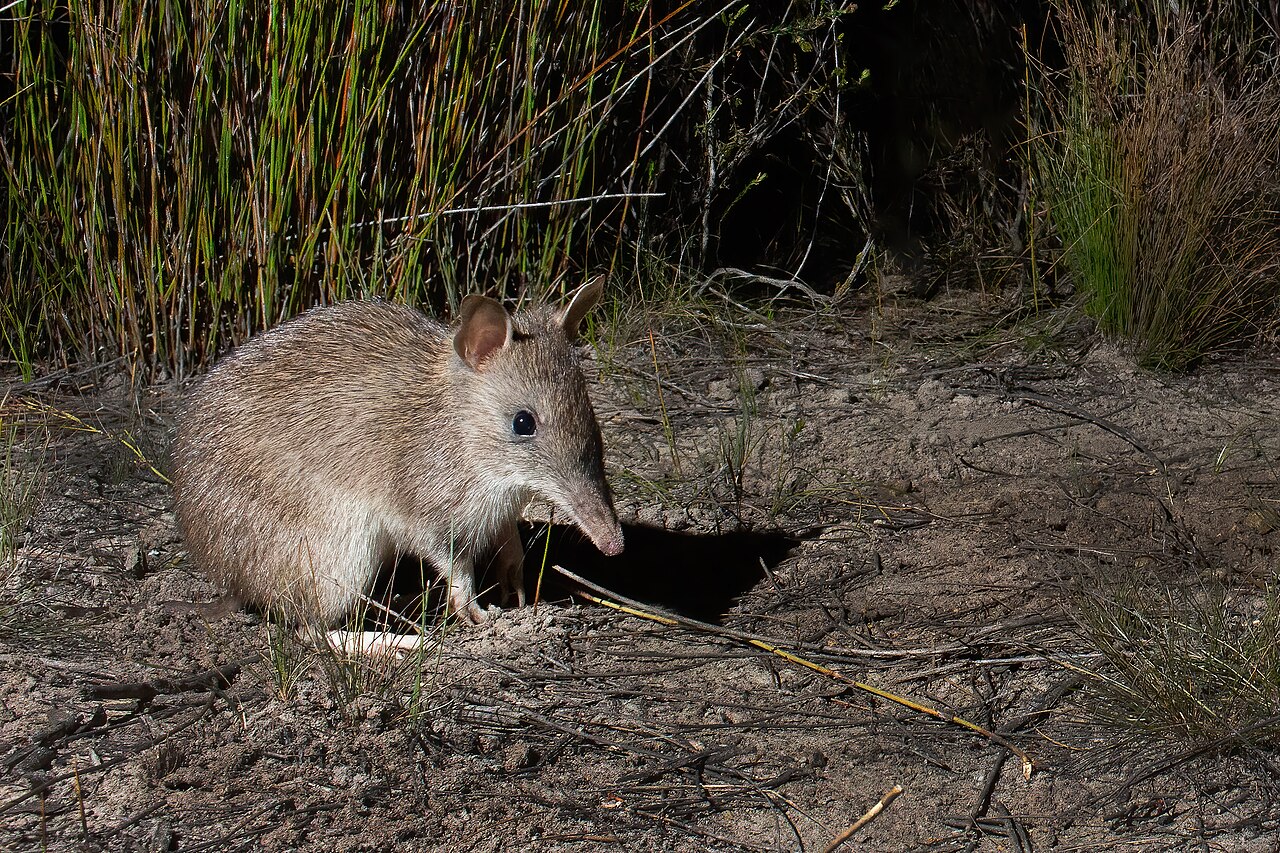
Long-nosed Bandicoot (Perameles nasuta) lives in rainforest and wet sclerophyll forest across Eastern Australia. Its conservation status is Least Concern.
Fascinating facts about the Long-nosed Bandicoot
- A newborn long-nosed bandicoot spends just 12.5 days in its mother's womb, one of the shortest gestation periods of any mammal, then inside the rear-facing pouch for another 50 to 54 days before emerging fully weaned. This rapid development lets females produce up to four litters a year.
- A single adult long-nosed bandicoot can weigh up to 1.5 kilograms and stretch about 40 cm long, with a 14 cm tail, roughly the size of a small housecat but built for digging. Their three long, clawed front toes and powerful fore-limbs churn up soil, creating conical holes that aerate the earth and help disperse fungal spores. This burrowing churns up to 0.044 km² of ground for males and 0.017 km² for females, turning over the topsoil and boosting nutrient cycling across eastern Australia's forests and grasslands.
- Long-nosed bandicoots thrive in a patchwork of habitats, from rainforest gullies to suburban lawns, because they can eat almost anything on the forest floor. Invertebrates dominate their diet year-round, while in summer they add spiders, caterpillars and seeds, and in winter they switch to cicada larvae, grass blades and underground roots. Their foraging digs could potentially decrease insect pest populations.
- Even after disappearing from most of Sydney in the 1960s, a tiny refuge of about 200 bandicoots still clings to the North Head headland, where the New South Wales government has listed the population as endangered. Taronga Zoo now runs a captive-breeding program to boost those numbers, while a separate, even smaller group survives in Dulwich Hill, adapting to garden foraging despite fragmented habitat.
- Long-nosed bandicoots are solitary night-crawlers that spend daylight hours tucked in burrows, emerging only to dig for grub-rich soil. Their nocturnal foraging creates a network of conical pits that aerate the ground. In a Booderee National Park study, bandicoot numbers surged when invertebrate prey spiked, then fell two years later.
Sources
Every fact above was checked against these pages, and kept only where one of them states it.
At a glance
RangeEastern Australia
HabitatRainforest and wet sclerophyll forest
DietInsects and worms
About the Long-nosed Bandicoot
In the moonlit underbrush, the long-nosed bandicoot emerges as a phantom, its pointed snout twitching with every whiff of insect life, as it snuffles and roots through the leaf litter with an air of quiet industry. With each swift, darting movement, its long, hairless tail streams behind like a banner, a counterbalance to its energetic foraging, as it weaves a nocturnal path through the shadows. As it pauses, one glowing eye gleams like a jewel in the dark, a fleeting glimpse of a creature that is at once both elusive and endearing.
Hear the Long-nosed Bandicoot, and 4,400+ more
Real recorded sounds, 11 nature games and a free Daily 5, 1v1 quiz duels, conservation wins and a safe Kids mode. Free on Feravox.