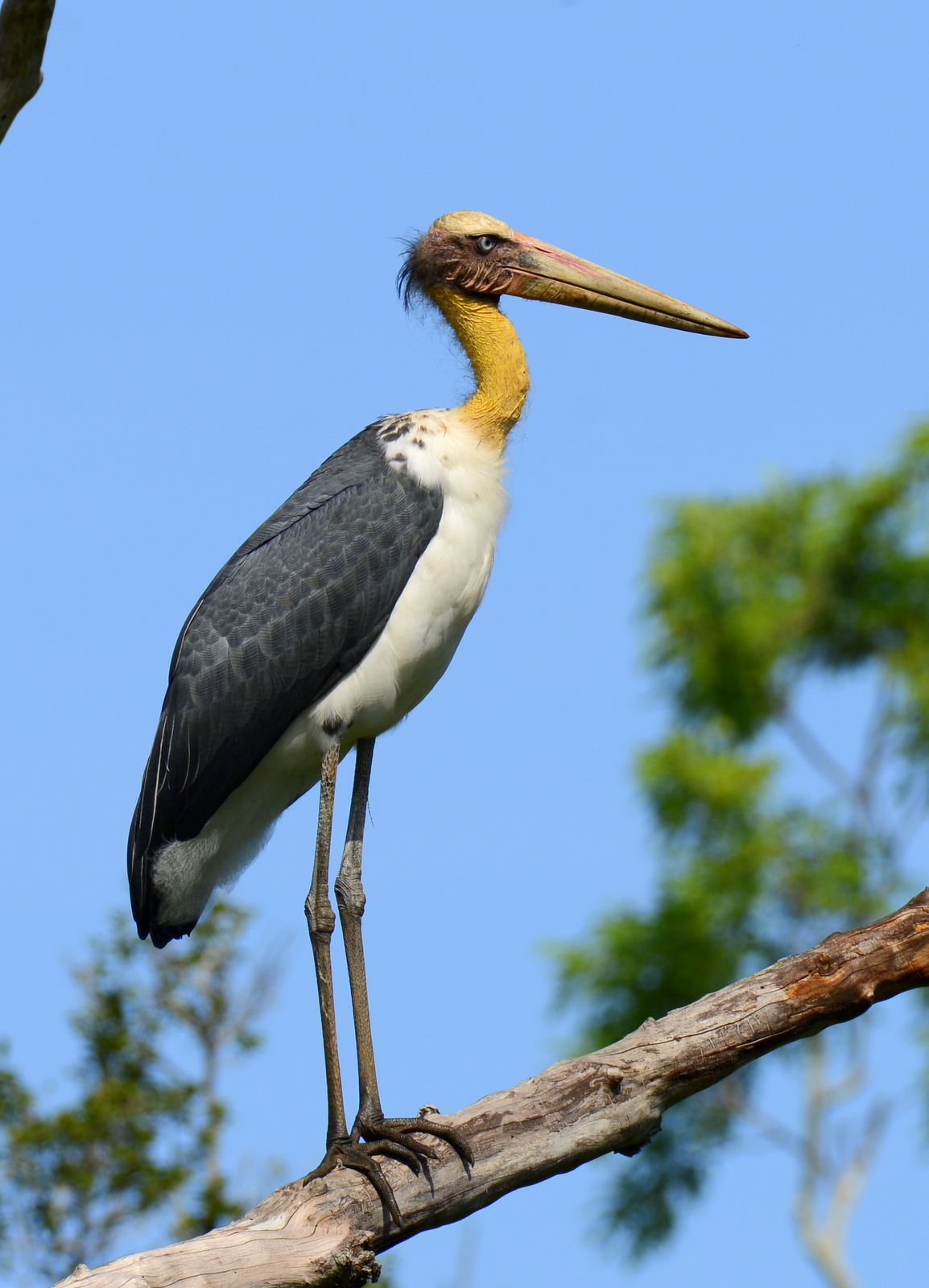
Lesser Adjutant (Leptoptilos javanicus) lives in wetlands, grasslands across Southeast Asia. It feeds on carrion and scraps. Its conservation status is Near Threatened.
Fascinating facts about the Lesser Adjutant
- During breeding, lesser adjutants gather in loose colonies that never exceed 20 nests, each perched on a massive tree up to a metre deep and over a metre across. In eastern Nepal four colonies held 61 nests on Haldina cordifolia and Bombax ceiba, while central lowland Nepal recorded 35 colonies with 101 nests across four tree species. The average colony size was just 2.9 nests, ranging from a single nest to 13, showing how the birds select only the tallest, most robust trees for their families.
- Colonies sited on taller trees in agricultural fields produce more fledglings. Studies in lowland Nepal found breeding success rose with colony size, likely because larger groups deter predators. Moreover, nests on trees within flooded-rice landscapes yielded higher chick survival than those in forest reserves, indicating that seasonal irrigation creates ideal feeding grounds. This link between tree height, farming cycles, and fledging rates shows how human-altered wetlands can actually boost the species when managed wisely.
- The global population of mature lesser adjutants is now estimated at 5,000-15,000 individuals, prompting the IUCN to downgrade their threat level from Vulnerable to Near-Threatened in 2023. The downlisting reflects successful community nest-protection programs and a slowdown in declines, yet the species remains at risk from hunting and loss of preferred nesting trees like Bombax ceiba. Monitoring these numbers helps gauge whether conservation actions are truly reversing the downward trend.
- In April 2024, a raid in Mymensingh, Bangladesh uncovered 48 captive animals, including lesser adjutant storks, held in a cramped mini-zoo 124 km (77 mi) north of Dhaka. The birds had been rescued after more than a decade of confinement, illustrating how illegal trade still threatens even large, protected waterbirds. Their removal underscores the need for strict enforcement and proper rehabilitation to prevent further loss of wild populations.
- A lesser adjutant stretches nearly a meter long, 87-93 cm from bill to tail, and towers 110-120 cm tall. It weighs between 4 kg and 5.71 kg. Its bill spans 25.8-30.8 cm and the tarsus 22.5-26.8 cm.
Sources
Every fact above was checked against these pages, and kept only where one of them states it.
At a glance
RangeSoutheast Asia
HabitatWetlands, grasslands
DietCarrion and scraps
About the Lesser Adjutant
In the misty dawn of the Asian wetlands, the Lesser Adjutant stalks its prey with stealthy deliberation, its stately strides eating up the distance as it navigates the murky shallows with an air of quiet confidence. With its sombre, grey-brown plumage and distinctive casque-like bill, this majestic bird moves through the landscape like a phantom, its very presence seeming to command the respect of its surroundings. As it rises into the sky, its broad wings beating with a slow, powerful rhythm, the Lesser Adjutant embodies a sense of austere, unyielding beauty, a testament to the enduring allure of the wild.
Hear the Lesser Adjutant, and 4,400+ more
Real recorded sounds, 11 nature games and a free Daily 5, 1v1 quiz duels, conservation wins and a safe Kids mode. Free on Feravox.