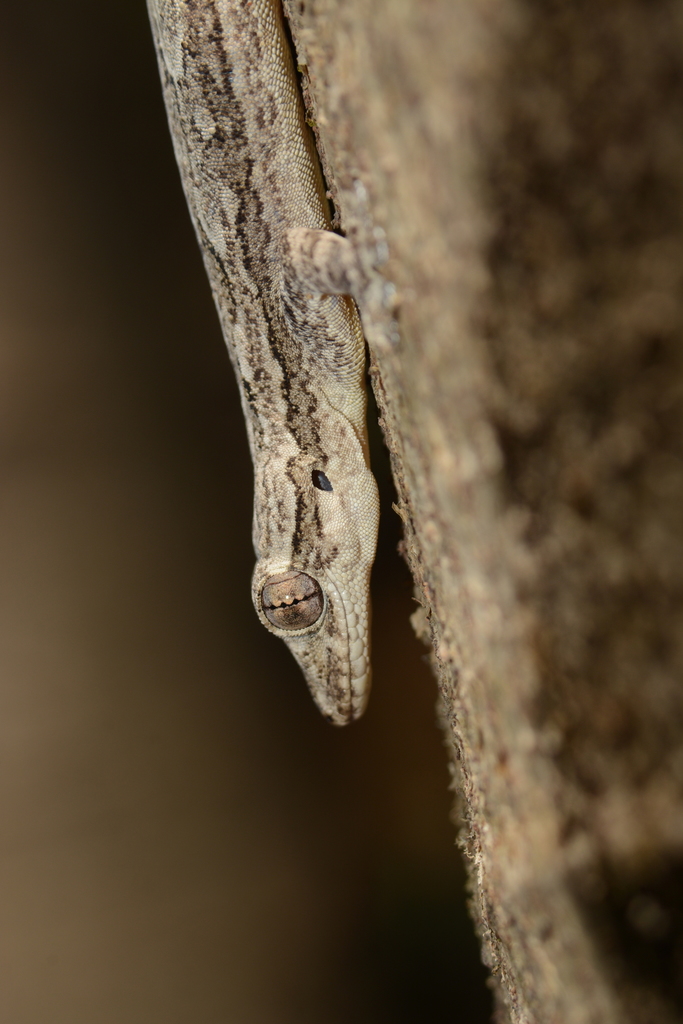
Photo: iNaturalist
Feravox · The Voice of the Wild
Leschenault's Leaf-toed Gecko
Hemidactylus leschenaultii
Least Concern
Leschenault's Leaf-toed Gecko (Hemidactylus leschenaultii) lives in forest habitat across South Asia, Oman. Its conservation status is Least Concern.
Leschenault's leaf-toed gecko, Hemidactylus leschenaultii, is a modest-sized lizard that blends the elegance of a forest dweller with the comfort of a houseguest. Measuring just over eight centimeters from snout to vent, its tail adds another eight centimeters, giving it a sleek, elongated silhouette. The head is marked by a concave forehead and prominent supra-orbital ridges, while the eyes sit beneath a snout that stretches 1.33 to 1.40 times the orbit’s diameter. Its most arresting feature is the leaf-shaped toe pads, each bearing six or seven lamellae on the inner digits and up to eleven on the median, granting the gecko an uncanny grip on bark, leaf litter, and even smooth indoor walls. The dorsal surface is a muted grey mottled with darker undulating cross-bars, rhomboidal spots, or longitudinal bands, punctuated by a dark stripe that runs from eye to shoulder; the ventral side is a clean white. A subtle skin fold runs along the belly from axilla to groin, a trait rarely highlighted in field guides but crucial for flexibility during arboreal pursuits. In the wild, H. leschenaultii favors forest habitats from sea level up to 1,000 m, yet its adaptability has led it to become a common resident of human homes across southern India, Sri Lanka, Pakistan, and Oman. An arboreal, oviparous species, it spends daylight hours perched on branches or walls, launching swift nocturnal hunts for insects that are drawn to its illuminated refuges. Males are distinguished by a series of 12 to 16 femoral pores on each side, a subtle clue to their reproductive readiness. Perhaps the most surprising aspect of this gecko is its ability to thrive in both pristine forest canopies and the cramped crevices of domestic interiors, a duality that underscores its evolutionary success and hints at a hidden resilience that continues to intrigue herpetologists.
Real recorded sounds, 11 nature games and a free Daily 5, 1v1 quiz duels, conservation wins and a safe Kids mode. Free on Feravox.