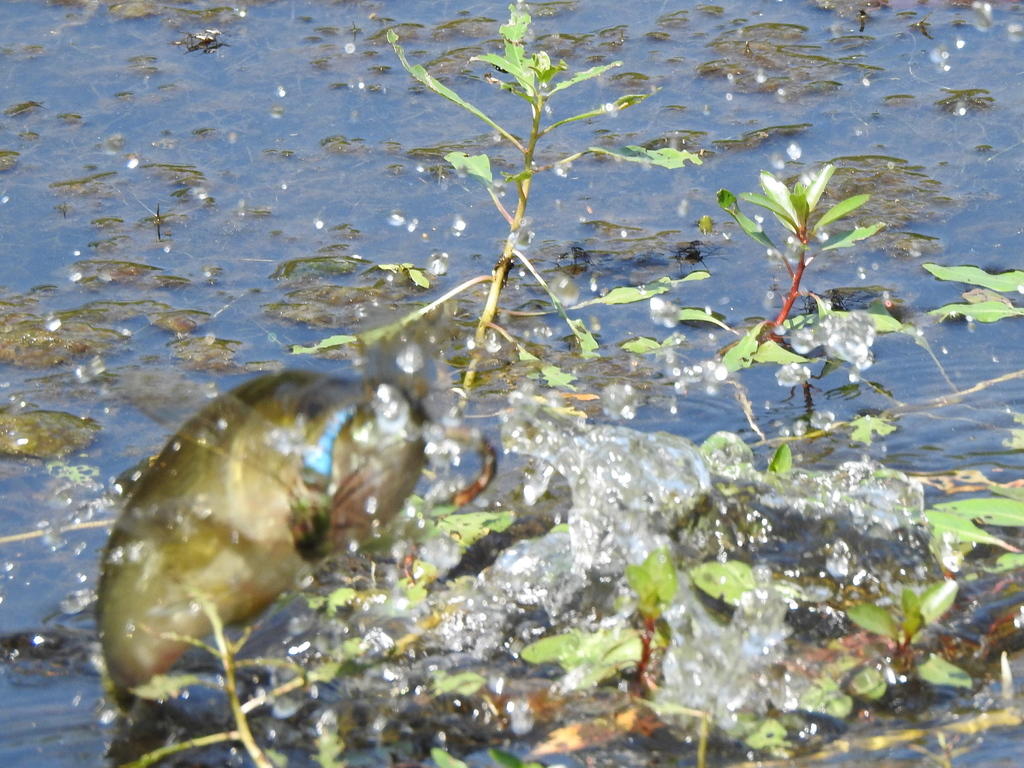
Largemouth Bass (Micropterus salmoides) lives in freshwater across North American Freshwater. It feeds on fish and crustaceans. Its conservation status is Least Concern.
Fascinating facts about the Largemouth Bass
- The largemouth bass holds the title of the biggest black bass, with the longest individual measured at 29.5 inches (75 cm). An unofficial heavyweight reached 25 lb 1 oz (11.4 kg), underscoring its formidable size. Females tend to outgrow males, and individuals typically live between ten and sixteen years in the wild, giving them ample time to achieve such dimensions.
- The IGFA's world-record largemouth bass is shared by two anglers because the governing body requires a new record to exceed the previous one by at least two ounces. Manabu Kurita landed a 10.12 kg (22 lb 5 oz) specimen from Lake Biwa in Japan on 2 July 2009, while George W. Perry's 10.09 kg (22 lb 4 oz) catch came from Montgomery Lake, Georgia, on 2 June 1932. The narrow margin keeps both fish on the record list.
- A largemouth bass can swallow prey that is half its own length or even larger, a testament to its powerful jaws. In the wild, adults often target smaller fish such as bluegill, shad and perch, but they will also take sizable crayfish and amphibians. This ability to handle large meals allows them to dominate as apex predators in many freshwater habitats.
- The upper jaw of a largemouth bass extends beyond the rear margin of the orbit, giving it a noticeably protruding mouth. This feature is part of an overall olive-green to greenish-gray colouration marked by dark blotches that run in a jagged horizontal stripe along each side. As the largest of the black basses, it can grow to a recorded length of 29.5 in (75 cm), a size that benefits from the extra reach of its jaw when seizing prey.
- Largemouth bass have been blamed for wiping out the Atitlán grebe, a large waterbird once native to Guatemala's Lake Atitlán, with their predation contributing to the bird's extinction. This impact mirrors other invasive effects, such as declines of native fish in Namibia and Canada, where the bass outcompete and prey on local species.
Sources
Every fact above was checked against these pages, and kept only where one of them states it.
At a glance
RangeNorth American Freshwater
HabitatFreshwater
DietFish and crustaceans
About the Largemouth Bass
In the warm, languid waters of North America, the largemouth bass reigns as a master of stealth and ambush, its mottled green and brown form blending seamlessly into the shadows as it lies in wait for unsuspecting prey. With a powerful tail and agile fins, it darts through the aquatic landscape with a swift, economical motion, its very presence seeming to embody the patient, calculating spirit of the hunt. As it glides effortlessly through the water, its large, gaping mouth open in anticipation, the largemouth bass is a testament to the enduring power and beauty of evolution.
Hear the Largemouth Bass, and 4,400+ more
Real recorded sounds, 11 nature games and a free Daily 5, 1v1 quiz duels, conservation wins and a safe Kids mode. Free on Feravox.