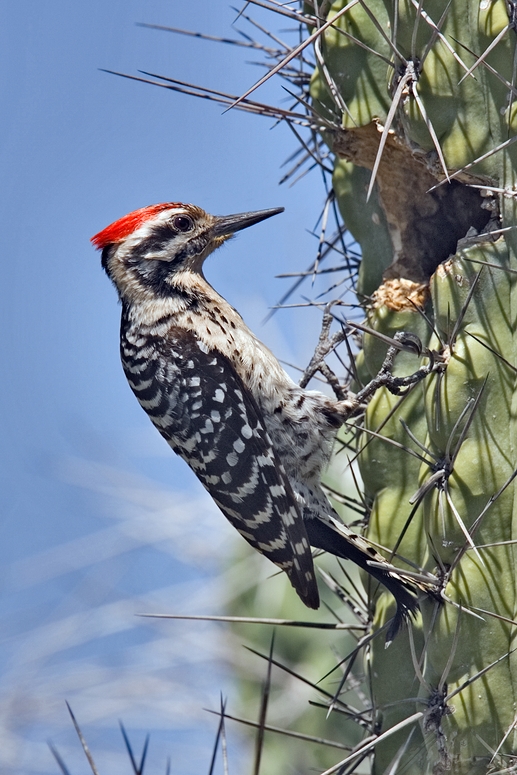
Ladder-Backed Woodpecker (Dryobates scalaris) lives in desert woodland across Southwestern United States, Mexico. Its conservation status is Least Concern.
Fascinating facts about the Ladder-Backed Woodpecker
- The ladder-backed woodpecker's plumage is chiefly black and white, and the feathers on its back and wings form a distinct barred pattern that looks like the rungs of a ladder. This striking design gives the species its common name and makes it easy to recognise in the field.
- Ladder-backed woodpeckers create their nests by excavating cavities in tree trunks, and in desert habitats they will also drill a hole in a large cactus to raise their young. The female typically lays between two and seven plain-white eggs in these chambers. Both the male and female share the responsibility of incubating the clutch until hatching, a cooperative behaviour common among woodpeckers.
- Like most woodpeckers, the ladder-backed woodpecker uses its chisel-like bill to bore into tree trunks in search of insects and their larvae, providing a reliable protein source. In addition to this insect diet, it also consumes the fruit produced by cacti, especially in the arid parts of its range where such resources are abundant. This mixed feeding strategy allows the bird to thrive across a variety of dry brushy habitats.
- Birds from the southern part of its range display a duskier buff colour on the breast and possess a noticeably smaller bill than those from the north. This colouration and bill size difference is a consistent regional variation within the species. The ladder-backed woodpecker overall measures only 16.5 to 19 cm in length, a modest size for a woodpecker, which makes these subtle southern traits easy to spot in the field.
- Its year-round range stretches from the extreme southern tip of Nevada and the extreme southeastern corner of Colorado, across most of Mexico, and down to Nicaragua in Central America. Within this broad area the bird is fairly common in dry brushy areas and thickets, habitats it favours throughout its distribution. These locations provide the trees and cacti needed for nesting and feeding, supporting its presence across the whole range.
Sources
Every fact above was checked against these pages, and kept only where one of them states it.
At a glance
RangeSouthwestern United States, Mexico
HabitatDesert woodland
DietInsects and sap
About the Ladder-Backed Woodpecker
In the sun-dappled canyons of the American Southwest, the Ladder-Backed Woodpecker dances across the desert landscape, its black and white stripes glistening like polished onyx as it flits from cactus to cactus. With each swift, decisive movement, this diminutive bird weaves a intricate narrative of survival and adaptation, its chisel-tipped beak probing the arid terrain for hidden insects and succulent sap. As it drums out its territorial rhythms on the resonant trunks of palo verde trees, the Ladder-Backed Woodpecker embodies the very essence of desert resilience, a tiny, indomitable spirit that thrives in one of the harshest yet most beautiful environments on Earth.
Hear the Ladder-Backed Woodpecker, and 4,400+ more
Real recorded sounds, 11 nature games and a free Daily 5, 1v1 quiz duels, conservation wins and a safe Kids mode. Free on Feravox.