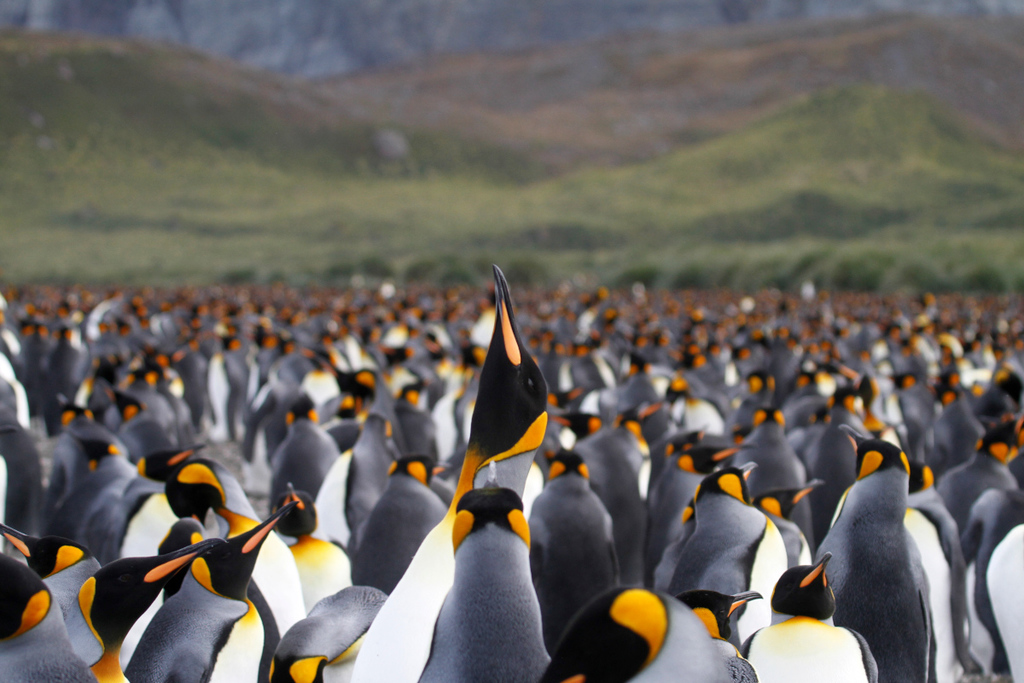
King Penguin (Aptenodytes patagonicus) lives in subantarctic islands and cold ocean across Subantarctic. It feeds on fish and krill. Its conservation status is Least Concern.
Fascinating facts about the King Penguin
- King penguins routinely plunge deeper than a 30-story building, diving past 300 metres (1,000 ft) and once hitting a record 343 metres in the Falklands. Their longest recorded submersion lasted 552 seconds, and daylight foraging dives usually last about five minutes. These extreme depths let them chase lanternfish and squid far below the surface, showing how their physiology pushes the limits of avian diving.
- Around 2.23 million breeding pairs of king penguins now roost across the sub-Antarctic, with the biggest colonies on the Crozet Islands (≈455,000 pairs) and Prince Edward Islands (228,000 pairs). Kerguelen hosts 240,000-280,000 pairs and South Georgia over 100,000. Single colonies can hold staggering numbers, Salisbury Plain on South Georgia houses more than 30,000 pairs, while St. Andrew's Bay supports over 150,000.
- A king penguin's life-cycle stretches over a year and a half: from laying a 300 g egg to fledging takes 14-16 months, the longest of any penguin. After about 55 days of incubation, parents guard the chick for 30-40 days, then raise it in crèches until it can survive on its own. Because the cycle is so prolonged, pairs only breed successfully every one or two years, and fidelity between years drops below 30%.
- Climate models warn that in less than 80 years, 70 % of king penguins could vanish as warming pushes their Antarctic Convergence farther poleward. To keep feeding, they may need to travel an extra 200 km (120 mi) each foraging trip, and nearly half of the world's colonies could lose their breeding grounds by 2100. These projections show how tightly the species is linked to a narrow oceanic band and why safeguarding that habitat is a climate-change priority.
- Standing 70-100 cm tall and weighing 9.3-18 kg, king penguins are the second-largest penguin species. Some individuals bulk up to about 20 kg before molting, yet they are still roughly 25 % shorter and a third lighter than their emperor cousins.
Sources
Every fact above was checked against these pages, and kept only where one of them states it.
At a glance
RangeSubantarctic
HabitatSubantarctic islands and cold ocean
DietFish and krill
About the King Penguin
In the unforgiving yet majestic landscapes of the Antarctic, the King Penguin reigns supreme, its regal demeanor and tuxedo-like feathers a testament to its adaptability and resilience in one of the harshest environments on Earth. With a waddling gait that belies its remarkable agility, the King Penguin moves with purpose, its flippers propelling it through the icy waters with a speed and grace that is both captivating and humbling. As it emerges from the sea, shaking its feathers with a dignified flourish, the King Penguin stands as a symbol of the unyielding power and beauty of the natural world.
Hear the King Penguin, and 4,400+ more
Real recorded sounds, 11 nature games and a free Daily 5, 1v1 quiz duels, conservation wins and a safe Kids mode. Free on Feravox.
King Penguin photographed on Feravox