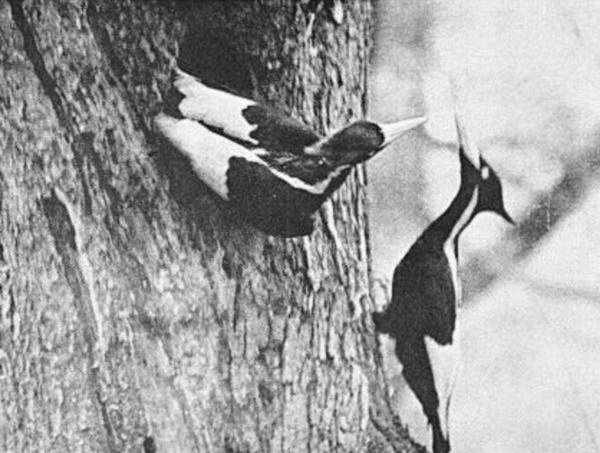
Ivory-billed Woodpecker (Campephilus principalis) lives in old-growth bottomland forest across Southeastern United States and Cuba. Its conservation status is Critically Endangered.
Fascinating facts about the Ivory-billed Woodpecker
- At roughly 51 cm (20 in) long with a 76 cm (30 in) wingspan, the ivory-billed woodpecker weighs about 450-570 g, making it the largest woodpecker in the United States and one of the world's biggest. Such dimensions let it hammer bark like a chisel, opening dead trees for larvae that smaller woodpeckers can't reach, underscoring its role as a unique forest engineer.
- The bird once roamed from eastern Texas to North Carolina and down to Cuba, favoring bottom-land hardwood swamps and temperate conifer forests. Habitat loss and hunting drove it to the brink; the last universally accepted U.S. sighting was in 1944 and the last Cuban record in 1987. Even today, the U.S. Fish and Wildlife Service is still debating whether to declare it extinct, highlighting how recent its disappearance is.
- Roughly half of its recorded stomach contents were large beetle larvae, especially wood-boring Cerambycidae, while the rest held nuts, fruits and seeds. The bird wedges bark from dead trees with its massive, chisel-shaped bill to expose the larvae tunnels, and within its range it faces no real competitor for this food. This specialization lets it exploit a niche no other North American woodpecker can, linking its survival to the presence of dying trees.
- Ivory-billed pairs are monogamous, building a new cavity each year 15-70 ft (4.6-21.3 m) above ground in a living or partially dead tree. Nests are about 12-14 cm tall by 10 cm wide, up to 150 cm deep. Clutches usually hold three glossy white eggs, but up to six have been recorded; incubation lasts roughly 20 days. Both parents share incubation and feeding, and the young stay with them for months, showing an unusually long family bond for a woodpecker.
- Individuals can travel up to 4 km from their nest, giving each bird a home range of about 50 km²; Cuban birds may need as much as 65 km². Such expansive territories mean the species depends on huge, uninterrupted tracts of forest with plenty of dead trees. When those forests were logged in the 19th century, the woodpecker's required space vanished, explaining why even tiny habitat fragments cannot sustain viable populations.
Sources
Every fact above was checked against these pages, and kept only where one of them states it.
At a glance
RangeSoutheastern United States and Cuba
HabitatOld-growth bottomland forest
DietInsects and sap
About the Ivory-billed Woodpecker
Deep within the primeval forests of the southeastern United States, the Ivory-billed Woodpecker, a majestic and elusive creature, moves with deliberate silence, its sleek black body undulating through the misty veil of the woodland canopy. With each powerful stroke of its chisel-like beak, the woodpecker excavates a labyrinthine world of insect-filled cavities, its drumming calls echoing through the trees like a haunting requiem. As it vanishes into the emerald shadows, this critically endangered bird leaves behind a whispered promise of a bygone era, a fleeting glimpse of a world unspoiled and untouched.
Hear the Ivory-billed Woodpecker, and 4,400+ more
Real recorded sounds, 11 nature games and a free Daily 5, 1v1 quiz duels, conservation wins and a safe Kids mode. Free on Feravox.