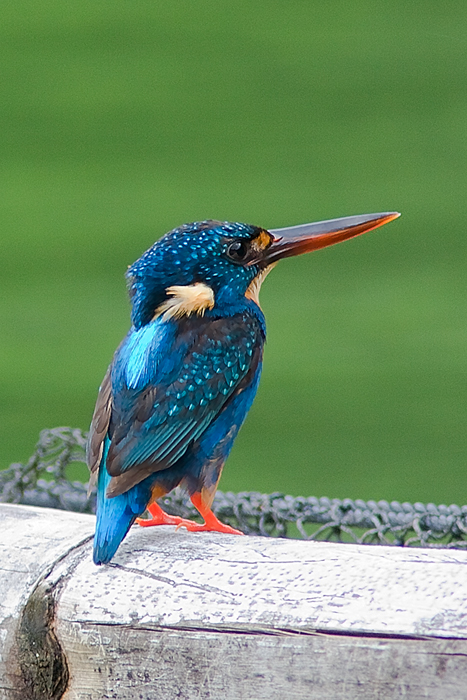
Indigo-banded Kingfisher (Ceyx cyanopectus) lives in forest streams across Philippines. It feeds on insects and fish. Its conservation status is Least Concern.
Fascinating facts about the Indigo-banded Kingfisher
- The indigo-banded kingfisher lives only within the Philippines, its range limited to a handful of islands. It is found on Luzon, Mindoro and Masbate as well as the Western Visayas region, which includes the islands of Panay, Negros and Cebu. The two recognised subspecies reflect this split, with the northern form occurring on Luzon, Polillo, Mindoro, Sibuyan, Masbate and Ticao, and the southern form on Panay, Negros and Cebu.
- Southern indigo-banded kingfishers are distinguished by an all-black bill, whereas their northern counterparts display a red lower mandible and a broader swathe of blue along the bill sides. These colour differences align with the two subspecies, C. nigriostris in the south and C. cyanopectus in the north. The Handbook of the Birds of the World even treats them as separate species based on these morphological traits.
- The southern indigo-banded kingfisher is estimated to number only between 1,000 and 2,499 mature individuals and its numbers are still falling. This small population is confined to the remaining forest fragments on islands such as Negros, where forest cover had shrunk to just 4 % by 1988, and to less-surveyed areas of Panay. The IUCN notes the species is uncommon in its range and continues to decline due to ongoing habitat loss.
- It perches on rocks, overhanging branches and foliage before launching into the water. The bird then dives steeply to seize fish or aquatic insects that swim below. After capture it returns to the same perch, beats the prey against the branch and swallows it whole. This hunting routine is carried out in the streams that wind through tropical moist lowland forest, its preferred habitat.
- It nests by digging tunnels into the banks of streams and rivers, creating a protected chamber for breeding. Although little is known about its overall breeding behaviour, these burrows provide a safe site for laying eggs and rearing chicks. The species chooses stream banks within its forested range, taking advantage of the soft, moist soil. Such nesting sites are essential for its reproduction in the lowland forest environment.
Sources
Every fact above was checked against these pages, and kept only where one of them states it.
At a glance
RangePhilippines
HabitatForest streams
DietInsects and fish
About the Indigo-banded Kingfisher
In the dwindling strongholds of its native habitat, the Indigo-banded Kingfisher flits with an air of iridescent urgency, its sapphire and emerald plumage flashing like a beacon as it darts between the shadows of a vanishing world. With each fleeting glimpse, this critically endangered bird seems to embody the very essence of its fragile ecosystem, its rapid, whip-like movements a testament to the frenetic energy that still pulses through the remnants of its forest home. As it alights upon a moss-encrusted branch, the kingfisher's bright, inquisitive gaze appears to hold a deep wisdom, a poignant awareness of the precarious balance that sustains it.
Hear the Indigo-banded Kingfisher, and 4,400+ more
Real recorded sounds, 11 nature games and a free Daily 5, 1v1 quiz duels, conservation wins and a safe Kids mode. Free on Feravox.