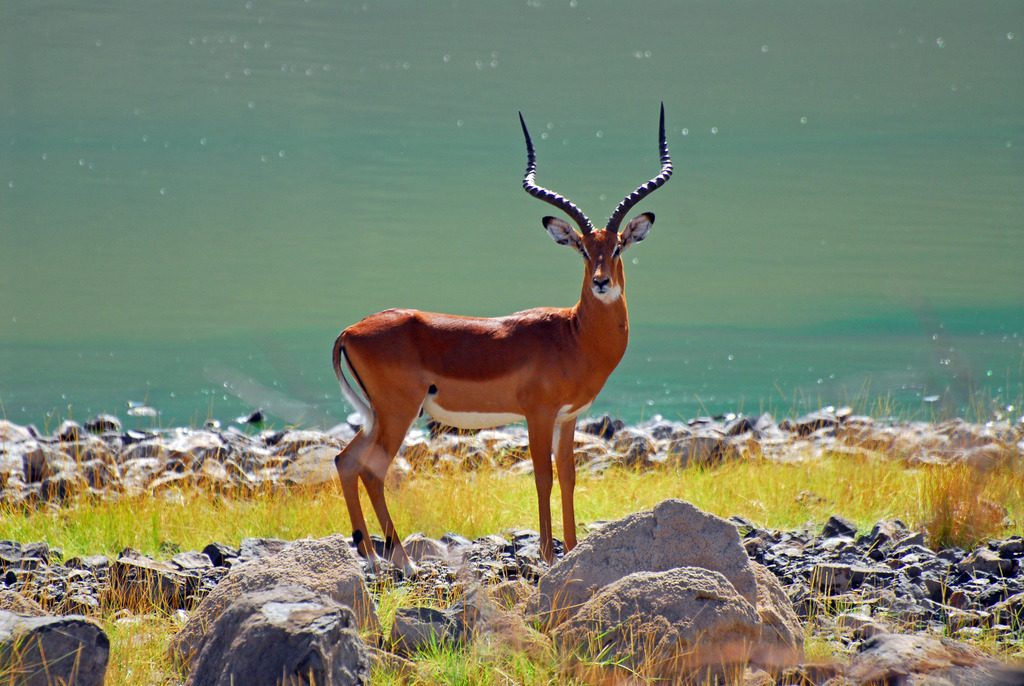
Impala (Aepyceros melampus) lives in savannah woodland, grassland edge across East and southern Africa. It feeds on grass and leaves. Its conservation status is Least Concern.
Fascinating facts about the Impala
- Impala pregnancies last six to seven months, after which a single calf is born and hidden in cover. The newborn stays concealed for the first few weeks, then joins a nursery group, and relies on its mother's milk for four to six months before weaning.
- Male impalas sport lyre-shaped horns that can reach up to 92 cm, longer than a school ruler laid end-to-end, and weigh between 53 and 76 kg. These massive, ridged horns interlock during fights, allowing males to throw off rivals and protect their skulls. The impressive weaponry underpins the intense territorial battles of the rut, shaping who gets to mate.
- Impala can launch themselves up to three metres into the air, and cover a horizontal distance of ten metres. This double-leap, which can be performed in any direction, confuses predators by making the antelope's trajectory unpredictable.
- The black-faced subspecies of impala is teetering on the brink, with fewer than one thousand individuals left in the wild as of 2008. This tiny population size places the subspecies in the vulnerable category.
- Female impala herds vary from six to a hundred animals and roam home ranges of 80-180 hectares. Bachelor groups stay small, never exceeding thirty members, while individuals keep a personal spacing of 2.5-3 m from one another.
Sources
Every fact above was checked against these pages, and kept only where one of them states it.
At a glance
RangeEast and southern Africa
HabitatSavannah woodland, grassland edge
DietGrass and leaves
About the Impala
In the golden light of dawn, the impala springs to life, its slender legs unfolding like a coiled spring as it bounds effortlessly across the sun-kissed savannah. With a gentle elegance, it navigates the grasslands, its large, dark eyes ever vigilant for the predators that lurk in the shadows, its very existence a testament to the enduring power of adaptability and grace. As it runs, its tawny coat glistens like polished copper, a fleeting glimpse of wild beauty in the heart of Africa's untamed wilderness.
Hear the Impala, and 4,400+ more
Real recorded sounds, 11 nature games and a free Daily 5, 1v1 quiz duels, conservation wins and a safe Kids mode. Free on Feravox.
Impala photographed on Feravox