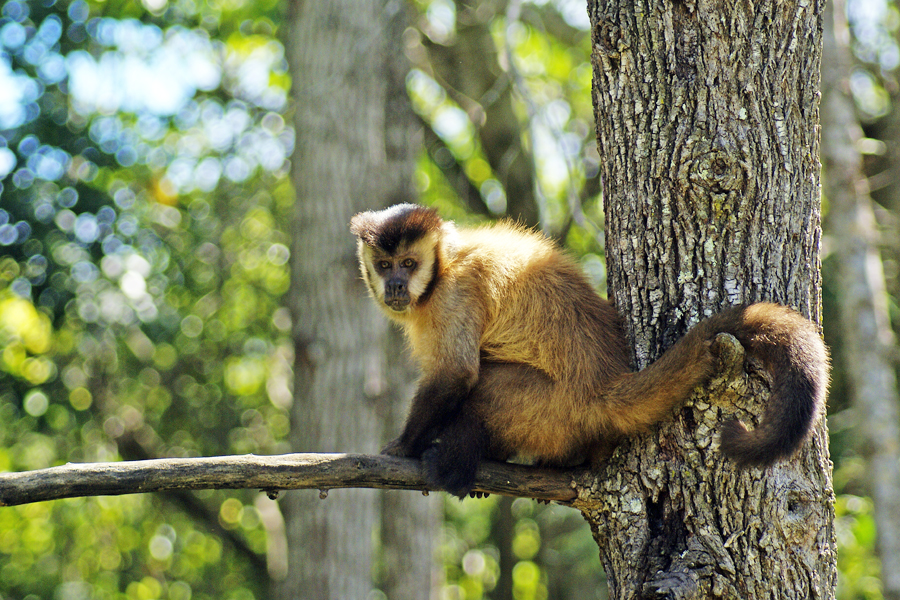
Hooded Capuchin (Sapajus cay) lives in tropical rainforest across South America. It feeds on fruits and insects. Its conservation status is Vulnerable.
Hear the Hooded Capuchin
A real field recording of the Hooded Capuchin, made in the wild.
The hooded capuchin occupies an extremely limited area of only about 200 hectares, roughly 500 acres. This tiny range is scattered across subtropical, humid, semi-deciduous gallery forests and the forested zones of the Pantanal. The climate there is hot and humid year-round with abundant rainfall and dense vegetation, and the monkeys can also use bushland and savanna patches within this mosaic.
In captivity hooded capuchins may live as long as 50 years, far exceeding the roughly 30-year average they reach in the wild. They attain sexual maturity relatively late, with females ready by four to five years and males not until about eight years of age. Such prolonged development and long potential lifespan give them ample time to acquire the complex foraging techniques and social knowledge characteristic of the species.
Capuchin troops can range from a handful of individuals to large bands of up to 44 members. Each group follows a multi-male, multi-female structure centred on an alpha male who is typically the biggest and most aggressive, controlling food access and mating opportunities. The parties move together continuously within their home range, rarely venturing beyond its borders except under extreme pressure.
Hooded capuchins use tools to access hard-shelled foods, gripping the fruit or seed with both hands and striking it against a branch that serves as an anvil. Although such items are not their preferred food, they form part of the diet and provide essential nutrients. High-ranking adults are especially adept at this technique, while lower-ranking individuals often wait for the leftovers after the dominant monkeys have processed the food.
Genetic evidence indicates that the robust Sapajus and the gracile Cebus lineages diverged roughly 6.2 million years ago when the Amazon River formed, separating the two groups. The river forced Cebus to expand northward into the Amazon rainforest and Sapajus to move southward toward the Atlantic forest. During the Pleistocene, Sapajus later spread north again, becoming sympatric with Cebus.
Sources
Every fact above was checked against these pages, and kept only where one of them states it.
In the lush canopies of South America, the hooded capuchin navigates its realm with effortless agility, its prehensile tail serving as a fifth limb as it leaps from branch to branch with a fluid, almost ethereal, grace. With eyes shining bright like dark jewels, this charismatic primate surveys its kingdom, its intelligent gaze drinking in every detail of its surroundings as it forages for fruit and insects with a nimble dexterity. As it moves, the hooded capuchin's very presence seems to embody the vibrant, unbridled energy of the tropical forest, its every motion a testament to the beauty and wonder of this captivating creature.
Advertisement
Hear the Hooded Capuchin, and 4,400+ more
Real recorded sounds, 11 nature games and a free Daily 5, 1v1 quiz duels, conservation wins and a safe Kids mode. Free on Feravox.