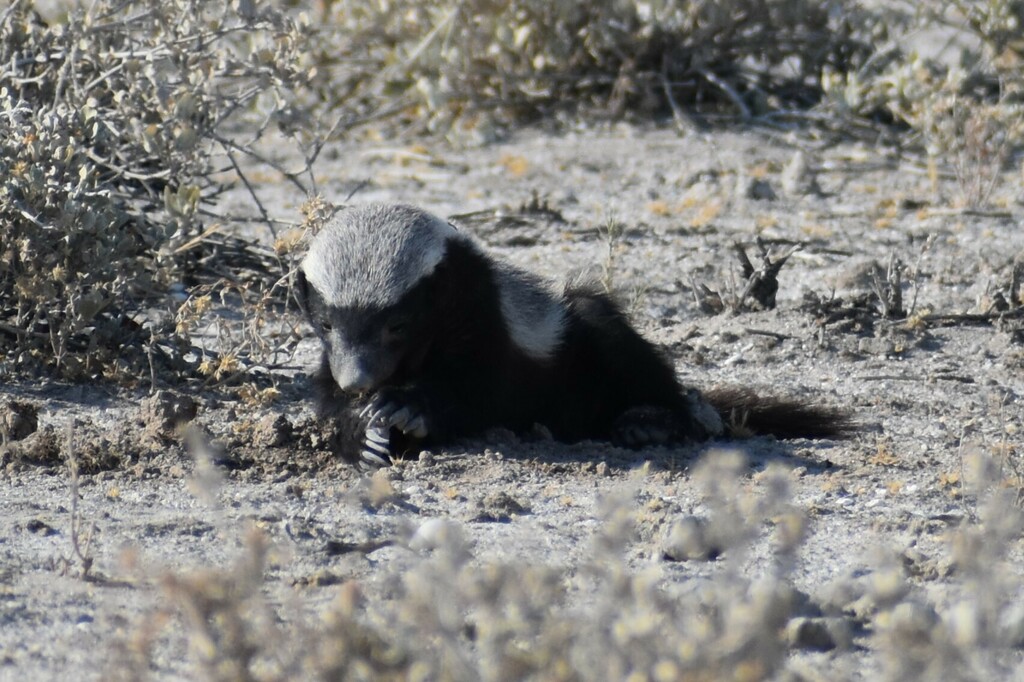
Honey Badger (Mellivora capensis) lives in savanna, forest, and desert across Africa and South Asia. It feeds on insects and carrion. Its conservation status is Least Concern.
Fascinating facts about the Honey Badger
- Honey badgers can twist inside their own skin like a sock puppet because their hide is both thick and loose. The skin around the neck is 6 mm (0.24 in) thick, an adaptation to fighting conspecifics. Its skin is remarkably loose, and allows the animal to turn and twist freely within it.
- Adult males have an average home range of 548 km² (212 sq mi), compared to females' average of 138 km² (53 sq mi). In the southern Kalahari region, adult male honey badgers have an average home range of 541 sq km, while adult females have a smaller average home range of 126 sq km. Such expansive ranges support their solitary, nomadic lifestyle and ensure access to scattered prey.
- Honey badgers eat almost anything that fits in their jaws, from insects to venomous snakes, and even break open turtle shells. The bulk of their prey comprised species weighing more than 100 g (3.5 oz) such as cobras, young Central African rock python and South African springhare. They often raid beehives in search of both bee larvae and honey, devouring all parts of their prey, including skin, hair, feathers, flesh and bones, holding their food down with their forepaws.
- Honey badgers can give birth any time of year after a short 50-70-day pregnancy, usually producing one or two blind, hairless cubs. After a gestation of 50-70 days, a female will give birth to an average of one to two cubs that will remain under her care for 1-1+1⁄4 years. Females care for their young for 1-1¼ years, teaching them hunting and climbing skills before the cubs become independent.
- In the wild honey badgers rarely live past a decade, but in captivity they can reaching two dozen years. Honey badgers in the wild tend to live between 7 and 8 years due to predation and risk of injury. In contrast, honey badgers bred in captivity live significantly longer, with a maximum lifespan of 26 years. This disparity highlights the pressures of natural predators and the protective benefit of human care.
Sources
Every fact above was checked against these pages, and kept only where one of them states it.
At a glance
RangeAfrica and South Asia
HabitatSavanna, forest, and desert
DietInsects and carrion
About the Honey Badger
In the scorching savannas and grasslands, the honey badger emerges as a fearless and formidable forager, its distinctive white stripes glistening like a badge of tenacity as it roots through the underbrush with unyielding determination. With a loose, ambling gait, it moves through the world with a sense of unapologetic ownership, its long claws and powerful jaws at the ready to unearth a succulent meal or defend against any would-be predator. As it snuffles and snorts, its distinctive, almost comical, appearance belies a fiercely resilient spirit that has earned it a reputation as one of the most unyielding creatures in the animal kingdom.
Hear the Honey Badger, and 4,400+ more
Real recorded sounds, 11 nature games and a free Daily 5, 1v1 quiz duels, conservation wins and a safe Kids mode. Free on Feravox.