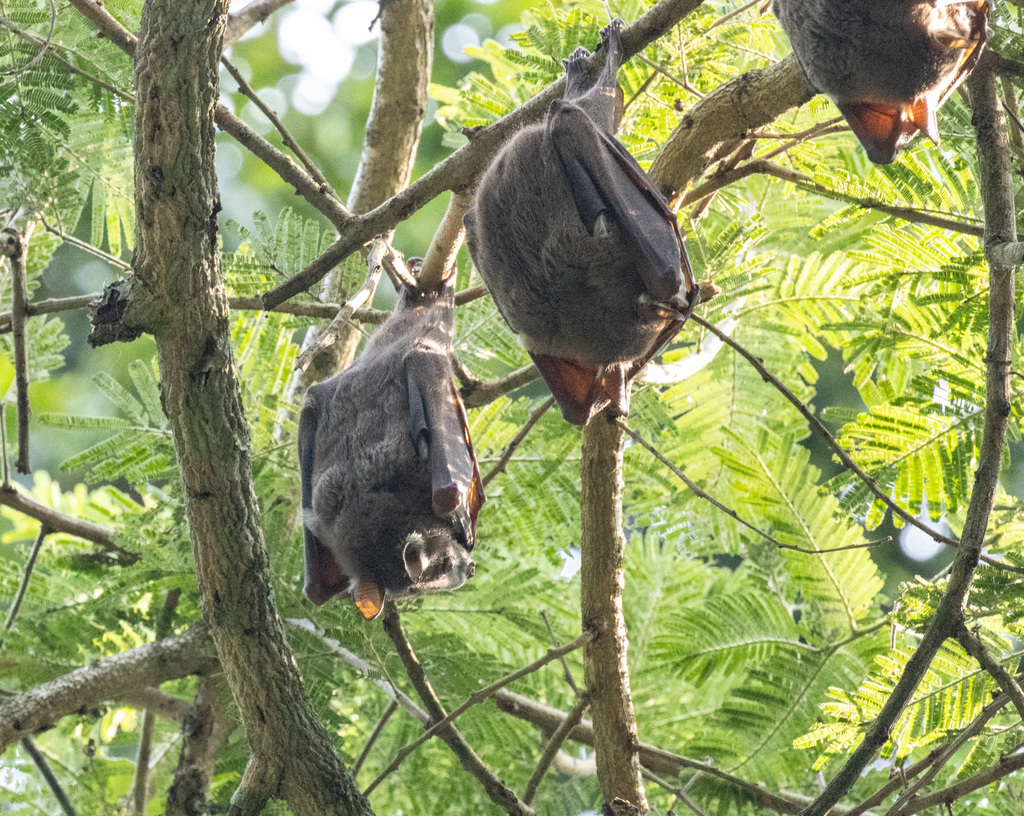
Hammer-headed Fruit Bat (Hypsignathus monstrosus) lives in tropical rainforest across Central Africa. It feeds on fruit and nectar. Its conservation status is Least Concern.
Hear the Hammer-headed Fruit Bat
A real field recording of the Hammer-headed Fruit Bat, made in the wild.
Fascinating facts about the Hammer-headed Fruit Bat
The hammer-headed bat holds the title of the biggest bat on mainland Africa, with males reaching a wingspan of up to 90.1 cm. All individuals have forearms longer than 112 mm, underscoring their robust build. Males average about 420 g in weight while females are roughly 234 g, meaning a male can be almost twice as heavy as a female. This extreme size difference makes the species the most sexually dimorphic bat known.
Male hammer-headed bats possess a voice box that is about three times larger than that of females and stretches half the length of the spine, occupying most of the thoracic cavity. This massive larynx pushes the heart, lungs and gastrointestinal tract aside to make room. In addition, they have specialised pharyngeal air-sacs and a large sinus in the humped snout that act as resonating chambers, amplifying their honks to extraordinary volumes.
Hammer-headed bats are the only bat species known to form a classical lek, where males line up along a riverbank and broadcast loud honks. A lek can host 20-135 males spread over an area about 40 m wide and 400-1,600 m long, each defending a roughly 10 m-diameter display territory. Within these territories males emit 60-120 honks per minute and flap their wings for up to four hours before foraging, with activity peaking at dusk and before dawn.
At the riverbank leks, only a tiny minority of males secure most of the matings; the top six percent achieve 79 % of all copulations while the majority never mate. These gatherings can hold between 20 and 135 males stretched over an area roughly 40 m wide and up to 1.6 km long. Females fly through the display, land beside a chosen male and trigger his final call before mating. The copulation itself is brief, lasting only thirty to sixty seconds.
Male hammer-headed bats use an unusual X0 sex-determination system, possessing a single X chromosome and lacking a Y chromosome, a pattern shared with only a few other bat genera. As a result, females carry 36 chromosomes - 34 autosomes plus a pair of sex chromosomes - while males have 35, the autosomes plus one X. This genetic arrangement is also found in the genera Epomophorus and Epomops.
Sources
Every fact above was checked against these pages, and kept only where one of them states it.
In the velvety blackness of the African night, a singular silhouette takes to the skies, its broad, hammer-shaped head a distinctive counterbalance to the delicate wings that propel it forward with hypnotic rhythm. As it swoops and dives, the Hammer-headed Fruit Bat navigates its world with an uncanny blend of elegance and brute force, its oversized cranium a testament to the remarkable vocal abilities that allow it to boom out a low-frequency call, a primal summons that echoes through the forest. With each beat of its wings, this nocturnal giant weaves a sonic tapestry that resonates deep within the heart of the tropical landscape.
Advertisement
Hear the Hammer-headed Fruit Bat, and 4,400+ more
Real recorded sounds, 11 nature games and a free Daily 5, 1v1 quiz duels, conservation wins and a safe Kids mode. Free on Feravox.