Photo: Ankur Nandi
Feravox · The Voice of the Wild
Gunther's Indian Gecko
Cyrtodactylus deccanensis
Least Concern
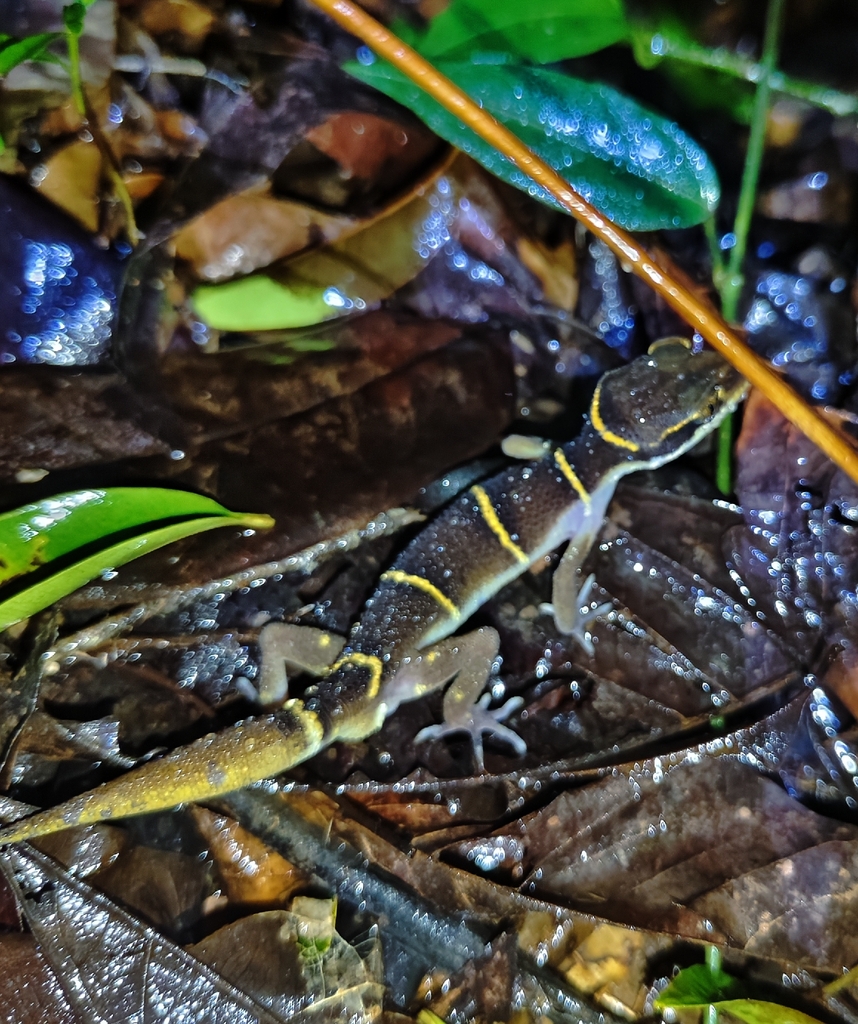
Gunther's Indian Gecko (Cyrtodactylus deccanensis) lives in forest floor across Northern Western Ghats. It feeds on insects and other arthropods. Its conservation status is Least Concern.
The Deccan ground gecko, Cyrtodactylus deccanensis, is a strikingly patterned reptile of the northern Western Ghats. Measuring about 2.5 inches from snout to vent with a tail nearly as long, its head is large and oviform, crowned with convex granules that are largest on the snout and temples. Its dorsal surface is a reddish-brown canvas crossed by narrow white, black-edged bands – a semicircular bar spanning the nape, a scapular stripe, two body bands, and a sacral bar – while the tail bears similar annular bands. The limbs are relatively long, ending in moderately elongated digits whose basal phalanges are cylindrical and distal portions compressed, giving the feet a subtly clawed appearance. Beneath, the belly is a clean whitish hue, and the tail tapers in a cylindrical fashion, covered in smooth, ring-arranged scales. This nocturnal gecko inhabits forest floors, where it prowls the leaf litter in search of insects, its diet wholly insectivorous. A surprising trait is its lack of preanal or femoral pores in males, a rarity among many gecko species, hinting at a unique reproductive physiology that remains poorly understood. Its range stretches from northern Maharashtra into southern Gujarat, with confirmed sightings in locales such as Sanjay Gandhi National Park, Phansad Wildlife Sanctuary, and the newly recorded Saputara Hills, underscoring a distribution that mirrors the fragmented yet biodiverse Western Ghats landscape. The species was first described by Günther in 1864 from a single specimen collected in the Deccan, then part of the Bombay Presidency. Though often hidden by night and the dense forest understory, the gecko’s distinctive banded pattern makes it a visual hallmark for those fortunate enough to encounter it on the forest floor. Some taxonomists still place it in the genus Geckoella, reflecting ongoing debates about its precise phylogenetic ties. Its robust, elongated body and the small, almost imperceptible tubercles under the basal phalanges hint at an adaptation for swift, silent movement across leaf litter, allowing it to ambush prey and evade predators in the dim understory.
Real recorded sounds, 11 nature games and a free Daily 5, 1v1 quiz duels, conservation wins and a safe Kids mode. Free on Feravox.