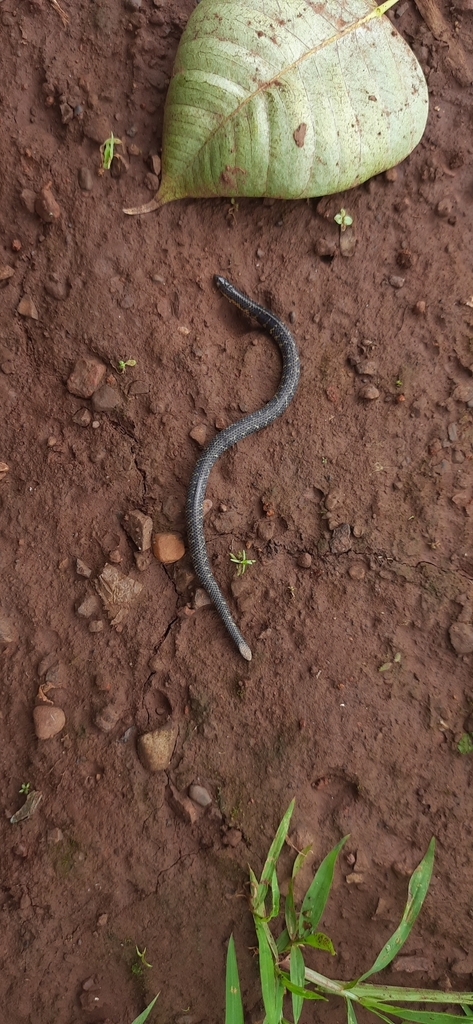
Photo: Sayee Girdhari
Feravox · The Voice of the Wild
Bombay Earth Snake
Uropeltis macrolepis
Least Concern
Bombay Earth Snake (Uropeltis macrolepis) lives in forest across Maharashtra, India. It feeds on earthworms and soil invertebrates. Its conservation status is Least Concern.
The Bombay earth snake, Uropeltis macrolepis, glides through the forest floor of Maharashtra like a living ribbon of midnight, its black or dark purplish-brown skin edged with faintly lighter scales. A flash of yellow decorates its lips and the sides of its neck, followed by two to five bold yellow spots, and a twin yellow stripe that traces each side of its short, truncate tail. Adults reach just under 30 cm in total length, their bodies slender enough that 24 to 29 of them could be measured along the snake’s length. The head is rounded, the rostral scale modest, and the eyes sit behind a large ocular shield, giving the creature a subtle, watchful appearance as it navigates the leaf litter. Its smooth dorsal scales are arranged in fifteen rows at mid-body, and the ventrals, twice the size of the surrounding scales, propel it through the soil with a silent, fossorial grace. Living at elevations from 10 to 1,350 m, this terrestrial specialist favors forest habitats where earthworms abound, its sole prey. The snake’s ovoviviparous reproduction means the young develop inside the mother before being born live, a surprising trait among reptiles that underscores its adaptation to a hidden, underground life. As it burrows, the terminal tail scale, bicarinate with a transverse ridge and two points, acts like a tiny shovel, helping it push through compact earth while remaining virtually invisible to predators and researchers alike, hinting at a world beneath the canopy that is still largely unseen
Real recorded sounds, 11 nature games and a free Daily 5, 1v1 quiz duels, conservation wins and a safe Kids mode. Free on Feravox.