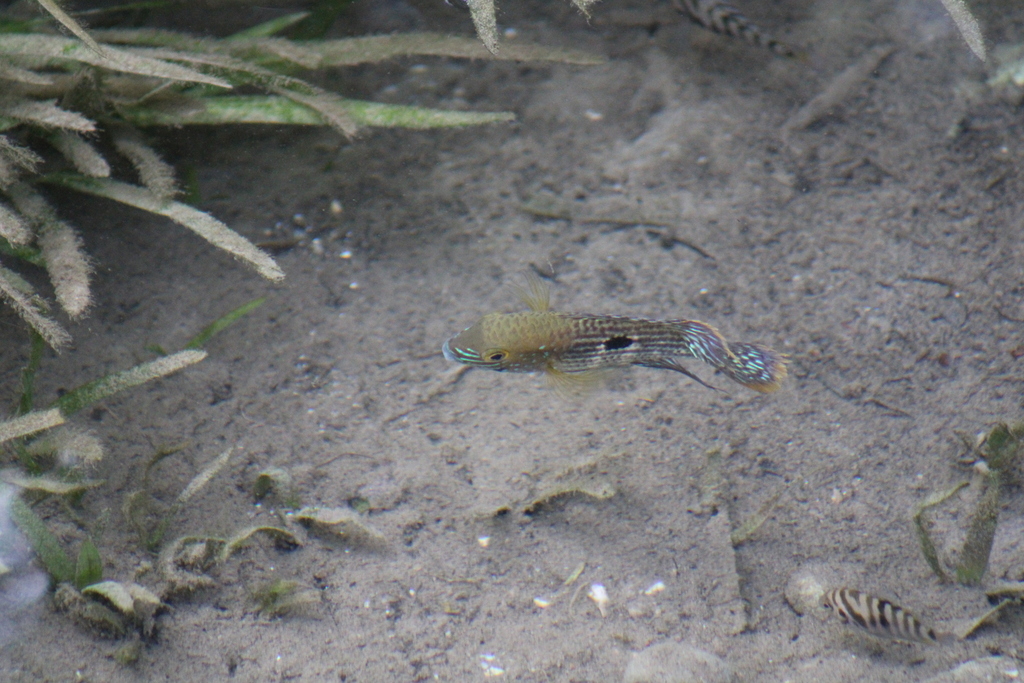
Photo: Philip Schaffer
Feravox · The Voice of the Wild
Green Terror
Andinoacara rivulatus
Least Concern
Green Terror (Andinoacara rivulatus) lives in tropical freshwater rivers across Peru and Ecuador. It feeds on carnivorous opportunistic. Its conservation status is Least Concern.
The green terror (Andinoacara rivulatus) dazzles with its iridescent blues, greens and oranges, a palette that deepens as the fish matures. Juveniles begin life tan, speckled with silver-blue flecks, then develop the striking, flowing fins and vivid coloration of adults, while males grow a pronounced fatty forehead hump that sets them apart from the more modest females, who reach sexual maturity at about 12 cm (4.7 in). In the wild these cichlids inhabit the Pacific-draining rivers of South America, from Peru’s Tumbes River to Ecuador’s Esmeraldas River, thriving in tropical waters with a pH of 6.5–8.0, hardness around 25 dGH, and temperatures of 20–24 °C (68–75 °F). Their deep-bodied shape and prominent forehead aid in both territorial displays and the fierce bouts that give the species its name; yet, not every individual is a bully, and peaceful specimens can be found among the typically aggressive juveniles and adults. In the aquarium trade the green terror is prized for its hardiness and visual appeal, often sold as juveniles that will later swell to lengths of 15–20 cm (5.9–7.9 in) in captivity, with some males reaching the full 30 cm (12 in). Their aggressive nature makes them adept at cohabiting with similarly bold cichlids, Jack Dempsey, midas, firemouth, and even larger predators like wolf and jaguar cichlids, provided the tank offers enough space and hiding places. Beyond aesthetics, A. rivulatus has contributed to scientific inquiry, serving as a model for studying testosterone’s effect on brain lateralization, a surprising link between flamboyant courtship and neuroendocrine pathways that underscores the species’ value far beyond the hobbyist’s aquarium.
Real recorded sounds, 11 nature games and a free Daily 5, 1v1 quiz duels, conservation wins and a safe Kids mode. Free on Feravox.