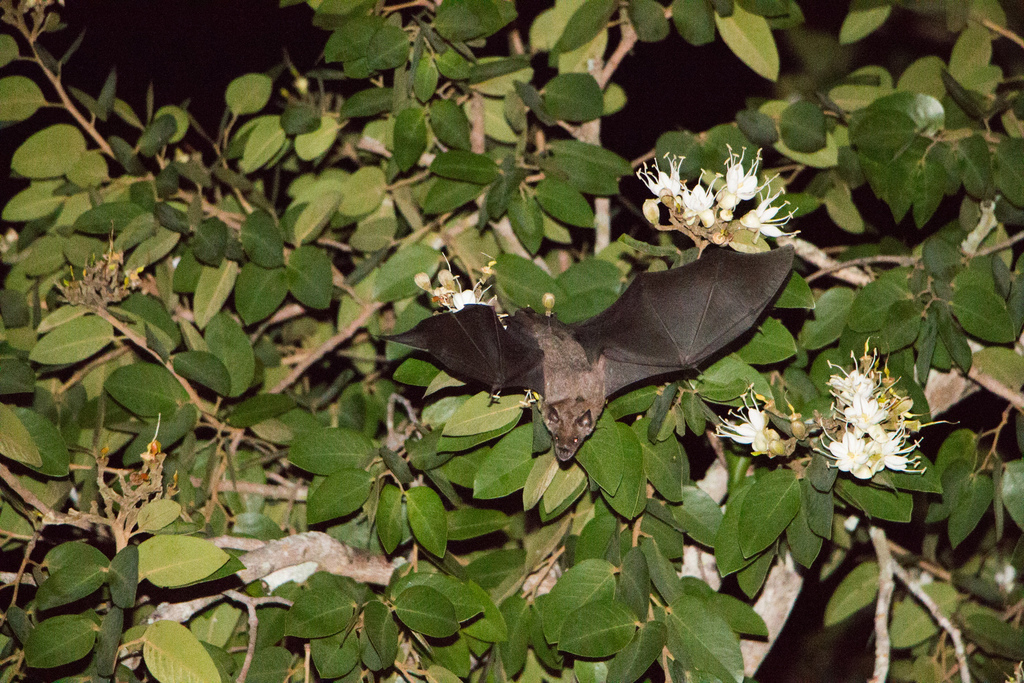
Greater Spear-nosed Bat (Phyllostomus hastatus) lives in tropical rainforest across Central and South America. Its conservation status is Least Concern.
Fascinating facts about the Greater Spear-nosed Bat
- At about 4-5 in long, the greater spear-nosed bat stretches a 455 mm wingspan yet tips the scales at only 81 g, making it one of the region's larger but light flyers. Its body length ranges from 100-130 mm, giving it a sleek silhouette for agile night hunting. This combination of size and feather-light mass lets the bat cover large distances in the patchy tropical landscapes it roams.
- Colonies range from ten to a hundred individuals, split into harems and bachelor groups. One dominant male may control up to thirty females, with the average harem holding eighteen members, while the remaining 80 % of males and young females form a large bachelor cohort. Lone males sometimes travel as far as 9 km (5.6 mi) to find feeding sites, highlighting the social pressure to secure resources close to the roost.
- Reproduction follows a tight annual calendar: pregnancy runs February-April, lactation May-mid-July, a resting anoestrous phase mid-July-late October, and a new oestrous period late October-February. Females give birth to a single pup, and the low birth rate, only one offspring per year, means population growth hinges on the survival of each juvenile, making the species vulnerable to disturbances that raise pup mortality.
- Beyond pollinating crops, these bats are forest engineers: they spread seeds of pioneer trees like Cecropia, Piper, Solanum and Vismia, especially after deforestation in French Guiana. By dispersing these fast-growing species, they accelerate habitat recovery and create stepping stones for later-successional plants, effectively expanding forest cover and restoring ecosystem resilience.
- Its sonar can pick out objects just 4 mm away, meaning echoes are separated by only 20 µs. Such razor-sharp resolution lets the bat detect tiny fruit pieces or hidden insects on the forest floor.
Sources
Every fact above was checked against these pages, and kept only where one of them states it.
At a glance
RangeCentral and South America
HabitatTropical rainforest
DietInsects and fruit
About the Greater Spear-nosed Bat
In the velvety blackness of a tropical night, the Greater Spear-nosed Bat unfurls its leathery wings, taking to the air with a soft whoosh as it embarks on its nocturnal forays. With echolocation calls that pierce the darkness like a series of high-pitched whip-cracks, this remarkable creature navigates the dense foliage, homing in on the sweet, juicy fruits that sustain it. As it flits through the shadows, its pointed snout and delicate, almost translucent wings imbue it with an otherworldly elegance, a true marvel of evolutionary adaptation.
Hear the Greater Spear-nosed Bat, and 4,400+ more
Real recorded sounds, 11 nature games and a free Daily 5, 1v1 quiz duels, conservation wins and a safe Kids mode. Free on Feravox.