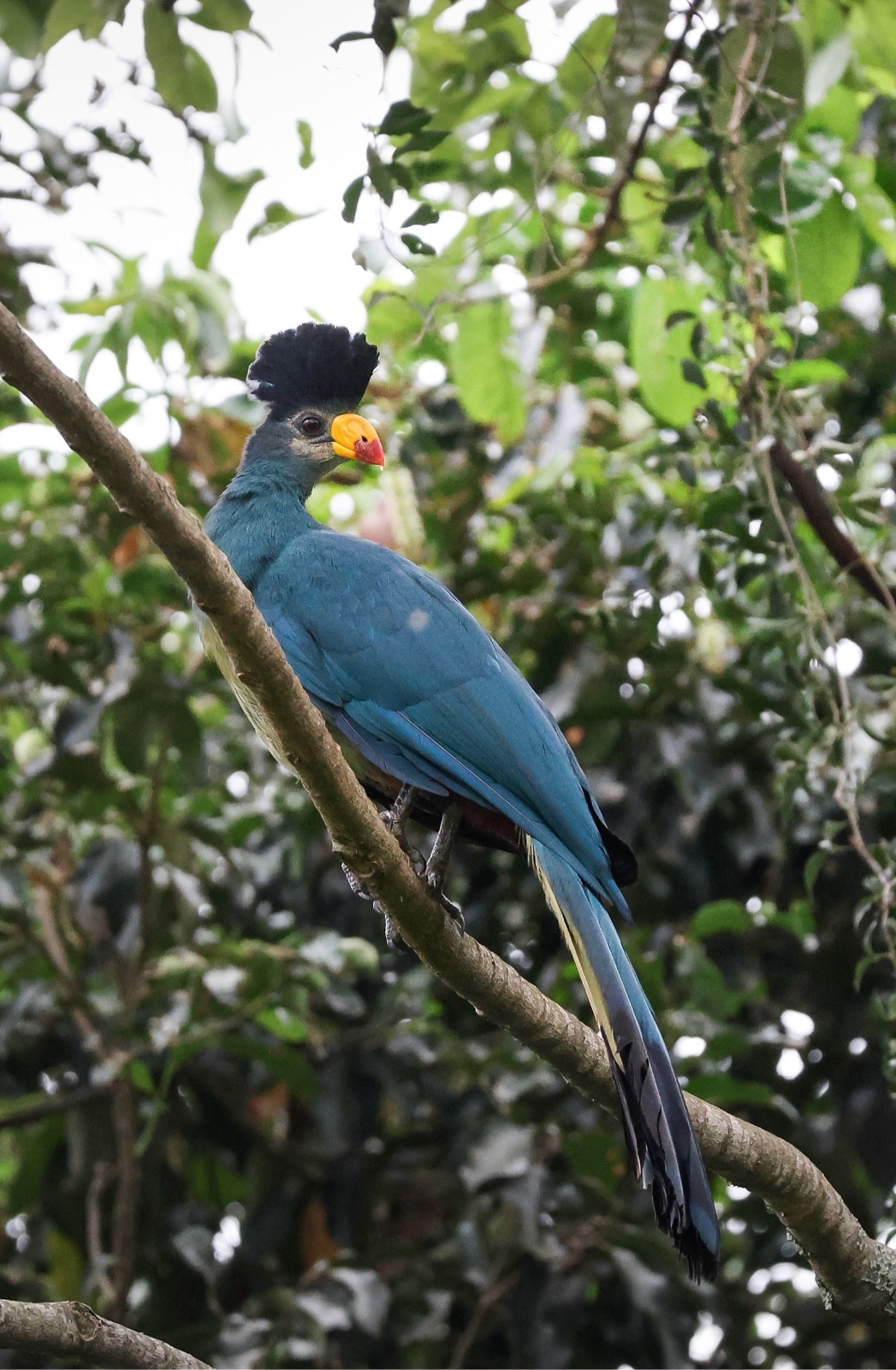
Photo: Ryan Nickol
Feravox · The Voice of the Wild
Great Blue Turaco
Corythaeola cristata
Least Concern
Great Blue Turaco (Corythaeola cristata) lives in tropical moist forest across West-Central Africa. It feeds on fruit and seed diet. Its conservation status is Least Concern.
Every fact above was checked against these pages, and kept only where one of them states it.
The Great Blue Turaco (Corythaeola cristata) is a living jewel of the African rainforest, its plumage a dazzling tapestry of iridescent blues and greens that shift like oil on water when caught in dappled sunlight. A long, crested head bears a striking white “V” on the throat, while the robust, black bill is perfectly adapted for cracking hard seeds. Its long, rounded tail ends in a subtle, feathered fan, and the bird’s legs are thick, pinkish‑gray, ending in strong claws that cling to moss‑covered branches. In the dense, humid understory of the Congo Basin, these turacos move with a deliberate grace, weaving through tangled vines and lianas, their calls—a resonant, low hoot—echoing through the canopy like a distant drum. They are largely frugivorous, favoring figs, wild bananas, and the bright berries of forest lianas, but they also supplement their diet with insects, especially during the breeding season when protein demands rise. Their digestive system is uniquely equipped with a specialized gizzard that crushes the tough seed coats, allowing them to disperse seeds over vast distances, a crucial service for forest regeneration. One surprising trait is their ability to produce a vivid, turquoise‑blue pigment called turacoverdin, a rare true blue pigment in birds that is chemically distinct from the structural blues seen in most avian plumage. This pigment is derived from dietary carotenoids, making the turaco a living indicator of forest health. Great Blue Turacos are monogamous, forming long‑term pair bonds that are reinforced by mutual preening and synchronized vocal duets at dawn. Nests are constructed high in the canopy, often in a forked branch, using a platform of twigs and leaves that blend seamlessly with the surrounding foliage. Both parents share incubation duties for the single white egg, and the chick, covered in downy gray feathers, is fed a diet rich in fruit pulp and insects until it fledges after about six weeks. Their territorial behavior is subtle; rather than aggressive chases, they defend their foraging range through a series of low, rattling calls that ripple through the understory, ensuring a steady supply of fruiting trees while maintaining the delicate balance of the rainforest ecosystem. The Great Blue Turaco’s presence is a vivid reminder of the intricate interdependence that defines tropical forest life, a story still unfolding in the shadows of towering mahoganies.
Real recorded sounds, 11 nature games and a free Daily 5, 1v1 quiz duels, conservation wins and a safe Kids mode. Free on Feravox.