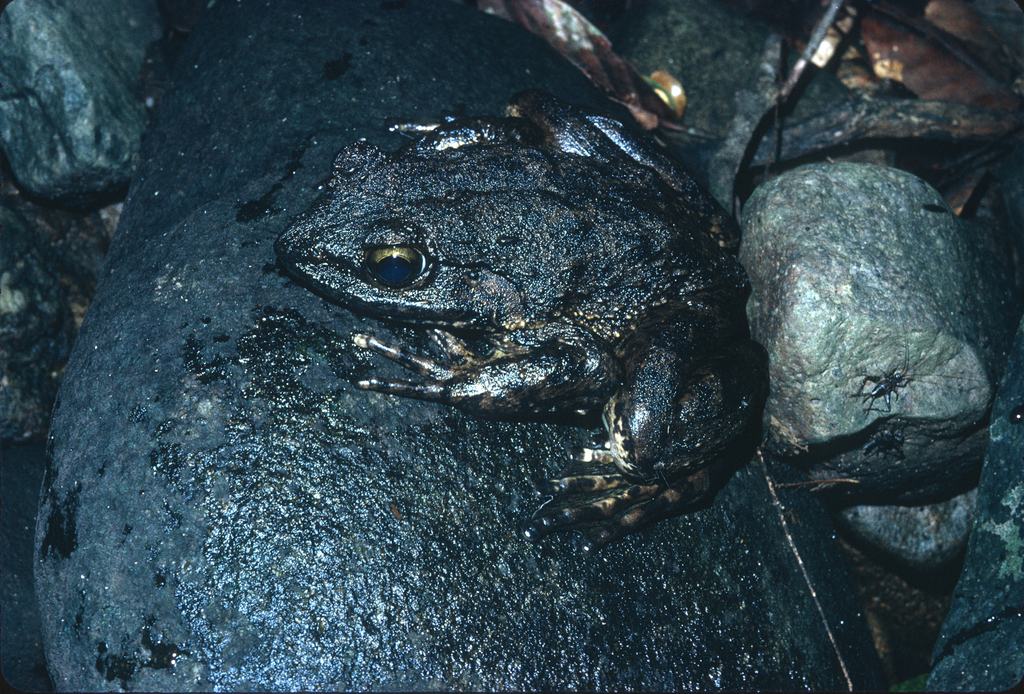
Goliath Frog (Conraua goliath) lives in tropical rainforest across Sub-Saharan Africa. It feeds on insects and fish. Its conservation status is Endangered.
Fascinating facts about the Goliath Frog
- The goliath frog is the largest living frog, with individuals reaching about 45 cm in snout-vent length and weighing up to 4.5 kg. It inhabits a very restricted area of dense equatorial forest fringe along rivers and waterfalls in Cameroon and Equatorial Guinea. Because its range is so small, the species is especially vulnerable to habitat loss, hunting for food and capture for the pet trade.
- The heaviest scientifically verified goliath frog weighed 3,305 g and measured 34.0 cm from snout to vent, a specimen caught in the Muni River system in 1960. The longest confirmed individual was recorded six years later in the same river, measuring 35.6 cm in snout-vent length and weighing 3,100 g. Although some reports claim even larger frogs. Together these records define the upper limits of the species' size.
- When breeding, the goliath frog can dig a new pool roughly 1 m wide and 10 cm deep, often moving large stones to create the nest. This is one of three recognised nest types, the others being cleared rock pools and expanded river-bank washouts. Adults have been observed guarding these nests at night, suggesting a role in protecting the eggs and developing tadpoles. The ability to construct such substantial nests may contribute to the frog's unusually large body size.
- Unlike most frogs, it has no vocal sac and therefore makes no mating calls. Because the goliath frog lacks a vocal sac, it does not produce mating calls, so courtship depends on visual signals and tactile contact between the pair. The females lay several hundred to a few thousand eggs, each about 3.5 mm, which are stuck to aquatic plants. Adults have also been shown to guard the nests at night, providing protection without the need for acoustic advertisement.
- Equatorial Guinea limits legal export to a maximum of 300 individuals per year for the pet trade. Due to their classification as an endangered species, the Equatorial Guinean government has declared that no more than 300 goliath frogs may be exported per year for the pet trade. This restriction is intended to curb over-harvesting, although recent reports indicate that few frogs are now actually exported from the country.
Sources
Every fact above was checked against these pages, and kept only where one of them states it.
At a glance
RangeSub-Saharan Africa
HabitatTropical rainforest
DietInsects and fish
About the Goliath Frog
In the mystical depths of West Africa's rainforests, the Goliath Frog emerges as a leviathan of the amphibian world, its massive, green-gray form gliding effortlessly across moss-encrusted boulders and through crystal-clear streams. With a gentle yet purposeful gait, this endangered giant navigates its domain, its bulging eyes and delicate, almost translucent skin a testament to its remarkable adaptability in a world where human activity threatens its very existence. As it moves, the Goliath Frog embodies a primordial power, a reminder of the awe-inspiring beauty and fragility that still persists in the most remote and forgotten corners of our planet.
Hear the Goliath Frog, and 4,400+ more
Real recorded sounds, 11 nature games and a free Daily 5, 1v1 quiz duels, conservation wins and a safe Kids mode. Free on Feravox.
More amphibians to discover