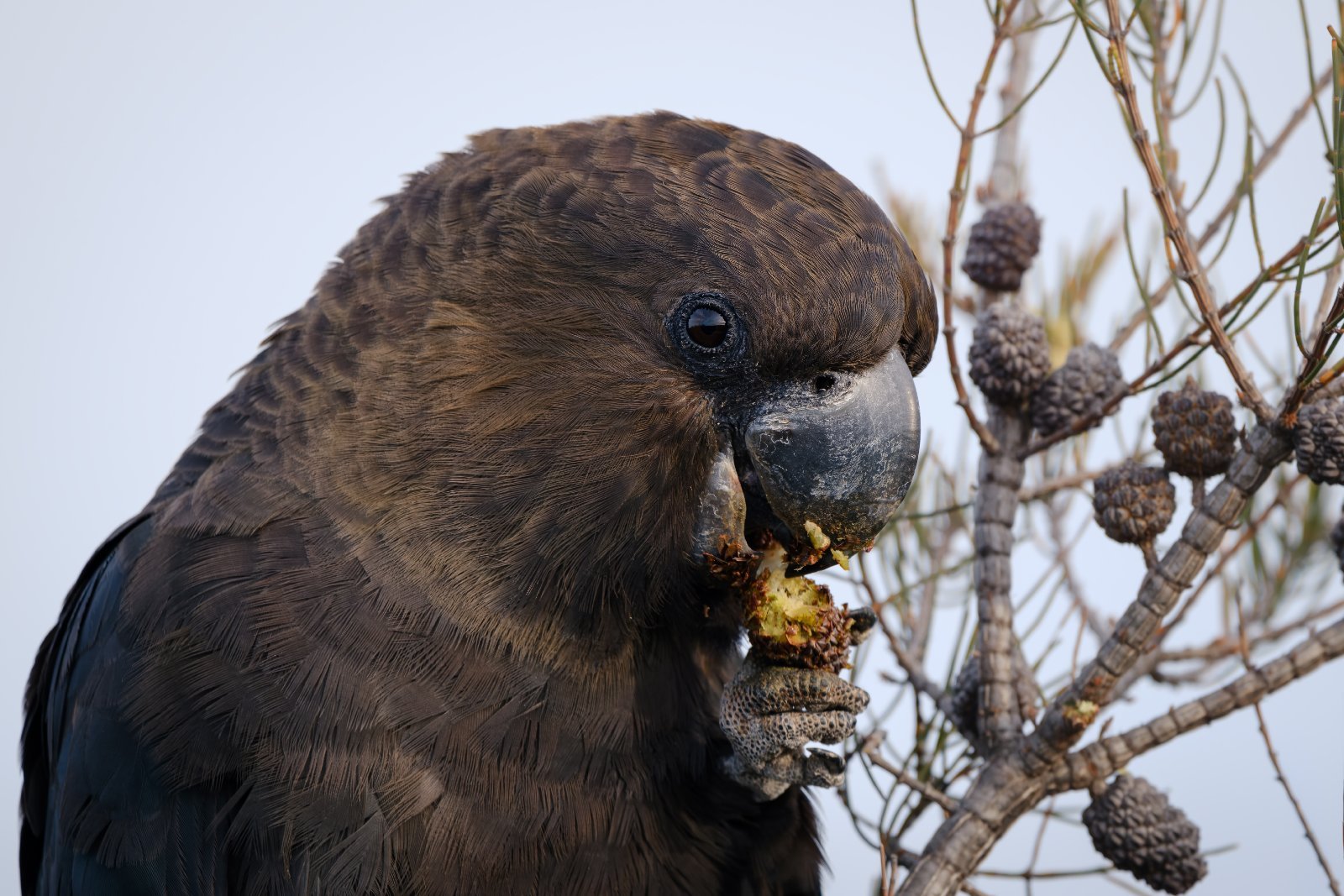
Glossy Black-cockatoo (Calyptorhynchus lathami) lives in open forest and casuarina woodlands from Southeastern Queensland to eastern Victoria, plus Kangaroo Island. Its conservation status is Vulnerable.
Fascinating facts about the Glossy Black-cockatoo
- The glossy black cockatoo is the smallest member of the subfamily Calyptorhynchinae, with adults measuring between 46 and 50 cm in length (18-19.5 in). It lives in eastern Australia, from southeastern Queensland down to Victoria, and manoeuvres among the thin branches of casuarina woodlands where it searches for seeds. Its powerful bill is adapted for cracking hard seeds.
- Males and females are strikingly different in colour. The male is predominantly blackish-brown with a prominent sub-terminal red tail band, while the female is dark brownish, bears an idiosyncratic yellow marking around the neck and displays a sub-terminal tail band of red crossed by black bars. This sexual dimorphism extends to the tail pattern, where the male's tail is patched and the female's tail is barred.
- The species feeds almost exclusively on the seeds of she-oaks and on sugar-gum cones. It shows a particular specialisation for the most recent season's cones of the drooping she-oak (Allocasuarina verticillata), preferring them over older cones of the same species and over cones of Allocasuarina littoralis. The bird grasps a cone in its foot, shreds it with its powerful bill and then extracts the seeds with its tongue.
- Two subspecies face very different conservation outlooks. The south-eastern subspecies (C. l. lathami) is listed as vulnerable under the EPBC Act, while the Kangaroo Island subspecies (C. l. halmaturinis) is listed as endangered. The island population once fell to as few as 158 individuals, recovered to about 370 in 2019, and a census in summer 2025/6 counted 446 birds. Threats include habitat loss, predation by common brush-tail possums, and the 2020 bushfires that burned one-third of the island. Conservation actions such as tin collars on tree trunks, canopy trimming, nest-box installation (now used by 80 % of breeding pairs), and planting of over a thousand drooping she-oak seedlings have helped the population rebound.
Sources
Every fact above was checked against these pages, and kept only where one of them states it.
At a glance
RangeSoutheastern Queensland to eastern Victoria, plus Kangaroo Island
HabitatOpen forest and casuarina woodlands
DietSeeds of she-oaks and sugar-gum cones
About the Glossy Black-cockatoo
The glossy black cockatoo (Calyptorhynchus lathami) is a medium-sized cockatoo measuring 46-50 cm in length, making it the smallest member of its subfamily. Males are blackish-brown with a vivid red tail band, while females are darker brown with yellow neck markings and a red-and-black barred tail. The bird inhabits open forest and woodlands across eastern Australia, from southeastern Queensland through Victoria, and is closely associated with casuarina woodlands. Its diet is dominated by the seeds of she-oaks, especially the newest cones of the drooping she-oak, and it also exploits sugar-gum cones, using its strong bill and tongue to extract seeds. This combination of size, striking sexual dimorphism, and specialised foraging ties the species tightly to the casuarina-dominated landscapes it calls home.
Common questions
What does the Glossy Black-cockatoo eat?
Diet: seeds of she-oaks and sugar-gum cones.
Where does the Glossy Black-cockatoo live?
Habitat: open forest and casuarina woodlands. Range: Southeastern Queensland to eastern Victoria, plus Kangaroo Island.
Is the Glossy Black-cockatoo endangered?
The Glossy Black-cockatoo is listed as Vulnerable on the IUCN Red List.
Hear the Glossy Black-cockatoo, and 4,400+ more
Real recorded sounds, 11 nature games and a free Daily 5, 1v1 quiz duels, conservation wins and a safe Kids mode. Free on Feravox.
Glossy Black-cockatoo photographed on Feravox