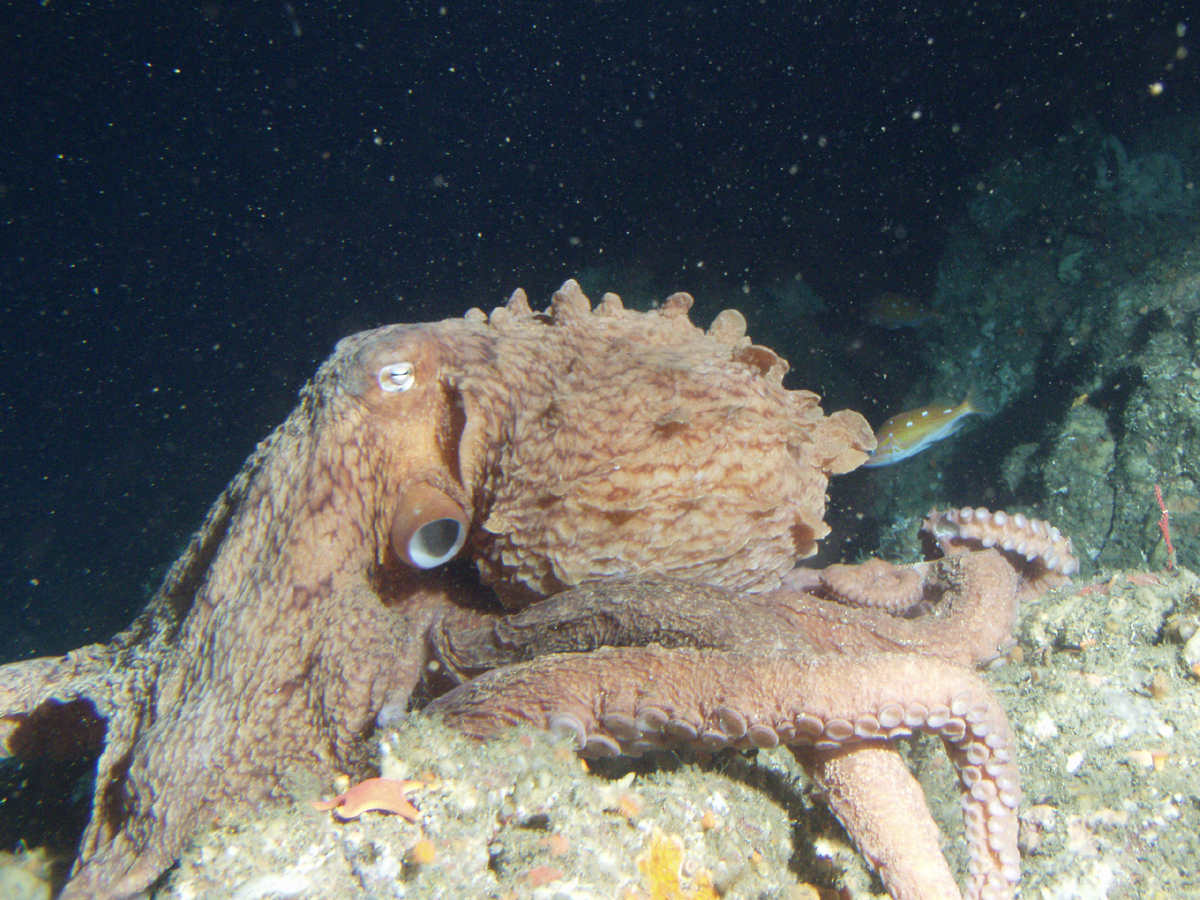
Giant Pacific Octopus (Enteroctopus dofleini) lives in temperate Waters across Pacific Northwest Coast. It feeds on crabs and clams. Its conservation status is Least Concern.
Fascinating facts about the Giant Pacific Octopus
- Adults usually weigh around 15 kg (33 lb), with an arm span up to 4.3 m (14 ft). The biggest recorded specimen tipped the scales at 600 lb (270 kg) and stretched a radial span of 32 ft (9.8 m). Its suckers are no joke, British zoologist G. H. Parker measured the largest at about 6.4 cm (2.5 in) and found each can hold 16 kg (35 lb).
- It has also been observed to catch spiny dogfish (Squalus acanthias) up to 1.2 m (4 ft) in length while in captivity. In May 2012, amateur photographer Ginger Morreau photographed a wild giant Pacific octopus attacking and drowning a seagull, proving the animal will seize any prey that fits its size range, even birds. These feats reveal a predator with a flexible diet that can shift to unexpected food sources, helping it survive in the variable deep-sea buffet.
- E. dofleini remain stationary or in hiding 94% of the time, usually concealed within dens, kelp, or camouflaged in their environment. When it does move, it uses jet propulsion, drawing water into its body cavity and forcefully expelling it through a siphon to generate a powerful thrust.
- Unlike most other octopus species, whose lifespans normally last only one year, the giant Pacific octopus has a lifespan of three to five years. It can lay between 120,000 and 400,000 eggs, each glued to a hard surface by the female. The mother then starves, living off her own body fats for roughly 6 months before dying once the hatchlings emerge.
- Following its DNA analysis, the giant Pacific octopus may actually prove to be three subspecies (one in Japan, another in Alaska, and a third in Puget Sound). The world's largest octopus, still called the giant Pacific octopus, is now known to comprise more than one species, according to new research led by an undergraduate at Alaska Pacific University. The newly documented frilled giant Pacific octopus has two distinctive white marks on its head.
Sources
Every fact above was checked against these pages, and kept only where one of them states it.
At a glance
RangePacific Northwest Coast
HabitatTemperate Waters
DietCrabs and clams
About the Giant Pacific Octopus
In the dark, mysterious depths of the Pacific, a master of disguise and deception weaves its way through the shadows, the Giant Pacific Octopus moving with an uncanny silence, its eight dexterous arms rippling like a living cloak as it navigates the rocky terrain. With eyes that gleam like polished onyx, this soft-bodied giant surveys its kingdom, a realm of hidden crevices and sunken ships, where it reigns supreme, a shape-shifting enigma that has long fascinated and eluded us. As it glides effortlessly through the water, its very existence seems a testament to the ocean's unfathomable secrets and unseen wonders.
Hear the Giant Pacific Octopus, and 4,400+ more
Real recorded sounds, 11 nature games and a free Daily 5, 1v1 quiz duels, conservation wins and a safe Kids mode. Free on Feravox.
More ocean life to discover