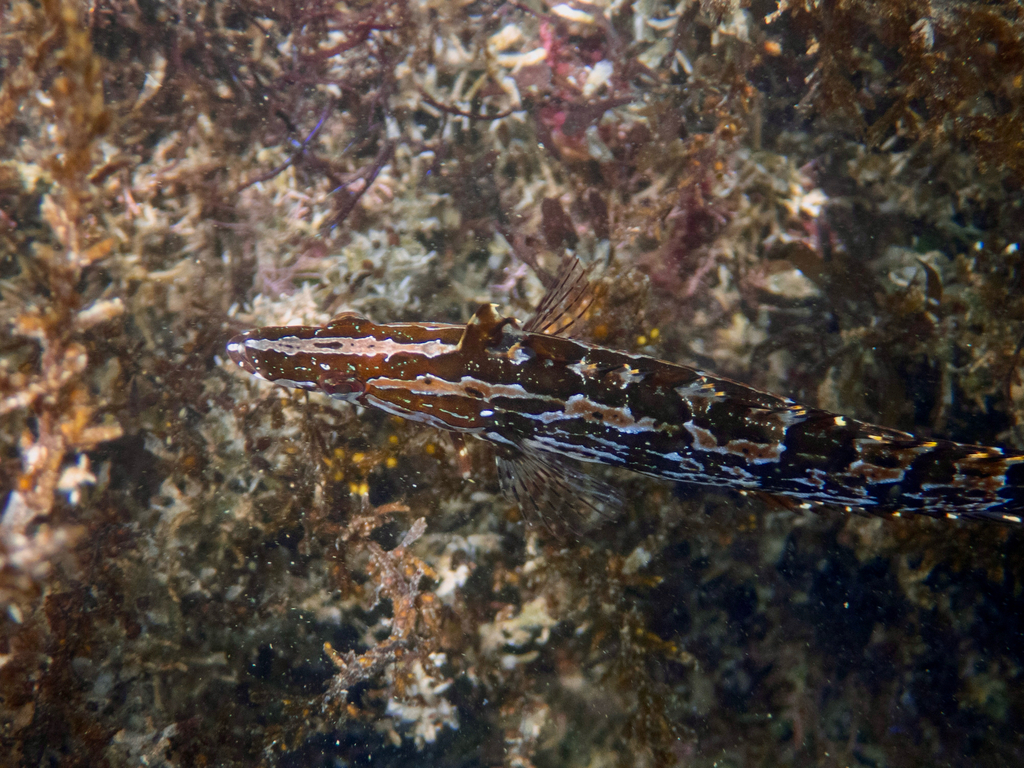
Photo: Rachel Lee Harper
Feravox · The Voice of the Wild
Giant Kelpfish
Heterostichus rostratus
Least Concern
Giant Kelpfish (Heterostichus rostratus) lives in kelp forest across California to Baja California. It feeds on small crustaceans, mollusks, fish. Its conservation status is Least Concern.
The giant kelpfish (Heterostichus rostratus) glides through the towering canopies of Pacific kelp forests like a living brushstroke, its eel-like, compressed body ranging from 10 to 24 inches (25–61 cm). Its dorsal fin runs the full length of the back, merging spiny and soft rays into a seamless ribbon, while rounded pectoral fins and a forked tail give it the agility to dart among the fronds. Three cryptic color morphs, red, brown, and green, are overlaid with melanistic bars that shift with sex, age, and habitat, rendering the fish almost invisible against the kelp’s swaying tapestry. This camouflage is not merely aesthetic; it is a vital survival tool, allowing the kelpfish to ambush crustaceans, mollusks, and small fish while remaining hidden from predators. Spawning occurs year-round, peaking in spring, with females depositing 400–1 200 eggs into soft algae nests that the male fiercely guards. After a brief 40–60-minute courtship display, head shakes, fin expansions, and a vivid melanistic stripe, the eggs hatch in two weeks, and the larvae drift for about two months before settling back into the kelp. Remarkably, males can spot conspecific rivals up to three metres (9.8 ft) away, reacting to size and species, a behavior that underscores the intense territoriality of this otherwise slow-moving, burst-swimmer. By the time they reach two to three years old, they are ready to repeat the cycle, a testament to the kelp forest’s role as both nursery and arena for this enigmatic predator.
Real recorded sounds, 11 nature games and a free Daily 5, 1v1 quiz duels, conservation wins and a safe Kids mode. Free on Feravox.