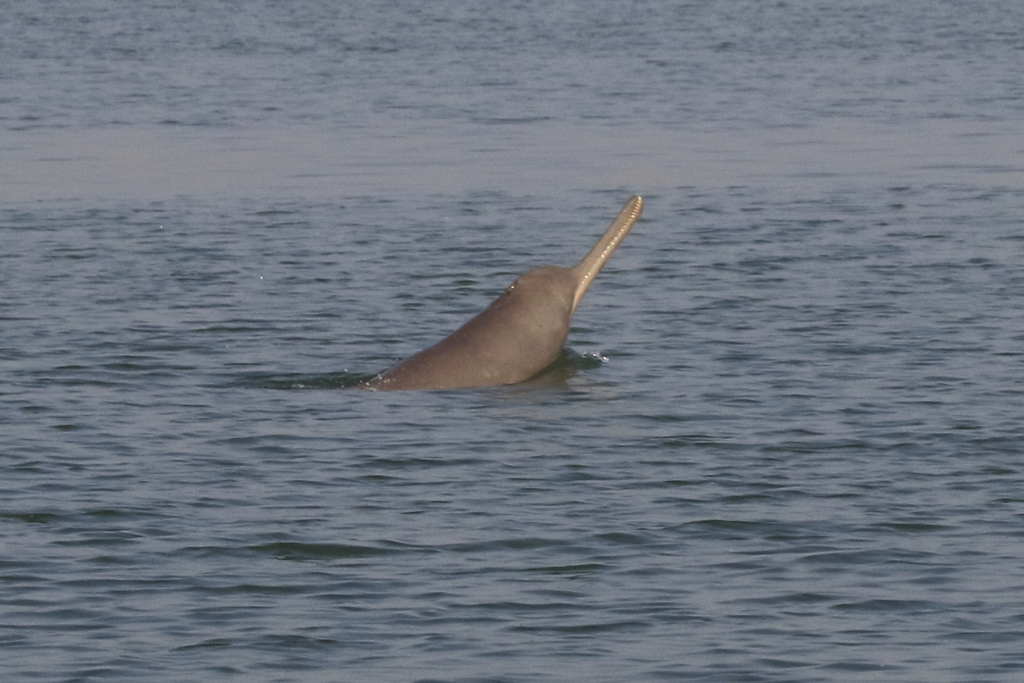
Ganges River Dolphin (Platanista gangetica) lives in freshwater rivers across South Asian rivers. It feeds on fish and crustaceans. Its conservation status is Endangered.
Fascinating facts about the Ganges River Dolphin
- Six-thousand-three-hundred-twenty-four Ganges river dolphins still swim the Indian waterways: 3,275 in the Ganges main channel, 2,414 in its tributaries, another 584 in the Brahmaputra mainstream and just 51 in its side streams. Those numbers, drawn from a 2025 survey.
- At just over two metres long, a Ganges river dolphin can stretch to 2.6 m (8 ft), yet the oldest known male measured only 199 cm and lived to 28 years, almost the species' 30-year lifespan ceiling. This size-age record, pulled from field observations.
- Blind to the murky waters, these dolphins navigate with clicks that are often under 15 kHz, but they can push the sound envelope up to 60 kHz. Those frequency bands, matching the Amazon river dolphin's pattern, let them "see" prey and obstacles in sludge-filled rivers.
- When the current opens, a Ganges river dolphin can sprint: captive tests logged 5.4 km/h, yet wild sightings have captured bursts up to 27 km/h. That speed, combined with their ability to glide just 30 cm above the riverbed on their side, lets them chase fish in shallow channels.
- Even in the Buriganga, ranked among the world's most polluted urban rivers, about 20 dolphins cling to survival. Researchers tracked them for a year along a 27-km stretch, noting groups of 4.18 individuals and calves making up nearly 16 % of sightings. The river has toxic waters, heavy metals, and near-zero dissolved oxygen during the dry season.
Sources
Every fact above was checked against these pages, and kept only where one of them states it.
At a glance
RangeSouth Asian rivers
HabitatFreshwater rivers
DietFish and crustaceans
About the Ganges River Dolphin
In the murky, serpentine waters of the Ganges River, a phantom-like creature glides effortlessly, its sleek, grey body undulating as it navigates the depths with a series of gentle, sweeping motions. The Ganges River Dolphin, with its distinctive rounded forehead and slender beak, is a master of this domain, using echolocation to pinpoint its prey in the turbid currents, its very existence a testament to the resilience of life in one of the most densely populated and threatened ecosystems on the planet. As it breaks the surface, its soft breath a whispered secret to the riverbank, we are reminded of the beauty and fragility of this endangered creature.
Common questions
What does the Ganges River Dolphin eat?
Diet: fish and crustaceans.
Where does the Ganges River Dolphin live?
Habitat: freshwater rivers.
Is the Ganges River Dolphin endangered?
The Ganges River Dolphin is listed as Endangered on the IUCN Red List.
Hear the Ganges River Dolphin, and 4,400+ more
Real recorded sounds, 11 nature games and a free Daily 5, 1v1 quiz duels, conservation wins and a safe Kids mode. Free on Feravox.
More ocean life to discover