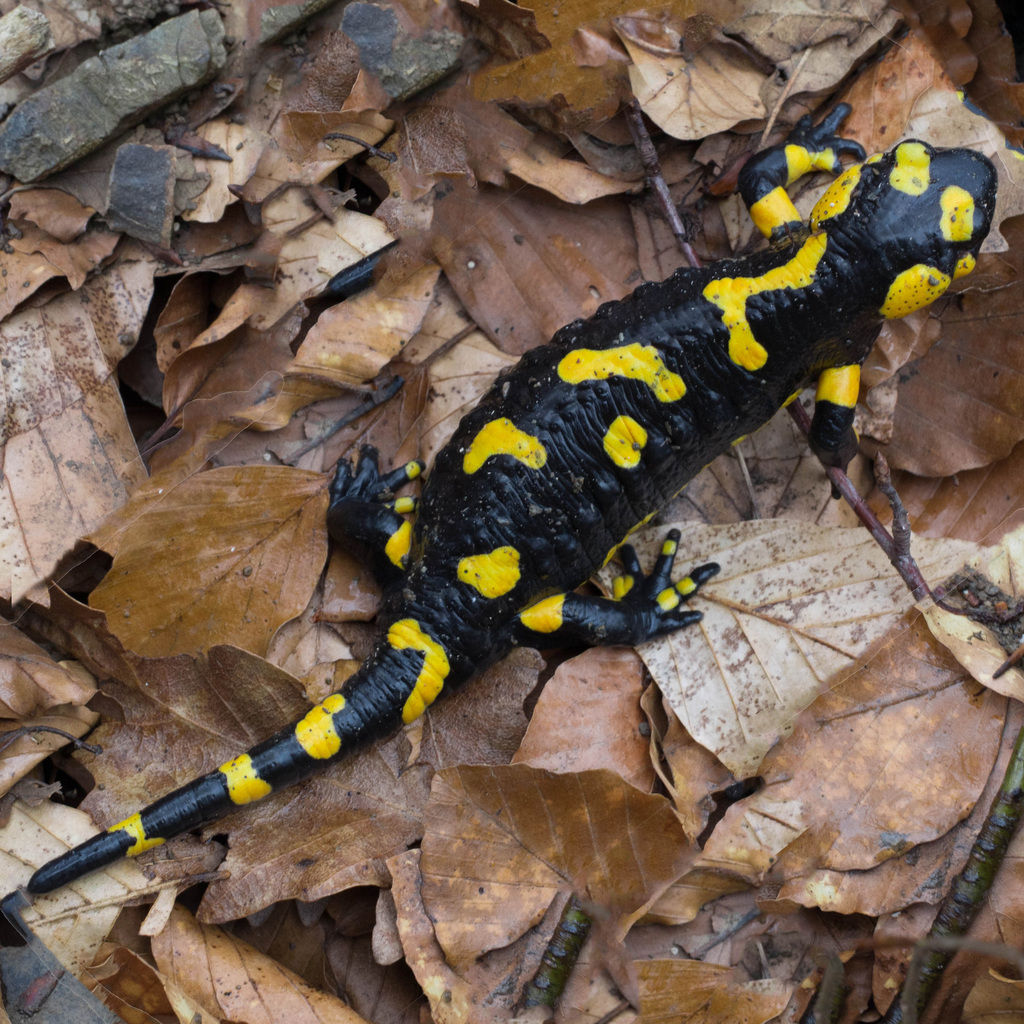
Fire Salamander (Salamandra salamandra) lives in deciduous mountain forest across Europe. It feeds on insects and worms. Its conservation status is Vulnerable.
Hear the Fire Salamander
A real field recording of the Fire Salamander, made in the wild.
Recording: Régis SICARD BARANOWSKI, CC0, via iNaturalist
Hear the full recording of the Fire Salamander, and 4,400+ more species, in the free Feravox app.
Among European amphibians, the fire salamander stretching from 15 cm to 25 cm on average and with some individuals surpassing 30 cm, while weighing about 40 g; the average mass across the species is recorded at 19.1 g. This bulk gives it a solid pectoral girdle and makes it one of the continent's largest salamanders.
Fire salamanders prefer hilly, forested terrain, most commonly occupying altitudes between 250 m (820 ft) and 1,000 m (3,300 ft), yet they can be found as low as 25 m (82 ft) in northern Germany. This altitude preference ties them to cool, moist microhabitats with clean streams for larval development, making them sensitive to water availability across their European range.
Since 2010 the introduced chytrid fungus Batrachochytrium salamandrivorans has driven a 96 % crash in Dutch fire salamander numbers, slashing the largest local group from 241 individuals to just four by 2011. Combined with a 57 % range loss since 1950, these declines prompted the IUCN to upgrade the species from Least Concern to Vulnerable in 2023.
Fire salamanders mate on land; the male deposits a spermatophore that the female later draws into her cloaca, achieving internal fertilisation. Females can store sperm for extended periods before ovulation, allowing them to delay fertilisation until conditions are right, which explains the long gap between summer courtship and spring larval birth. This sperm-storage strategy, combined with a lifespan over 14 years, lets females breed repeatedly across seasons.
A fire salamander once outlived half a century, with a museum specimen recorded at over 50 years, while may live in excess of 14 years and can survive up to 24 years in captivity. Such longevity lets females reproduce many times.
Sources
Every fact above was checked against these pages, and kept only where one of them states it.
In the damp, misty realms of European forests, the fire salamander emerges as a fiery apparition, its vibrant orange and black hues glistening like embers as it moves with deliberate, almost languid, pace through the underbrush. With an air of quiet confidence, it navigates the shadows, its keen senses alert to the subtlest vibrations of its surroundings, as it searches for the small invertebrates that sustain it. As it pauses, its gaze seems toburn with an inner intensity, a testament to the fierce, unyielding spirit that has allowed this remarkable creature to thrive in its mystical, moonlit world.
Advertisement
Hear the Fire Salamander, and 4,400+ more
Real recorded sounds, 11 nature games and a free Daily 5, 1v1 quiz duels, conservation wins and a safe Kids mode. Free on Feravox.