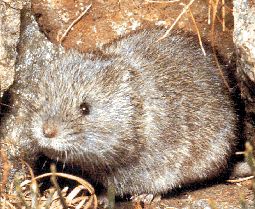
European Snow Vole (Chionomys nivalis) lives in alpine mountain meadows across Southern European mountains. Its conservation status is Least Concern.
Fascinating facts about the European Snow Vole
- The European snow vole never hibernates, remaining active throughout the cold months and sometimes seeking refuge in mountain huts. It moves both by day and by night, often seen lying on sun-warmed rocks in summer, and its network of tunnels with many exit holes lets it quickly escape predators, while it holds its tail upright when running across the scree.
- In summer, breeding females defend strictly exclusive territories and will aggressively confront any other female that approaches their borders. Males, by contrast, maintain larger, overlapping ranges and show a higher degree of social tolerance toward neighbours. This seasonal pattern shifts in winter when territorial boundaries dissolve and both sexes become nomadic and solitary, reducing direct conflicts.
- Research shows the species is a rock-dwelling specialist, with reproductive females and juveniles concentrating in the central parts of scree fields, especially near juniper bushes. Males and non-breeding females are less selective, occupying any available rocky habitat in proportion to its presence. This division creates a clear habitat preference where breeding individuals seek the protective cover of dense scree, while other individuals disperse more widely.
- The European snow vole typically raises two litters each year, each containing about four young, though numbers can range from two to seven. After a brief gestation of three weeks the pups are born altricial and their eyes open at roughly thirteen days. They are weaned at eighteen days and achieve full independence after four weeks, usually not breeding themselves until the following year.
- The vole's distribution is governed by the suitability of the micro-habitat rather than by ambient temperature, allowing it to persist in isolated rocky patches even where the climate is milder. It is confined to petricolic soils and can occur at lower elevations wherever those soils exist, though it is more common at medium to high altitudes where competition from larger mammals is reduced.
Sources
Every fact above was checked against these pages, and kept only where one of them states it.
At a glance
RangeSouthern European mountains
HabitatAlpine mountain meadows
DietGrass and seeds
About the European Snow Vole
In the harsh, snow-encrusted landscapes of the European Alps, the European Snow Vole emerges as a diminutive, yet resilient, inhabitant, its grey-brown fur blending seamlessly into the rocky terrain as it scurries with purpose. With a nimble gait, it navigates the labyrinthine tunnels and hidden crevices of its subnivean world, a secret realm of icy passages and sheltered dens that crisscross beneath the snow's frozen crust. Here, this unassuming creature has adapted to thrive in one of the most inhospitable environments on the continent, its very existence a testament to the boundless ingenuity of life.
Hear the European Snow Vole, and 4,400+ more
Real recorded sounds, 11 nature games and a free Daily 5, 1v1 quiz duels, conservation wins and a safe Kids mode. Free on Feravox.