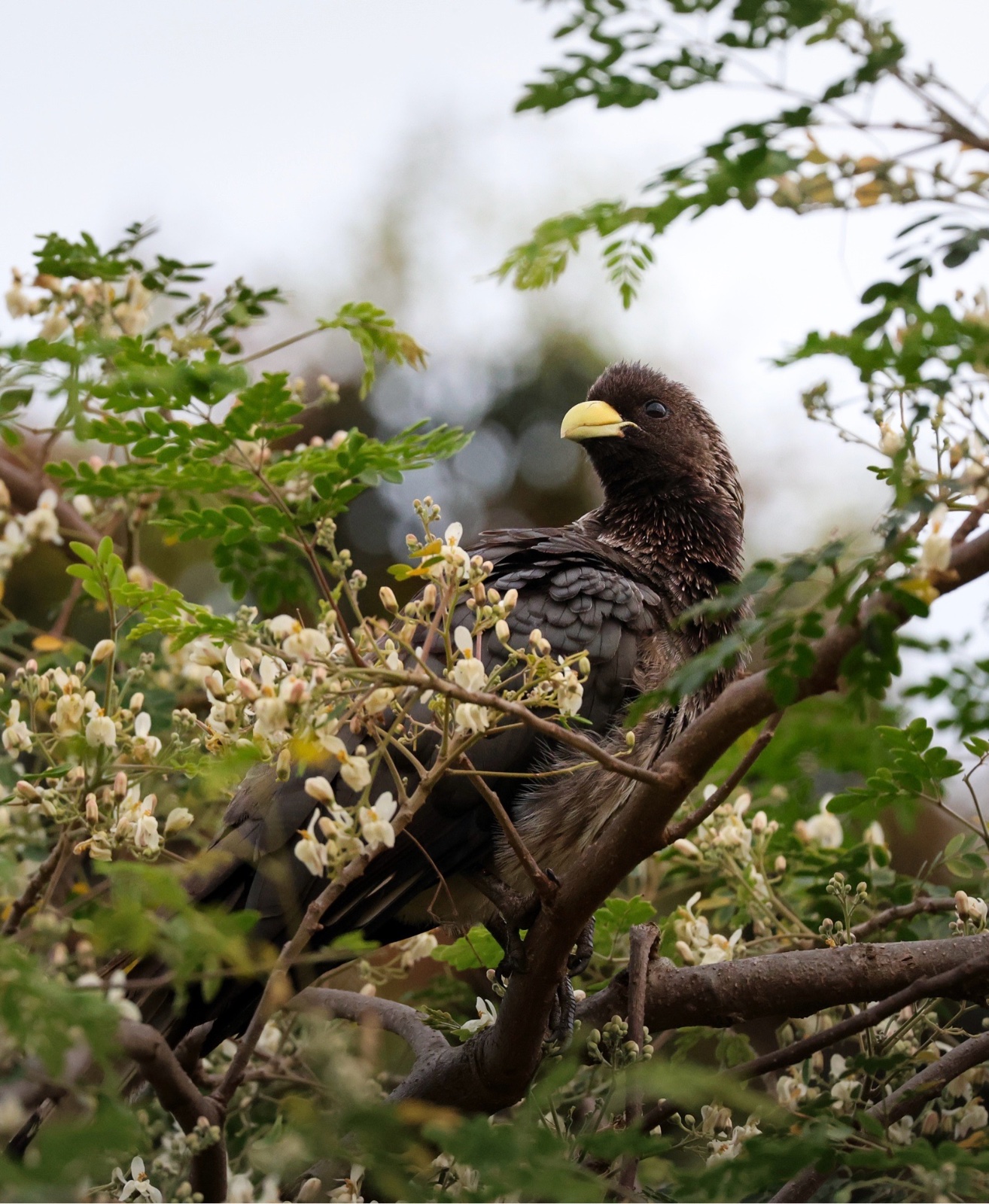
Photo: Ryan Nickol
Feravox · The Voice of the Wild
Eastern Plantain-eater
Crinifer zonurus
Least Concern
Eastern Plantain-eater (Crinifer zonurus) lives in tropical forest canopy across West and Central Africa. Its conservation status is Least Concern.
Every fact above was checked against these pages, and kept only where one of them states it.
The Eastern Plantain‑eater (Crinifer zonurus) is a striking member of the hornbill family, instantly recognizable by its massive, ivory‑white bill crowned with a bright orange casque that tapers to a blunt tip. Its plumage is a tapestry of deep brown and black, interlaced with bold white bands that run across the wings and tail, while a conspicuous white stripe runs from the crown down the nape, giving the bird a regal silhouette against the dappled forest light. Adults measure up to 70 cm in length and weigh as much as 1.5 kg, their robust bodies built for a life spent perched on sturdy branches where they scan the canopy for fruit and insects. In the lowland rainforests and moist woodlands of eastern Africa—from southern Ethiopia through Kenya and Tanzania to northern Mozambique—these birds favor dense, evergreen thickets near water, where the humid microclimate fuels the year‑round fruiting of their favorite food plants. Their diet is a sumptuous blend of figs, wild bananas, and the eponymous plantain, complemented by occasional insects, small reptiles, and even carrion—a flexibility that underpins their success in fragmented habitats. Eastern Plantain‑eaters are monogamous, forming long‑term pair bonds; the female seals herself inside a tree cavity using mud and feces while the male delivers food through a narrow slit, a ritual that can last weeks. A surprising trait is their vocal repertoire: beyond the deep, resonant booming calls that echo at dawn, they can produce a series of rapid, high‑pitched whistles that serve as a covert alarm system, alerting mates to aerial predators without attracting the attention of larger carnivores, a subtle acoustic dance that keeps the forest’s social fabric humming
Real recorded sounds, 11 nature games and a free Daily 5, 1v1 quiz duels, conservation wins and a safe Kids mode. Free on Feravox.