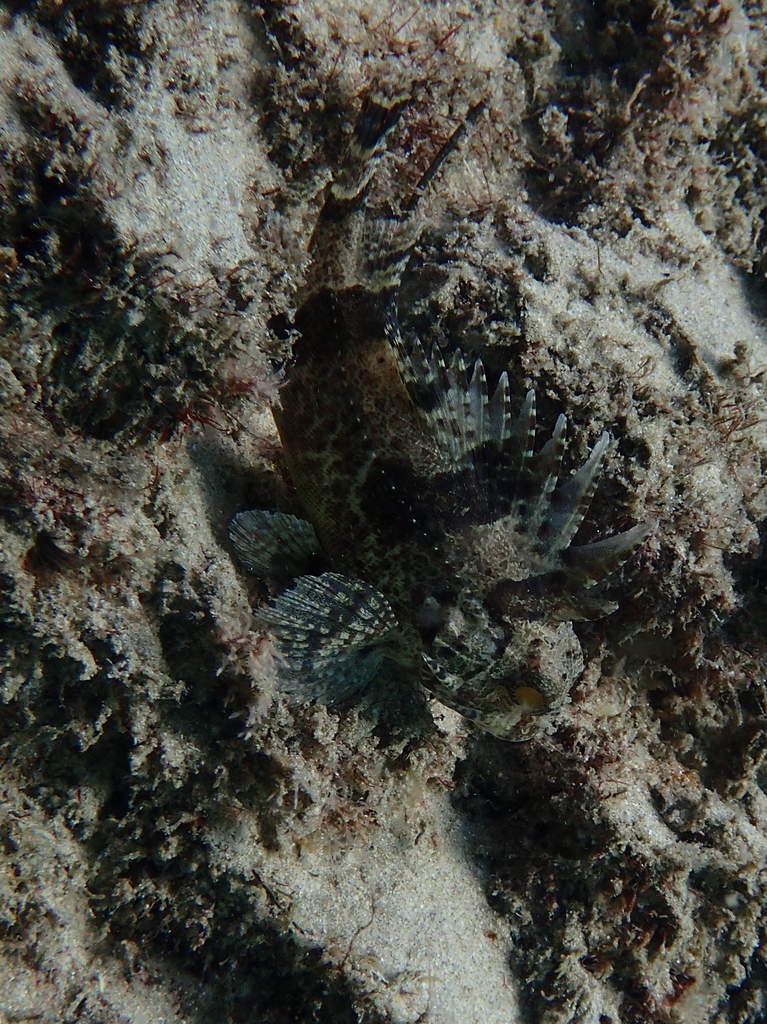
Photo: Julien Renoult
Feravox · The Voice of the Wild
Eastern Fortescue
Centropogon australis
Least Concern
Eastern Fortescue (Centropogon australis) lives in seagrass beds, sponge reefs across eastern Australia. It feeds on unknown diet. Its conservation status is Least Concern.
The Eastern fortescue (Centropogon australis) is a compact, venom-armed waspfish that prowls the temperate coastal waters of eastern Australia. Its body, capped with a covering of ctenoid scales, is interrupted by a wide scaleless strip above the lateral line that runs from the upper back of the head to the base of the spiny dorsal fin. The fish bears 15 or 16 dorsal spines and 7 to 9 soft rays, while the anal fin carries 3 spines and 5 soft rays. Two prominent nasal spines and a row of 8–13 strong supra-ocular spines crown its head, and a pair of large, forward-projecting snout spines can be thrust outward when threatened. Its coloration shifts from creamy to brown, marked by irregular vertical bars that break up its outline among the sea grasses and sponge beds where it lives, and it reaches up to 15 cm in total length. In the shallow seagrass meadows and sponge-laden inshore reefs from Fraser Island in Queensland down to the Powlett River estuary in eastern Victoria, the fortescue gathers in large numbers on the bottom, especially in spring when breeding peaks. Resting motionless, it relies on its potent dorsal-fin venom to deter predators, a surprising defensive trait that can deliver painful wounds to any creature that dares to disturb it. Though little is known about its diet, its habitat preferences and seasonal abundance suggest a fish well-adapted to the dynamic estuarine and reef environments of its range, ever poised to strike with its hidden spines.
Real recorded sounds, 11 nature games and a free Daily 5, 1v1 quiz duels, conservation wins and a safe Kids mode. Free on Feravox.