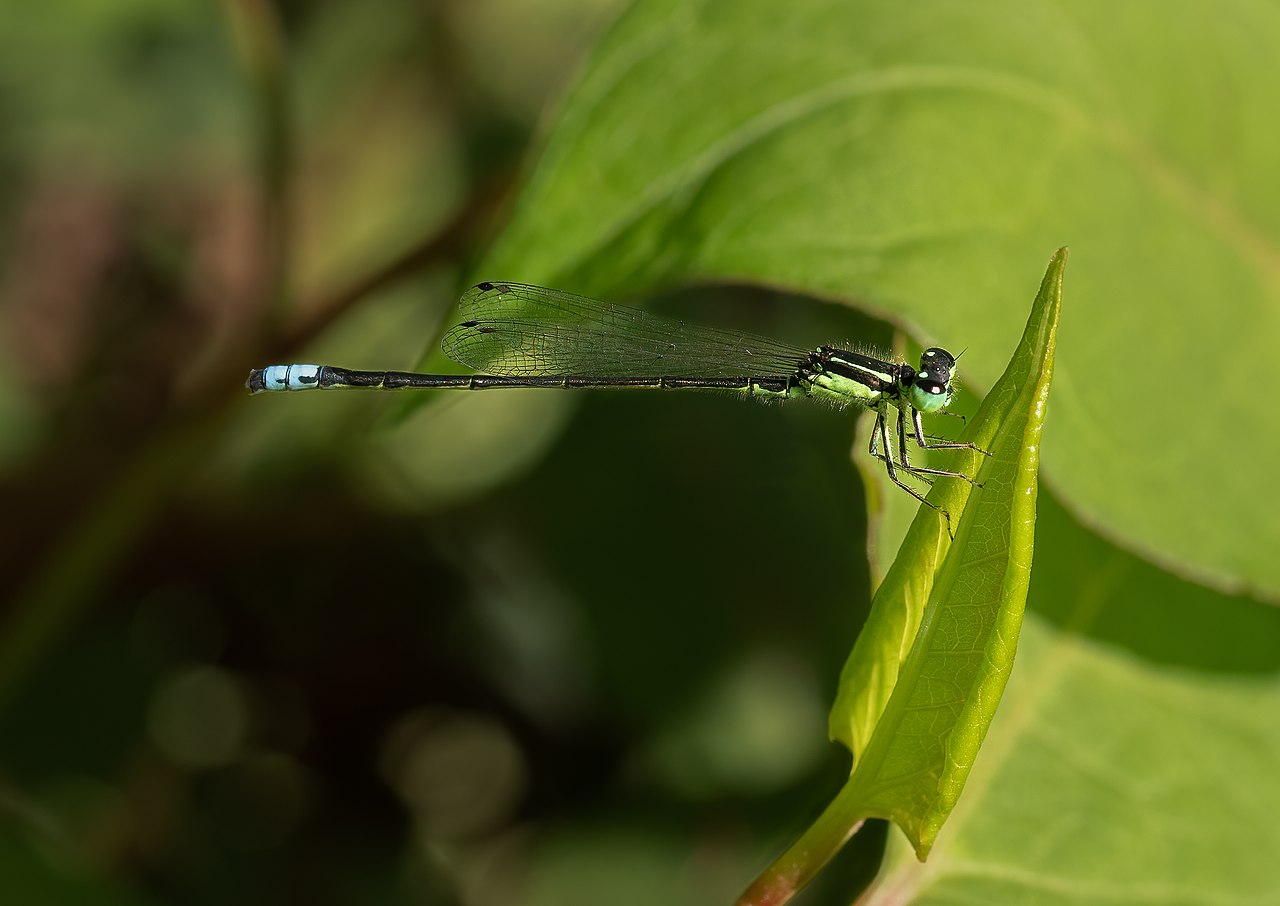
Eastern Forktail (Ischnura verticalis) lives in freshwater areas across North America. It feeds on insects and larvae. Its conservation status is Least Concern.
Fascinating facts about the Eastern Forktail
- The eastern forktail inhabits a broad swath of North America, occurring throughout the Eastern United States from the Atlantic shoreline westward to the Midwest. Its range also reaches north of Florida, extends into Southern Canada, and pushes west as far as Montana and New Mexico. This distribution reflects its adaptability to many temperate wetland zones across the continent.
- Eastern forktails are tied to wetland environments, where they can be observed perched among emergent vegetation. They favour the calmer waters of small ponds, the gentle flow of slow-moving streams, and the shallow edges of marshes. These habitats provide both hunting grounds for catching tiny insects and suitable sites for laying eggs on submerged plant stems. Their presence is therefore a good indicator of healthy, low-flow freshwater systems.
- Adult eastern forktails take to the air in the warm months, with most individuals on the wing from late June through early October. In more southerly or milder locales, the flight season can begin as early as early April and persist until early November. This extended period allows a longer window for mating and egg-laying, increasing the chances of successful reproduction each year. Their activity peaks when temperatures are moderate and daylight is abundant.
- Female eastern forktails usually mate only once, making them effectively monogamous. After this single copulation the stored sperm is sufficient to fertilise a very large clutch, as a female can produce over a thousand eggs from one male's contribution. This reproductive strategy means the female does not need to seek additional mates during the breeding season, allowing her to focus on finding suitable sites for laying her eggs in the surrounding wetlands.
- The eastern forktail measures between 22 and 30 millimetres in length, placing it among the smaller damselflies. Its compact size is paired with a slender, colourful body that displays green, black and blue hues, and its four wings rest neatly folded over the back when at rest. Such dimensions enable it to manoeuvre deftly among the reeds and low vegetation of ponds, streams and marshes where it hunts and later deposits its eggs on submerged plant stems.
Sources
Every fact above was checked against these pages, and kept only where one of them states it.
At a glance
RangeNorth America
HabitatFreshwater areas
DietInsects and larvae
About the Eastern Forktail
As the sun dances across the tranquil waters, the Eastern Forktail emerges, its iridescent blue body glimmering like a shard of splintered sky. With a delicate flutter, it takes to the air, its agile form weaving through the lush vegetation with an effortless elegance, as if borne on the gentle breeze itself. In this serene world of ponds and slow-moving streams, the Eastern Forktail reigns, a tiny, unassuming monarch, its beauty and resilience a testament to the enduring wonders of the natural world.
Hear the Eastern Forktail, and 4,400+ more
Real recorded sounds, 11 nature games and a free Daily 5, 1v1 quiz duels, conservation wins and a safe Kids mode. Free on Feravox.
More insects and spiders to discover