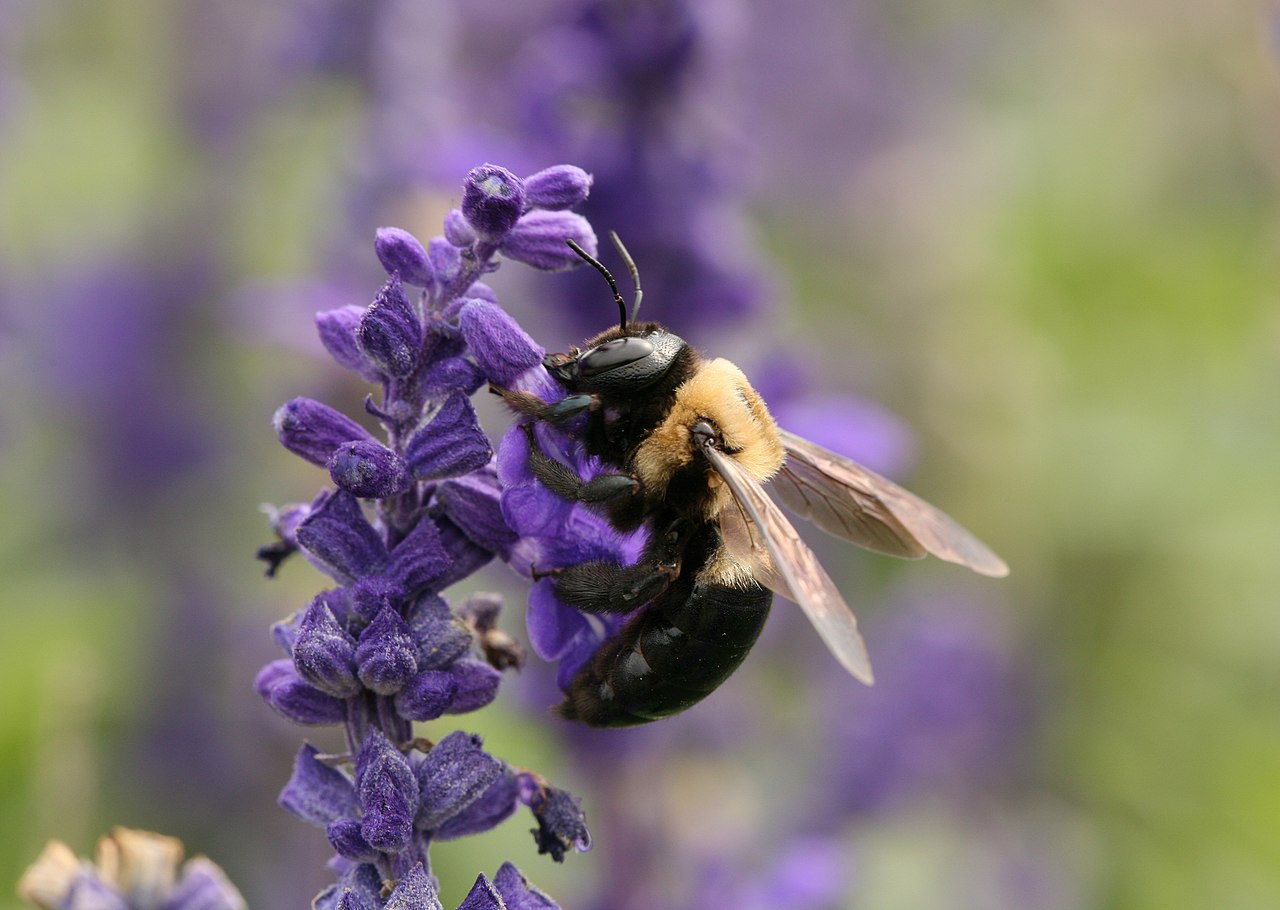
Eastern Carpenter Bee (Xylocopa virginica) lives in open woodland across Eastern North America. It feeds on nectar and pollen.
Fascinating facts about the Eastern Carpenter Bee
- Eastern carpenter bees chew tunnels up to 47 cm long into dead wood, then line the walls with wood shavings to make brood cells. Because building a nest costs a lot of effort, females often reuse old tunnels for new generations, turning a single hole into a multi-year home.
- Mating happens just once each spring, then females lay eggs in July farthest from the exit hole; by August-mid-September all larvae have pupated and emerged as adults. Young bees can fly after only 3-4 days, yet they stay inside the nest for at least two weeks feeding on nectar before their first flight. This tight, single-year cycle means each generation is synchronized, preventing early-emerging siblings from killing later ones and keeping the colony's timing stable.
- In a social nest, the dominant primary female does everything, reproduces, gathers food, builds cells, while younger secondary and tertiary females either help a little or simply wait to overwinter. Remarkably, one-year-old females live together with two-year-old females, the older pair doing all the labor while the younger guard the entrance. This division of work shows a step toward true eusociality, where age and experience dictate role.
- When carpenter bees visit blueberry fields, each extra bee species adds about $311 in crop value. Xylocopa virginica was one of the five groups that boosted yields, contributing to an estimated $1.42 million extra blueberry harvest each year in North Carolina, making farms more productive and resilient to weather swings.
- Male eastern carpenter bees guard territories near nest entrances that can stretch up to 20 m² and last as long as two weeks. Near the entrance the boundaries are linear and several meters long; farther away they become square-shaped and shorter. If an intruder flies by fast, the male gives chase, but a slow hover is ignored. This aggressive patrolling protects the nest's resources and mating opportunities.
Sources
Every fact above was checked against these pages, and kept only where one of them states it.
At a glance
RangeEastern North America
HabitatOpen woodland
DietNectar and pollen
About the Eastern Carpenter Bee
In the warm, languid air of a summer's day, the Eastern Carpenter Bee moves with a languorous elegance, its iridescent body glimmering like polished onyx as it flits from bloom to bloom. With a gentle hum, it navigates the intricate landscape of petals and stamens, gathering nectar and pollen with an unhurried precision that belies its remarkable industry. As it flies, its powerful wings beat at a hypnotic pace, a mesmerizing blur of motion that seems to embody the very essence of a sun-drenched afternoon.
Hear the Eastern Carpenter Bee, and 4,400+ more
Real recorded sounds, 11 nature games and a free Daily 5, 1v1 quiz duels, conservation wins and a safe Kids mode. Free on Feravox.
More insects and spiders to discover