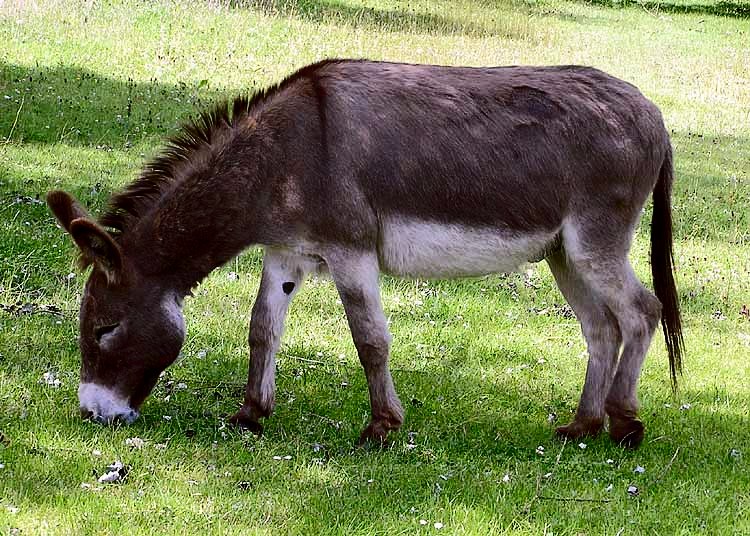
Donkey (Equus asinus) lives in desert savanna across Sub-Saharan Africa. It feeds on grass and hay.
Fascinating facts about the Donkey
- Donkeys were first tamed in Africa some 5,000-7,000 years ago, long after cattle, sheep and goats had already been domesticated. Their early owners in Nubia quickly swapped oxen for the smaller, cud-free pack animal, giving pastoral peoples a mobile lifeline across the desert. By Egypt's Dynasty IV (2675-2565 BC) wealthy families owned over 1,000 donkeys for agriculture, dairy, meat and transport, and ten donkey skeletons were buried with pharaohs, a clear sign that the animal was already a prized state resource.
- A single donkey's bray can be heard for more than three kilometres, a sound that lasts about twenty seconds. This long-range call lets solitary desert donkeys keep in touch across the sparse landscape where food and water are scattered. Their oversized ears not only pick up these distant noises but also act as radiators, cooling blood that circulates close to the skin, a vital adaptation for surviving in hot, arid habitats.
- Donkey pregnancies stretch to about 12 months, 370 days on average, and twins are a rarity, occurring in only 1.7 % of pregnancies, with both foals surviving in just 14 % of those cases. Breeders plan for three foals in four years rather than expecting a yearly litter, a pace far slower than that of horses.
- Globally there are more than 40 million donkeys, but 96 % live in under-developed nations where they pull carts, carry water and haul loads. In the United States, donkeys now make up 14.2 % of all livestock guard animals, using their loud brays and powerful kicks to deter coyotes, foxes and mountain lions.
- Donkey meat and hide have become lucrative commodities: a kilogram of ejiao, gelatin made from boiled donkey skin, fetched up to $388 in October 2017, while Italy's donkey-meat industry slaughtered about 1,000 animals in 2010, producing roughly 100 tonnes of flesh. This soaring demand has driven a sharp decline in China's donkey numbers, from 11 million in 2006 to just 3 million by 2017, prompting African nations to ban exports to China and sparking warnings that the world's donkey population could halve within five years.
Sources
Every fact above was checked against these pages, and kept only where one of them states it.
At a glance
RangeSub-Saharan Africa
HabitatDesert savanna
DietGrass and hay
About the Donkey
Across the sun-baked landscapes, the donkey roams with a quiet resilience, its sturdy frame and deliberate gait a testament to its unyielding adaptability. With ears attuned to the whispers of the wind and eyes watchful for the promise of distant water, it navigates the harsh yet beautiful terrain with a gentle stubbornness, its soft bray carrying on the breeze like a melancholy serenade. In this unforgiving world, the donkey's humble presence is a reminder of the enduring power of simplicity and perseverance.
Hear the Donkey, and 4,400+ more
Real recorded sounds, 11 nature games and a free Daily 5, 1v1 quiz duels, conservation wins and a safe Kids mode. Free on Feravox.