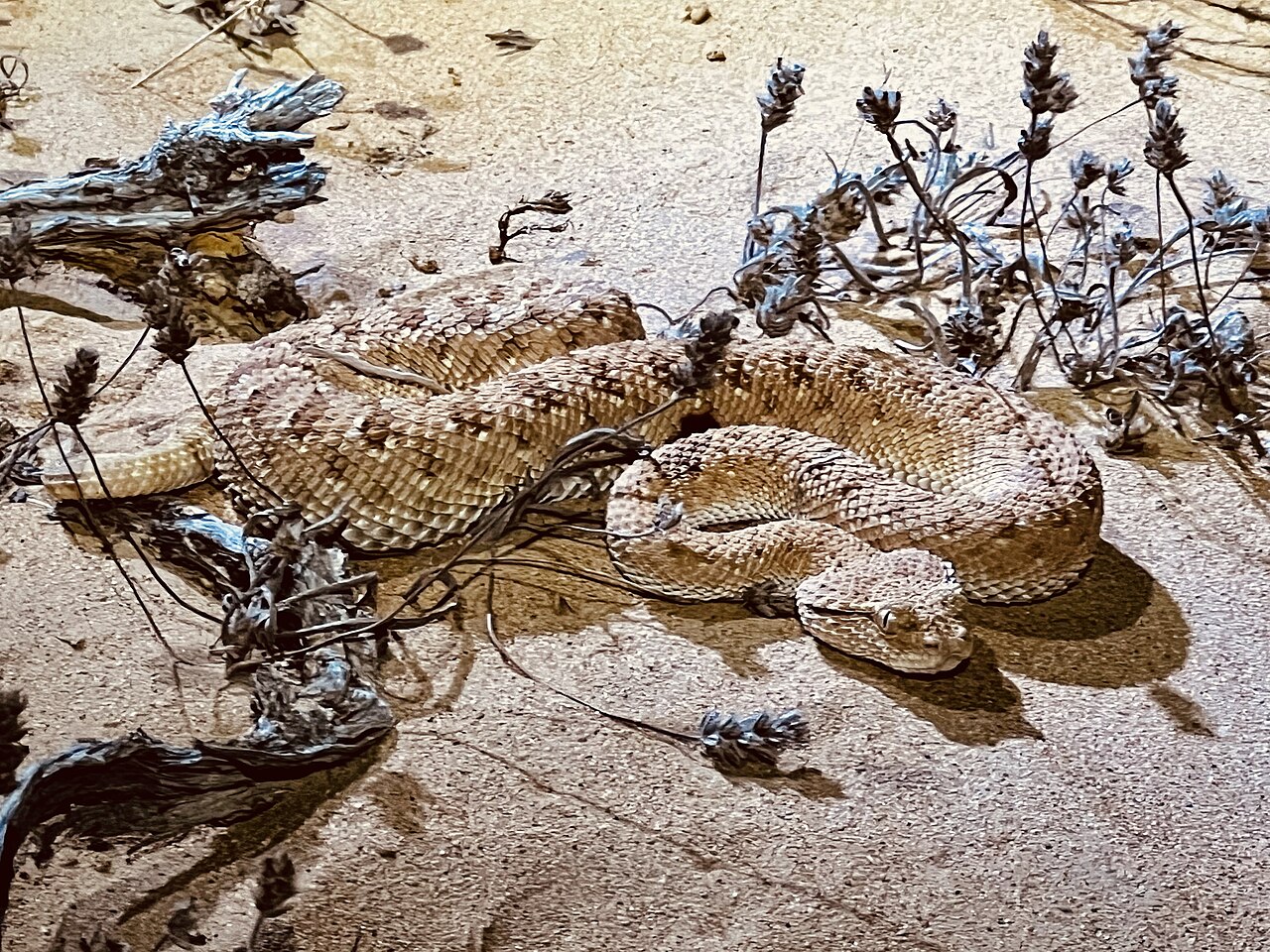
Desert Horned Viper (Cerastes cerastes) lives in desert across North African Deserts. It feeds on small mammals rodents. Its conservation status is Least Concern.
Fascinating facts about the Desert Horned Viper
- When the horned viper moves, it doesn't slither like a garden snake, it sidewinds, pressing its weight into the sand and leaving whole-body impressions that can be used to count its ventral scales. This locomotion lifts most of the body off the hot surface, keeping the belly cool. The technique also lets the snake travel quickly across loose dunes without sinking, a crucial advantage when hunting nocturnal rodents. The visible tracks are a reliable sign of its presence for researchers tracking population density.
- A single bite can deliver between 19 mg and 100 mg of dried venom, yet the lethal dose for a human is only 40-50 mg, making every drop potentially deadly. Laboratory tests show an LD50 of 0.4 mg/kg intravenously and 3.0 mg/kg subcutaneously, indicating extreme potency when injected directly into the bloodstream. The venom's high phospholipase A2 content can cause heart and muscle damage, explaining the severe swelling, necrosis and haematuria reported after envenomation. Understanding these exact toxicity values guides medical teams in dosing antivenin quickly and accurately.
- The horned viper's range stretches from the Sahara's western edge in Morocco to Iraq in the east, covering deserts of Egypt, Libya, Sudan, Saudi Arabia, Jordan, Israel, Qatar, Yemen and even the Sahel fringe. It prefers dry, sandy habitats with sparse rocks, avoiding coarse sand, and thrives at altitudes up to 1,500 m where annual averages stay at or below 20 °C (68 °F).
- Even a fully grown Saharan horned viper fits on a ruler: the average total length (body and tail) is 30-60 cm (12-24 in), with the longest recorded at 85 cm (33 in). Females consistently outgrow males.
- In the wild the horned viper lays a clutch of 8-23 eggs, which hatch after a 50- to 80-day incubation buried under rocks or abandoned burrows. Newborns emerge at 12-15 cm (5-6 in) long.
Sources
Every fact above was checked against these pages, and kept only where one of them states it.
At a glance
RangeNorth African Deserts
HabitatDesert
DietSmall mammals rodents
About the Desert Horned Viper
In the scorching expanse of the desert, the Desert Horned Viper emerges as a master of stealth, its mottled scales blending seamlessly into the sandy dunes as it navigates the unforgiving terrain with calculated precision. With each deliberate movement, it embodies the essence of patience, lying in wait for the perfect moment to strike, its horn-like protrusions above its eyes seeming to twitch with an air of quiet anticipation. As the sun dips below the horizon, casting the desert in a warm orange glow, the viper stirs, its sinuous body weaving through the rocky outcrops with a mesmerizing fluidity.
Hear the Desert Horned Viper, and 4,400+ more
Real recorded sounds, 11 nature games and a free Daily 5, 1v1 quiz duels, conservation wins and a safe Kids mode. Free on Feravox.
More reptiles to discover