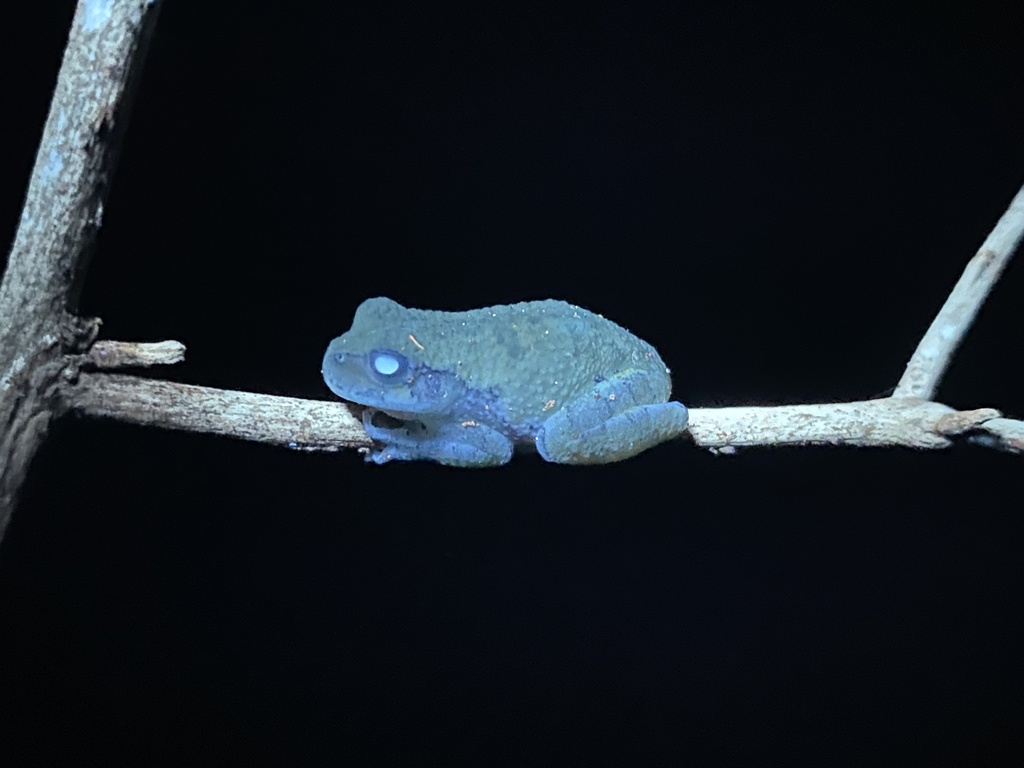
Cope's Gray Tree Frog (Dryophytes chrysoscelis) lives in moist woodlands across Eastern North America. It feeds on insects and spiders. Its conservation status is Least Concern.
Hear the Cope's Gray Tree Frog
A real field recording of the Cope's Gray Tree Frog, made in the wild.
Cope's gray treefrog carries the standard diploid set of chromosomes, meaning it has two complete sets, which is the usual condition for vertebrates. Its close relative, the gray treefrog, possesses double that number, being tetraploid. This chromosomal difference underpins a clear genetic division between the two species. Even though they share much of the same habitat, the two frogs generally do not interbreed, reinforcing the split.
Cope's gray treefrog can survive being frozen by producing glycerol as a cryoprotectant, a strategy used by only a few frog species. In laboratory tests it endures temperatures as low as −8 °C while up to half of its body water turns to ice. The frog rapidly synthesises glycerol when it gets colder, allowing 40-50 % of its total body water to freeze without lethal damage. This freeze-tolerance lets it persist through harsh winter conditions.
During the breeding season male Cope's gray treefrogs emit calls that reach sound pressure levels of 85 to 90 dB. Their calls are faster-paced and slightly higher-pitched than those of the gray treefrog, and females can discriminate differences of only a few decibels, preferring calls with average or higher frequencies.
When a Cope's gray treefrog jumps, the concealed bright-yellow markings on its hind legs are suddenly revealed, creating a flash of colour that can startle a predator. Such sudden bursts of colour are thought to confuse attackers as the frog makes its escape. Similar hidden bright patterns are also found in certain moths, showing a convergent defensive strategy.
Research on overwintering Cope's gray treefrogs shows that 40-50 % of their total body water can freeze and the animals still survive, a rare physiological capability. The frogs achieve this by rapidly synthesising glycerol, a cryoprotectant that protects cells as temperatures drop.
Sources
Every fact above was checked against these pages, and kept only where one of them states it.
In the warm, humid forests of North America, the Cope's Gray Tree Frog navigates its arboreal realm with an unhurried elegance, its slender limbs unfolding like a slow-motion ballet as it leaps from leaf to leaf. As it moves through the dappled light, its mottled gray skin blends seamlessly with the shadows, allowing it to vanish and reappear with an air of quiet magic. With a voice that rings out like a melodic whistle, this unassuming amphibian fills the evening air with a chorus of song, a testament to its thriving presence in the wild.
Advertisement
Hear the Cope's Gray Tree Frog, and 4,400+ more
Real recorded sounds, 11 nature games and a free Daily 5, 1v1 quiz duels, conservation wins and a safe Kids mode. Free on Feravox.